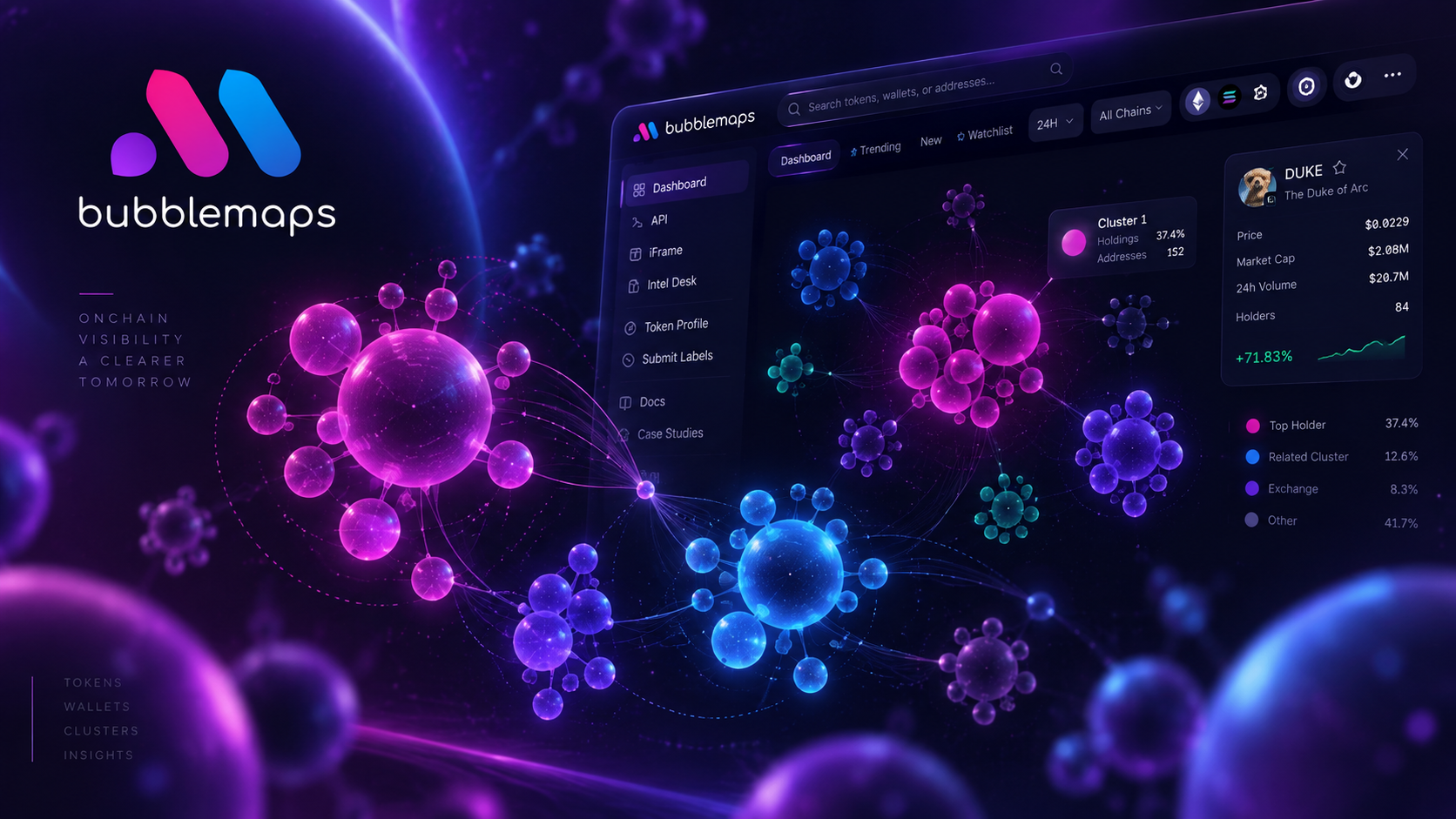
I have used Bubblemaps for years, but usually too late. I would discover a token somewhere else, notice something unusual, and only then open the map to work out who was actually holding what. The new version changes the order of that investigation.
That distinction matters more than it first appears.
A research tool can be powerful and still arrive at the wrong moment. If it only enters the workflow after a token has caught your attention—or after a trade has already gone wrong—it becomes a diagnostic instrument. Useful, yes, but reactive.
Bubblemaps' September 2026 revamp starts one step earlier. Its new homepage is a live discovery feed for fresh and trending tokens across multiple chains. The same surface lets you narrow the field by chain, launchpad, market cap, price, volume and liquidity. Arc was included from day one alongside established networks.
More importantly, holder structure is no longer hidden behind a second research step. Hovering a token exposes an instant bubble-map scan without forcing you to leave the feed.
The investigation is no longer waiting after discovery. It is sitting inside discovery.
Where does the investigation begin?
Switch between the two paths. The tools are similar; the timing—and therefore the quality of the first decision—is not.
Discovery becomes a risk filter
The live feed is the practical center of the redesign. Trending and newly launched assets can be reviewed across chains, while filters reduce the need to scan an unstructured stream of tickers. Launchpad, price, volume and liquidity filters are not glamorous features, but they determine whether discovery is useful or simply noisy.
The instant map preview is what makes the feed meaningfully different. A token can look active on a conventional dashboard because price and volume are moving. Its holder graph may tell a second story: several apparently separate wallets might be connected, supply may be concentrated, or a cluster may deserve a closer look before momentum becomes the only thing you see.
This does not make every token in the feed safe. It changes which questions are available before attention becomes conviction.
The score is a triage tool, not a verdict
The new Bubblemaps Score brings insider clusters and bundled wallets closer to the surface. That gives users a faster way to prioritize what deserves scrutiny. Wallet labels are reviewed by professional onchain investigators, while project socials can be submitted, reviewed and verified.
Those additions reduce two common sources of friction: not knowing what an address represents and not knowing whether a project's public identity is the one it claims to be.
But a score should not become a substitute for interpretation. A connected cluster can have an innocent operational explanation. A clean-looking map can still hide economic, liquidity or contract risk. Verification can establish identity; it cannot guarantee intent or future behavior.
Historical distribution changes the questions
The feature I have spent the most time exploring is historical distribution. Click a candle on the chart and Bubblemaps reconstructs the holder map at that moment.
A current holder map is an end state. It shows where the supply sits now, after the accumulation, transfers, price reaction and exits have already happened. Moving backwards through the chart turns the map from a snapshot into a sequence.
That is a much more forensic way to investigate a token. Instead of asking only “who holds the supply?”, you can ask when the structure formed and whether the market reacted before or after it changed.
Holder-map time machine
Select a candle to see how the same investigation changes when distribution becomes a sequence rather than a final screenshot.
The first map gives you a baseline. Large holders exist, but the visible wallets are not yet moving as a coordinated cluster.
Before the moveWas the connected cluster already present, or did it form later?
During accumulationDid multiple wallets begin building positions together?
At consolidationWhen did a larger share of supply move into related hands?
After price reactedDid ownership structure lead the market, follow it, or remain unchanged?
From five disconnected tabs to one research loop
The broader product direction is clear: discover, analyze and trade without repeatedly rebuilding context in different tools.
You can find a token in the feed, inspect its map, use the Bubblemaps Score to identify structural warnings, review labels and project socials, move backwards through historical distribution, and then use the built-in swap. Bubblemaps' campaign brief lists the swap fee at 0.5% and positions it as the lowest fee on the market.
There is also in-app token boosting. That can improve visibility for projects, but visibility and verification are different concepts. A promoted token should still go through exactly the same research process as any other asset.
Use Fresh or Trending, then narrow by chain, launchpad, price, volume and liquidity.
Preview the holder map, inspect the score, and review clusters, bundles, labels and socials.
Click earlier candles and compare distribution before, during and after the move.
Continue, watch, reject or trade—with the structure visible before execution.
A pre-trade investigation you can actually repeat
The best research workflow is not the one with the most tabs. It is the one you can repeat before attention, urgency or price action takes over.
Use the checklist below as a final pause between finding a token and acting on it.
Before the trade
Six checks. None of them asks whether the chart feels exciting.
Why this revamp matters
Bubblemaps used to be the place I went after something had already earned my attention. The revamp is trying to become the place where that attention begins.
That is a bigger product shift than adding another dashboard or another score. It moves onchain structure ahead of the trade. It gives distribution a chance to challenge the narrative before price becomes the narrative.
The historical view is the strongest expression of that idea. A static map can show you the current arrangement. A map connected to time can help you reconstruct behavior.
If your normal process is find first, investigate later, the revamped Bubblemaps is worth trying precisely because it collapses that gap. Find the token, inspect the structure, rewind the distribution, and decide what the evidence deserves—before the post-mortem.
Bubblemaps launched the revamped experience on September 15, 2026. The platform is powered by $BMT. Product links: Bubblemaps V2, official X account, and @Bubblemaps.io on Binance Square. This article is for research and educational purposes, not financial advice.
 Post on X
 Telegram