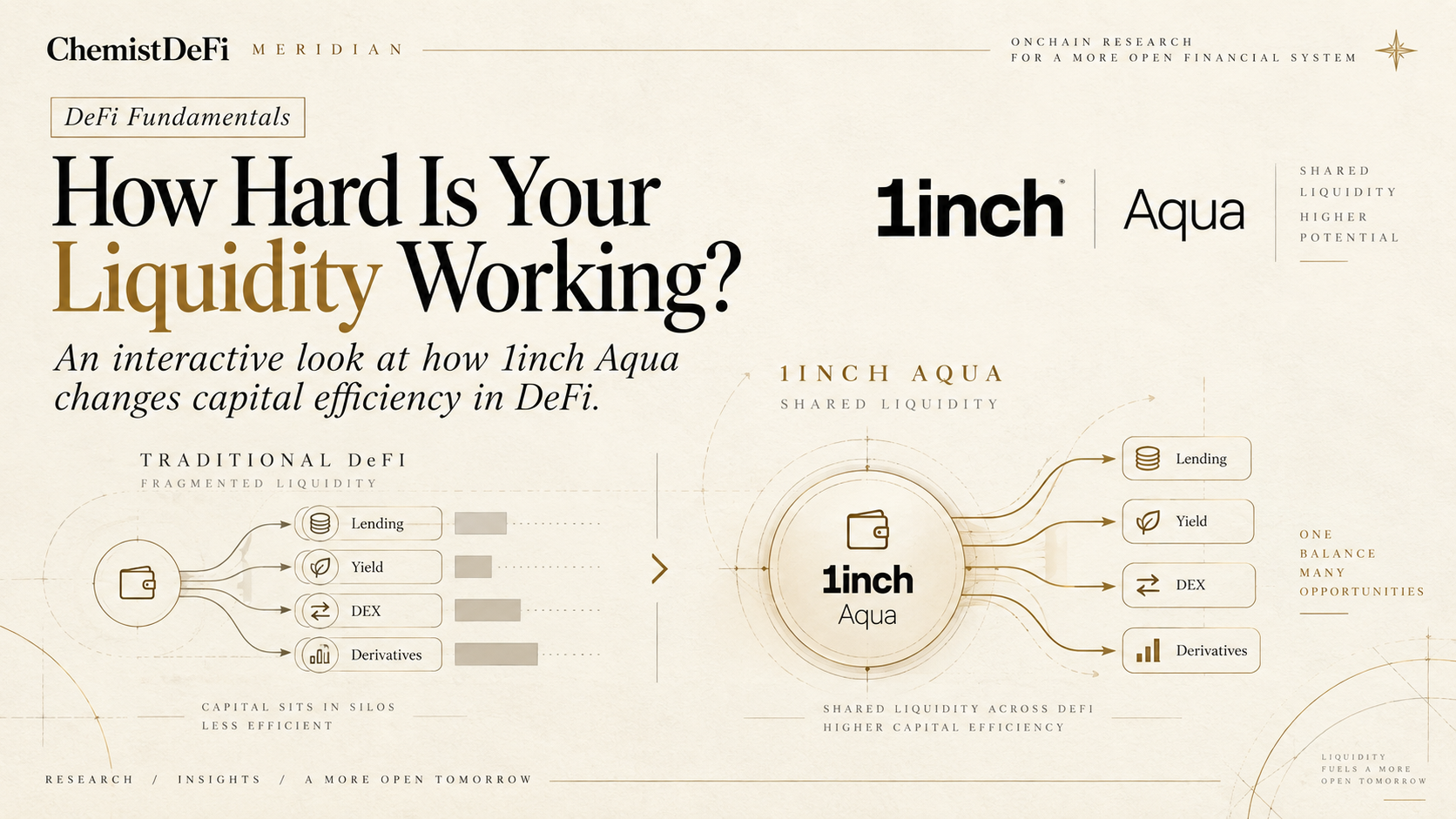
Liquidity is usually framed as a question of where capital should be deposited. 1inch Aqua changes the order of operations: the tokens remain in the maker-controlled wallet, strategies receive virtual allocations, and real inventory moves only when a swap actually fills.
The problem is not only liquidity. It is where liquidity waits.
Traditional pools isolate capital by venue and position. If the next trade arrives somewhere else, the deposited liquidity can remain economically idle even though it is technically active.
1inch-commissioned Dune research covering the first half of 2026 measured 29.5% of observed concentrated liquidity completely outside its fee-earning range. For the Uniswap v3 family, the broader measure — including in-range liquidity that swaps never touched — was roughly 85% unused.
Aqua does not create more tokens. It changes how many strategies can reference the tokens that already exist.
One balance, multiple strategies
Aqua records a separate virtual balance for each strategy. Those records are authorizations and accounting state, not deposits. The real ERC-20 inventory remains in the maker wallet under a revocable allowance.
At execution, Aqua settles atomically. A pull() moves the maker's output token out of the wallet and reduces that strategy's virtual balance; a push() returns the counter-asset to the maker and increases the corresponding virtual balance. If the real wallet cannot satisfy the pull, the fill reverts.
The strategy's virtual balance describes what it is allowed to quote. The wallet balance and allowance determine what can actually settle.
 1"
Aqua research model
1"
Aqua research model
How hard is the same USDC balance working?
This model isolates one token side — USDC — so the accounting is readable. Every Aqua strategy below is provisioned with the full illustrated USDC balance. That is an intentionally simplified setup for explaining shared liquidity, not a live quote.
across positions
Five virtual USDC allocations reference the same real $10,000 maker balance. This is availability, not $50,000 of owned capital.
Educational accounting model. It isolates one token side and assumes sufficient allowance. Actual Aqua pricing, token amounts and execution come from each strategy's on-chain program and fresh state.
What happens when two strategies want the same tokens?
This recreates the concurrency problem documented by 1inch: virtual commitments can overlap, but all strategies ultimately draw from the maker's one real wallet inventory.
$120,000 real backing against $200,000 of virtual USDC commitments.
The developer-doc safety check also caps real backing by Aqua allowance. This replay assumes allowance is sufficient so the balance constraint is isolated.
Waiting for the first fill.
Its virtual balance is independent of Strategy A.
What does a filled swap actually pay the LP?
Every Aqua position sets its own swap fee. A higher fee earns more per fill but can win fewer fills. The current 1inch documentation also describes a DAO protocol share taken from the LP fee.
Fee split shown as a September 16, 2026 documentation snapshot. 1inch states that the protocol share is controlled by DAO governance and can change. The docs describe the tier boundary as approximately 0.12%; this educational calculator uses 0.12% as the displayed cutoff.
Read the first experiment carefully
Before execution, five Aqua strategies can each carry a virtual USDC allocation against the same real wallet inventory. Under the equal-allocation assumption in the lab, $10,000 of real USDC backing and five $10,000 virtual allocations produce $50,000 of aggregate virtual availability. On this isolated token side, that is a 5× availability ratio — a simplified illustration of the Shared Liquidity Ratio logic, not a claim that the wallet owns five times more capital.
That is not leverage. Nothing was borrowed. If one strategy pulls $2,000 USDC during a fill, the maker's real USDC inventory falls to $8,000 while the counter-asset is pushed back to the maker in the same atomic transaction. The wallet did not simply lose $2,000 of portfolio value; its inventory composition changed.
Aqua tracks virtual balances per strategy. A fill against Strategy A changes Strategy A's accounting and the real wallet inventory, but another strategy can still show a larger virtual balance. Real inventory remains the final settlement constraint.
The edge case matters: first fill wins
Shared liquidity introduces a concurrency problem that should not be hidden behind a clean diagram. The 1inch developer documentation gives the example of two strategies each advertising 100 units while the wallet holds only 120 real units. A 100-unit pull against the first strategy succeeds and leaves 20. The second strategy's virtual balance can still show 100, but a second 100-unit pull fails at the ERC-20 transfer because the real inventory is no longer there.
The second interactive model lets you move the wallet backing above or below the combined $200,000 commitment and replay the sequence. This is why Aqua operators must treat real wallet inventory as the true budget.
Virtual liquidity can overlap. Settlement cannot. A strategy can only pull tokens the maker wallet actually holds and has allowed Aqua to move.
Fees: price the fill, not the fantasy
Aqua positions earn their configured swap fee when a swap fills. Fees are paid in the swapped tokens into the maker wallet, where they can immediately back positions again. No fill means no swap fee.
1inch's current Aqua guide also documents a DAO protocol share taken from the position's swap fee: one quarter on lower fee tiers and one sixth on higher tiers, with the boundary described as roughly 0.12%. The DAO controls that parameter, so it should be treated as current protocol configuration rather than a permanent constant.
More fee per fill
Raising the quoted fee increases gross revenue on a fill that actually happens.
What Aqua is actually changing
The important shift is not a promise that every dollar will earn more. It is a change in capital architecture. Traditional liquidity asks the LP to decide where tokens should live before flow arrives. Aqua lets multiple strategies reference the same wallet inventory and resolves the actual movement only at fill time.
That makes availability a more useful concept than simply counting deposits. It also makes inventory management more important: the more strategies share a wallet, the more carefully virtual commitments must be compared with real backing.
The multiplier is in quoted availability, not in owned capital.
Research notes
The interactive models above are educational reconstructions of the mechanics described in 1inch's Aqua documentation. They do not query live Aqua positions, estimate returns, model price impact or predict fill probability. All dollar amounts inside the labs are illustrative unless a date and source are explicitly stated.
- Aqua protocol mechanics: 1inch Business Aqua Overview — virtual balances,
ship(),dock(),pull(),push(), atomic settlement and Shared Liquidity Ratio. - Inventory concurrency: 1inch Business Access, Resolvers & Pathfinder — real inventory versus virtual commitments and the first-fill-wins failure mode.
- Fees: 1inch Aqua Fees, Earnings & APR — per-position fees, fee-volume trade-off and the current DAO protocol-share description.
- Idle-liquidity research: 1inch Aqua Shared Liquidity — 29.5% out-of-range and roughly 85% broader unused-liquidity measurements, based on commissioned Dune research.
- Branding: current black wordmark from the official 1inch Press Room brand-asset set.
Take the model to the live product
The experiments above are intentionally simplified. If you want to move from the research model to the live 1inch product, start with Aqua itself and then compare the mechanics with the protocol's shared-liquidity explainer.

 Post on X
 Telegram