A leverage loop repeats the same exposure—and compounds its failure paths.
Trace recursive supply and borrow actions through liquidation, rate and incentive risk before judging the spread.
In the previous articles, we built the foundation of DeFi lending step by step.
First, we learned what lending means in DeFi.
Users supply assets to a protocol. Other users borrow those assets by depositing collateral. Borrowers pay interest. Suppliers earn from that borrowing demand.
Then we moved to the risk side.
We learned that a borrow position is not static. It has collateral, debt, LTV, Health Factor, and liquidation risk.
After that, we looked at the cost side.
Borrowing is not free. Interest rates can change based on supply, demand, utilization, and liquidity conditions.
Now we are ready for the next layer:
Leverage
Leverage is where borrowing stops being only a liquidity tool and starts becoming a risk amplifier.
This article is about one of the most common forms of leverage in DeFi:
Leverage loops.
The main question is simple:
What happens when you repeatedly supply, borrow, and supply again?
Lesson mapNavigate this lessonExplore all 22 sections
See the model before the details.
Use the flow, the leverage explorer and the comparison table as a map while you read.
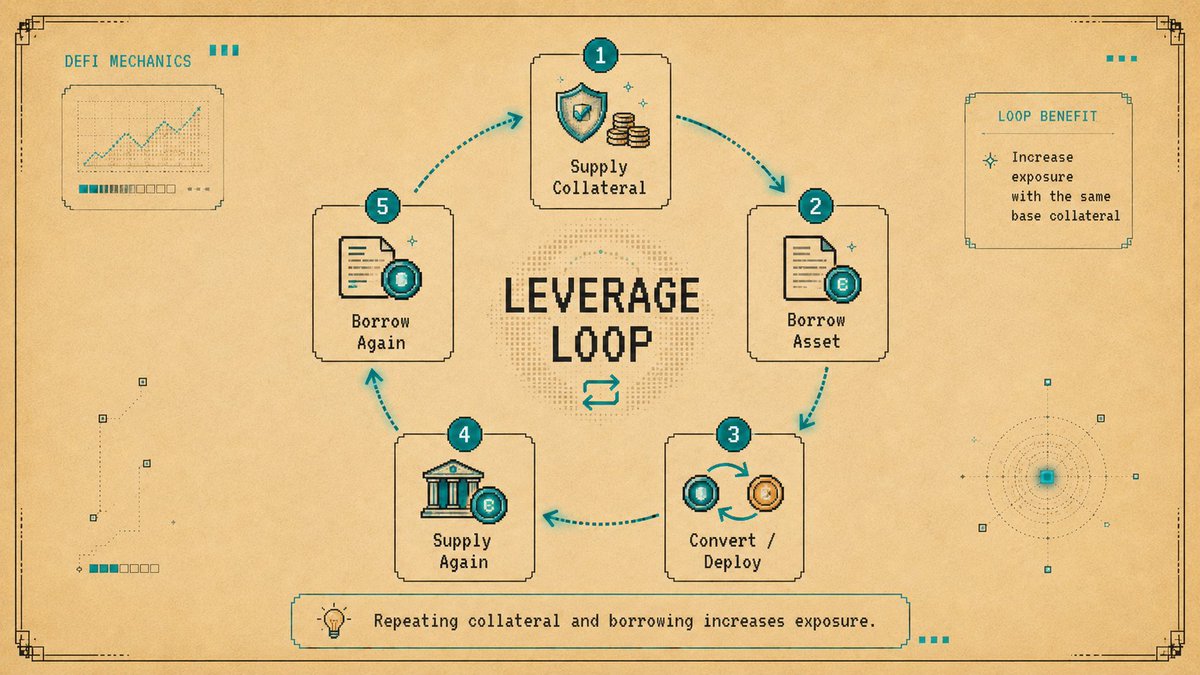
- 01Supply collateral
- 02Borrow asset
- 03Resupply proceeds
- 04Borrow again
- 05Exposure compounds
Adjust the controls to begin.
| Loop component | Potential benefit | Amplified risk |
|---|---|---|
| Recursive supply | More supplied balance | More capital tied to one protocol |
| Recursive borrow | Greater gross exposure | Higher debt and liquidation sensitivity |
| Incentives | Additional rewards | Emissions can fall or lose value |
| Rate spread | Supply return minus borrow cost | Can turn negative quickly |
Why This Topic Matters
Leverage looks attractive because it can make a position feel more powerful.
- You start with one asset.
- You borrow against it.
- Then you use the borrowed asset to increase the size of your position.
At first, this can look like smart capital efficiency.
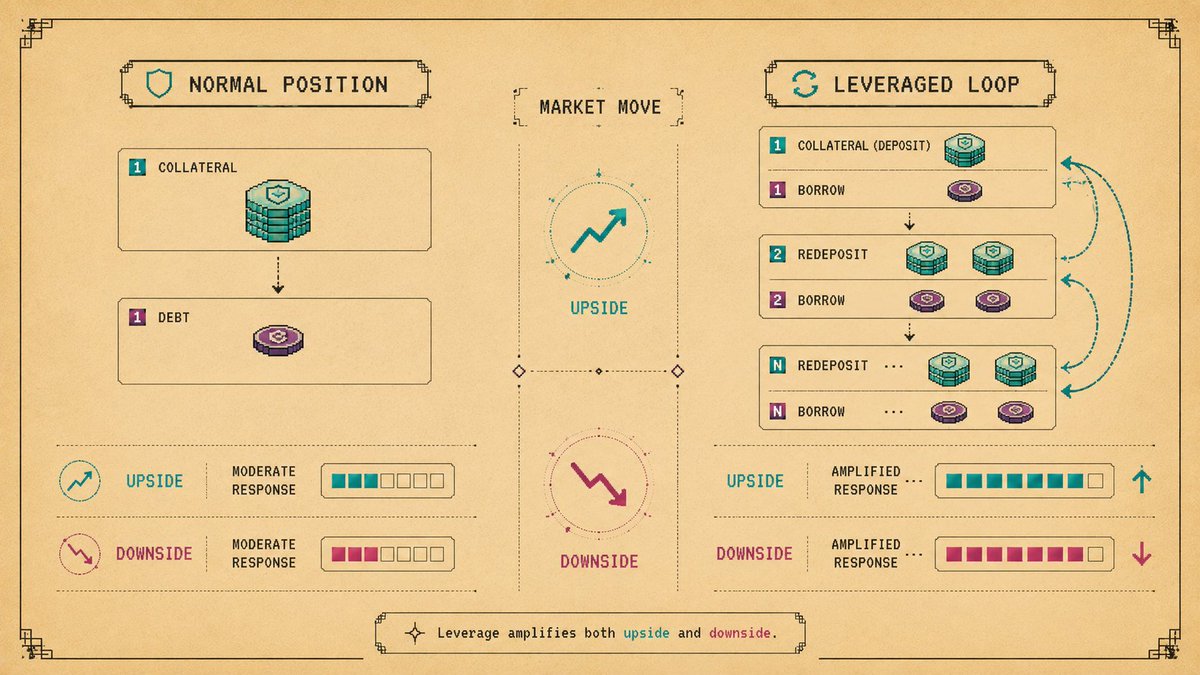
But leverage does not only amplify upside.
It also amplifies risk.
This is the part beginners often miss.
A normal borrow position already has two major risks:
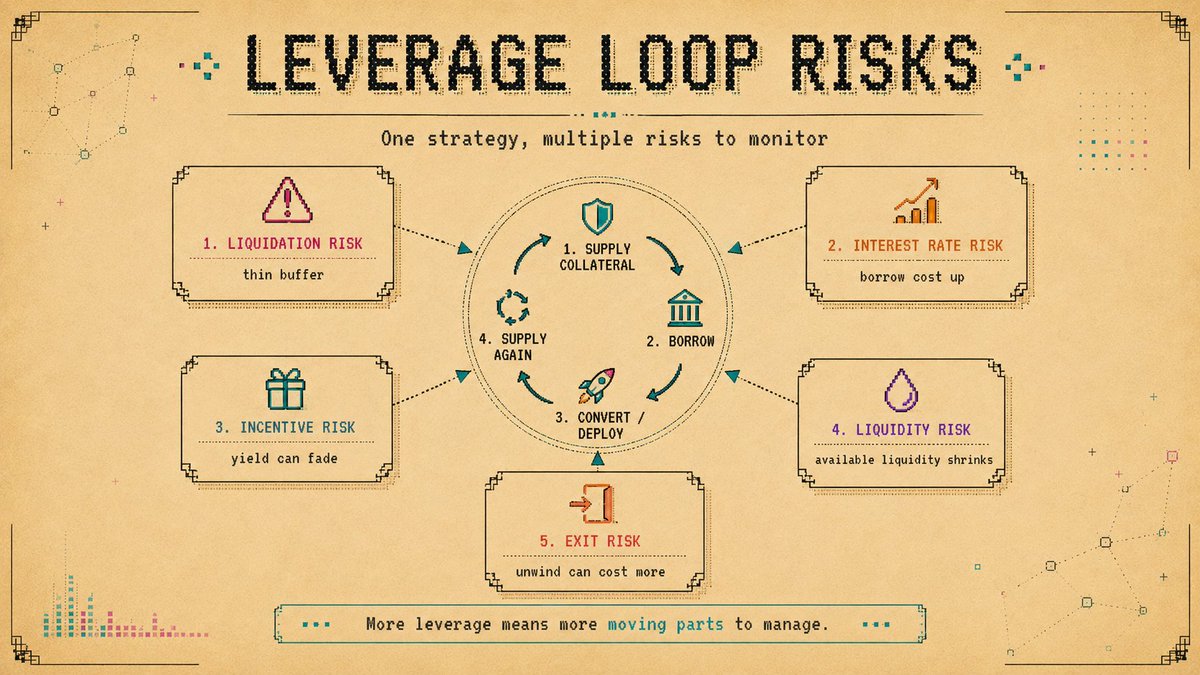
Liquidation risk.
Interest rate risk.
A leverage loop combines both.
If the collateral moves against you, liquidation risk increases faster.
If borrow rates rise, the cost of the strategy increases.
If liquidity becomes tight, exiting can become harder.
So leverage is not just “more exposure.”
It is more sensitivity.
The position reacts more aggressively to market changes.
That is why leverage should be understood before it is used.
What Is Leverage?
Leverage means using borrowed capital to increase exposure.
In simple terms:
You use debt to make your position larger than your original capital.
Example:
You have $10,000.
Without leverage, your position size is $10,000.
With leverage, you might use that $10,000 as collateral, borrow more capital, and build a larger position.
Now your exposure may be larger than your starting capital.
That is leverage.
The important point is this:
Leverage does not create free money.
It changes the size and risk profile of the position.
If things go well, gains may feel larger.
If things go badly, losses can accelerate.
Leverage Is Not Only for Traders
Many beginners hear leverage and think only about perps or margin trading.
That is one form of leverage.
But leverage also exists inside DeFi lending.
You do not need to open a futures position to be leveraged.
If you borrow against collateral and use the borrowed funds to increase your exposure, you are using leverage.
This can happen through lending protocols, vaults, LP strategies, stablecoin strategies, or looping systems.
So leverage is not just a trading feature.
It is a structure.
Any time debt increases your exposure, leverage exists.
What Is a Leverage Loop?
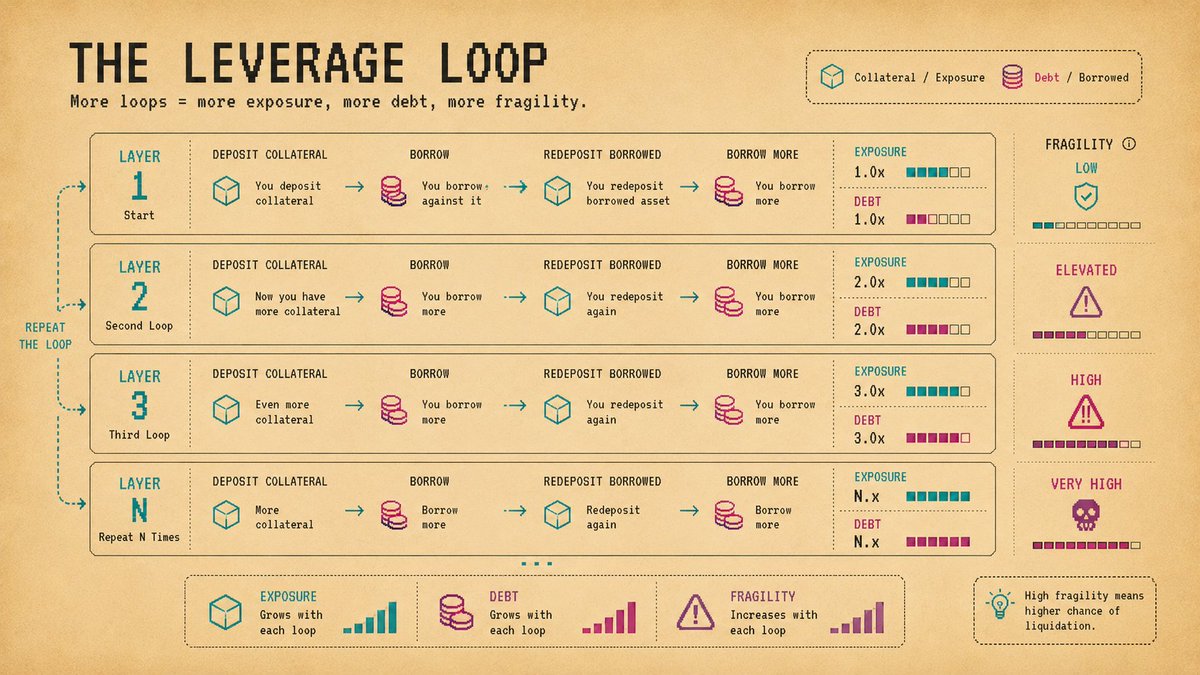
A leverage loop is a strategy where a user repeatedly supplies and borrows to increase position size.
The basic flow looks like this:
- Supply collateral.
- Borrow against it.
- Use the borrowed asset to get more collateral.
- Supply again.
- Borrow again.
- Repeat.
That repetition creates a loop.
The purpose is usually to increase exposure, increase yield, or improve capital efficiency.
But the loop also increases fragility.
Because every new borrow adds more debt.
And every new layer makes the position more sensitive to price movements and interest rate changes.
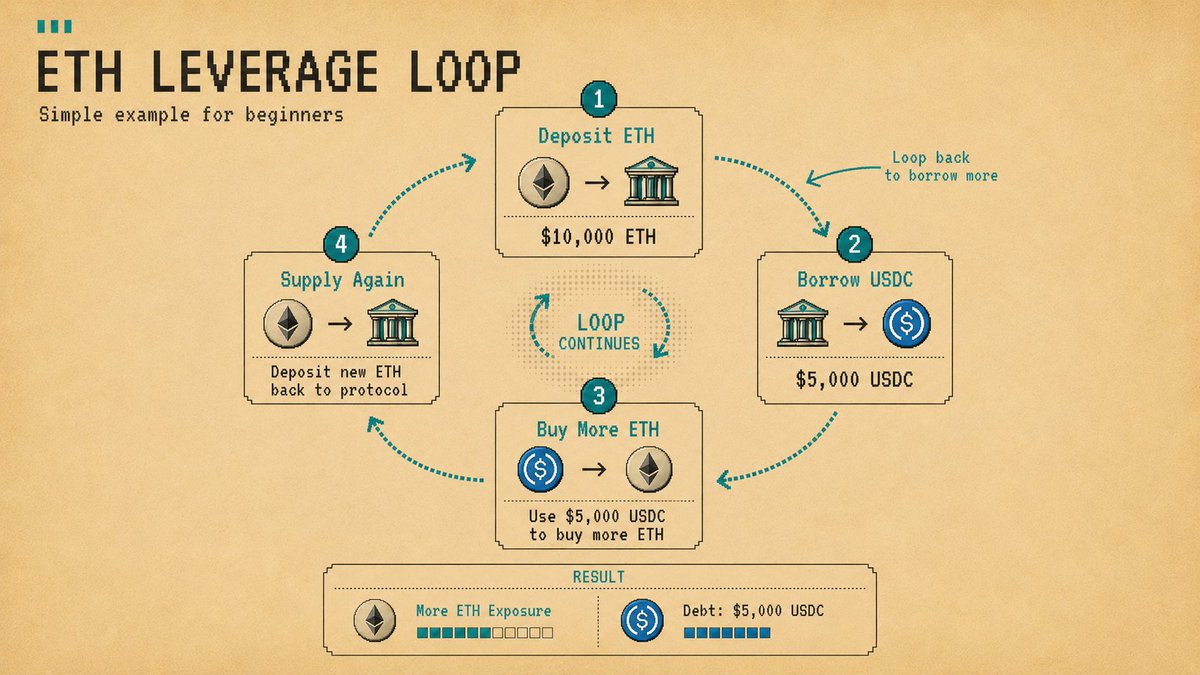
A Simple Loop Example
Let’s keep it simple.
Choose an option to begin.
- You start with $10,000 worth of ETH.
- You deposit ETH as collateral into a lending protocol.
- Then you borrow $5,000 in USDC.
- With that USDC, you buy more ETH.
- Then you deposit that extra ETH as collateral too.
- Now your ETH exposure is larger than your original $10,000.
But you also have debt.
You did not magically create more wealth.
You increased your exposure by taking on a liability.
If ETH rises, the position may perform better than simply holding $10,000 of ETH.
If ETH falls, the position becomes riskier faster.
That is the core tradeoff.
Why People Use Leverage Loops
People use leverage loops for a few common reasons.
The first reason is increased exposure.
If someone is bullish on an asset, they may use borrowing to increase their position without starting with more capital.
The second reason is yield farming.
Some users loop positions to earn more rewards, especially when supply incentives are high.
The third reason is capital efficiency.
Instead of leaving collateral idle, users try to extract additional liquidity from it.
The fourth reason is strategy stacking.
A user may borrow one asset, deploy it elsewhere, earn yield, and try to keep the spread between earned yield and borrow cost.
But every reason has the same hidden question:
Is the extra return worth the extra risk?
Most leverage mistakes happen because users focus on the return and underestimate the risk.
The Loop Does Not Remove Risk
A loop can make a dashboard look more productive.
More supplied value.
More borrowed value.
More apparent yield.
But the structure is still built on debt.
Debt must be managed.
Debt has cost.
Debt has liquidation risk.
Debt reduces flexibility.
This is why leverage loops can be dangerous for beginners.
They may look like a clever way to “boost yield,” but they also stack multiple risk layers on top of each other.
A simple supply position is one layer.
A borrow position is two layers.
A leverage loop is several layers connected together.
When one part moves, the whole structure can become unstable.
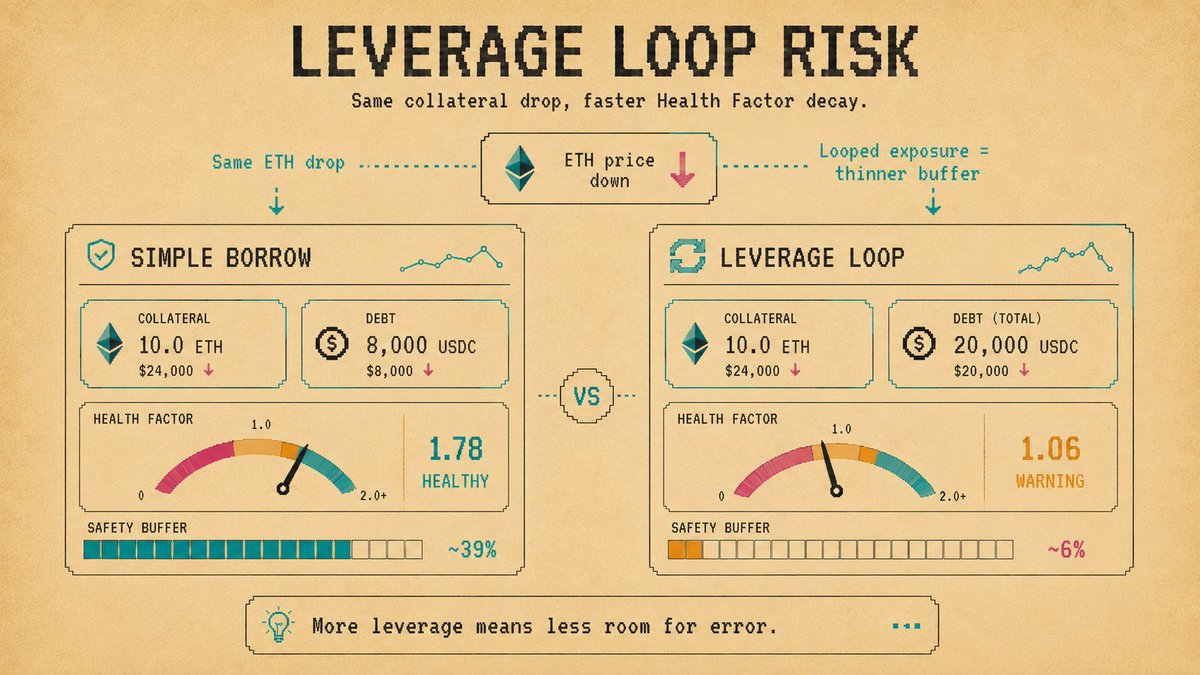
Liquidation Risk in a Loop
In the LTV and Health Factor article, we learned that collateral value matters.
If collateral falls compared to debt, liquidation risk increases.
In a leverage loop, this risk becomes more sensitive.
Why?
Because the position has more exposure and more debt than a simple borrow position.
If the collateral asset falls, the value of the position drops.
At the same time, the debt still exists.
Because the position is larger, a price move can have a stronger effect on the Health Factor.
This is why leveraged positions often feel fine until they suddenly do not.
The danger does not increase slowly forever.
At some point, the buffer becomes thin.
Then a normal market move can become a liquidation event.
Interest Rate Risk in a Loop
In the interest rate article, we learned that borrow cost can change.
This becomes even more important in leverage loops.
A loop usually depends on borrowing.
If borrow rates stay low, the strategy may look profitable.
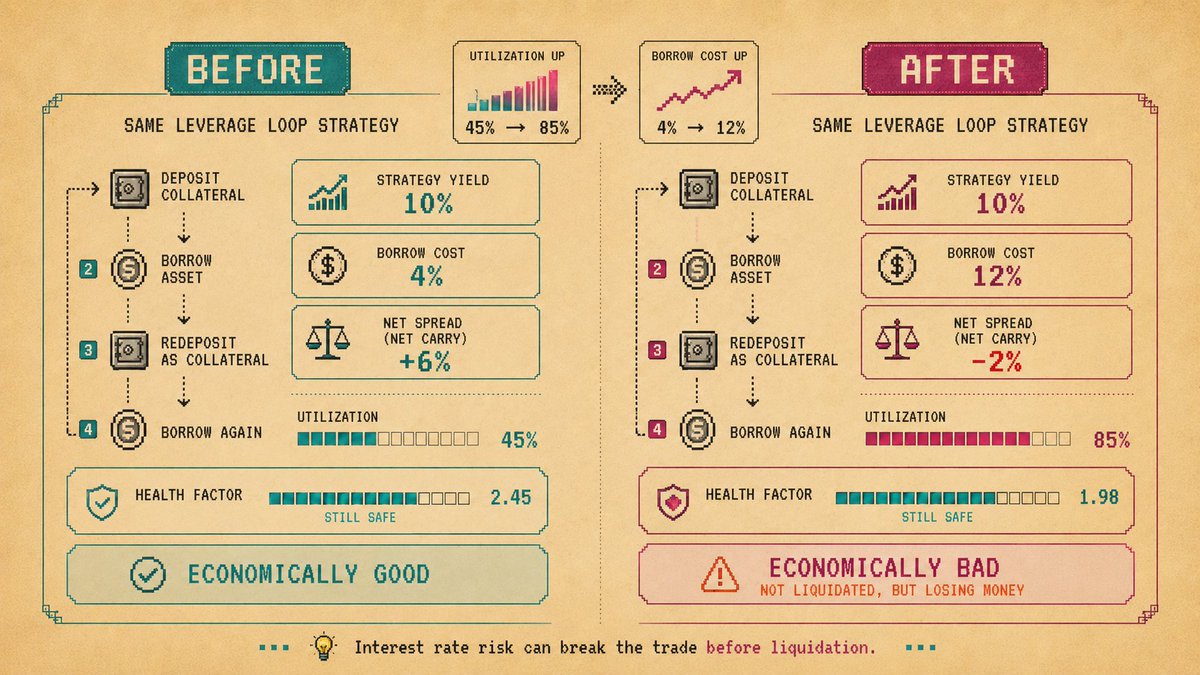
But if utilization rises and borrow rates increase, the economics can change quickly.
Example:
- You are earning 10% from a strategy.
- You are borrowing at 4%.
- At first, the spread looks attractive.
- But then utilization rises.
- Borrow rate moves to 12%.
- Now the strategy may no longer work.
You may not be close to liquidation.
But the position can become economically bad.
This is the second major risk of leverage loops.
Not every bad leverage outcome starts with liquidation.
Sometimes the debt simply becomes too expensive.
The Spread Is the Real Question
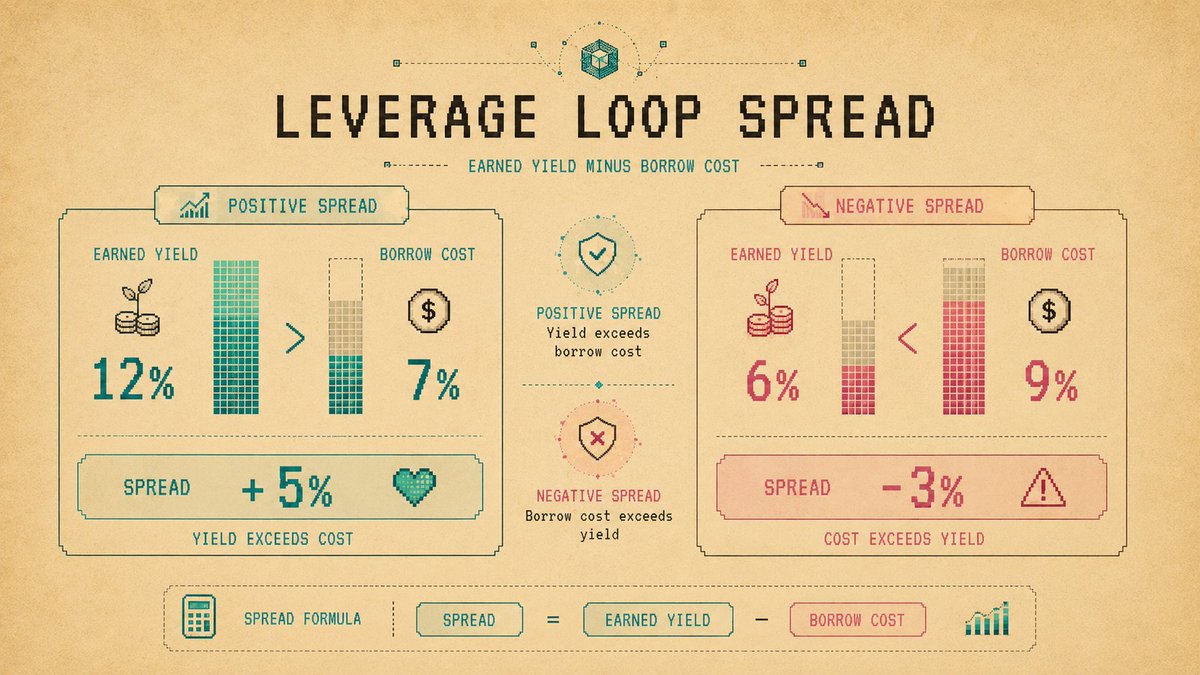
Many loop strategies depend on a spread.
The spread is the difference between what you earn and what you pay.
If you earn 9% and borrow at 4%, the spread is positive.
If you earn 9% and borrow at 12%, the spread becomes negative.
This is why you cannot evaluate a loop by looking only at the displayed APY.
You need to ask:
- What am I earning?
- What am I paying?
- Can the borrow cost change?
- Can the earned yield drop?
- Are incentives included?
- What happens if the spread turns negative?
A loop that only works under perfect conditions is fragile.
A safer strategy must survive imperfect conditions.
Incentives Can Make Loops Look Better Than They Are
Many leverage loops become popular when incentives are high.
A protocol may reward suppliers or borrowers with extra tokens.
This can make a loop look profitable on the surface.
But incentives are not the same as structural yield.
They can be reduced.
They can end.
The reward token can fall in price.
The market can become crowded as more users enter the same strategy.
When that happens, the apparent opportunity can disappear.
This is why loops built only around temporary rewards are fragile.
If the incentives vanish, you may be left with debt, risk, and a strategy that no longer makes sense.
Recursive Risk
A leverage loop is recursive.
That means the output of one step becomes the input for the next step.
Supply leads to borrow.
Borrow leads to more supply.
More supply leads to more borrow.
This is powerful, but it also means mistakes compound.
If your assumptions are wrong in a simple position, the damage is limited to that position.
If your assumptions are wrong in a loop, every layer can amplify the mistake.
This is why leverage loops need stricter risk limits than normal borrow positions.
More complexity means less room for lazy monitoring.
- Liquidity Risk When Exiting
- Opening a loop can be easy.
- Exiting a loop can be harder.
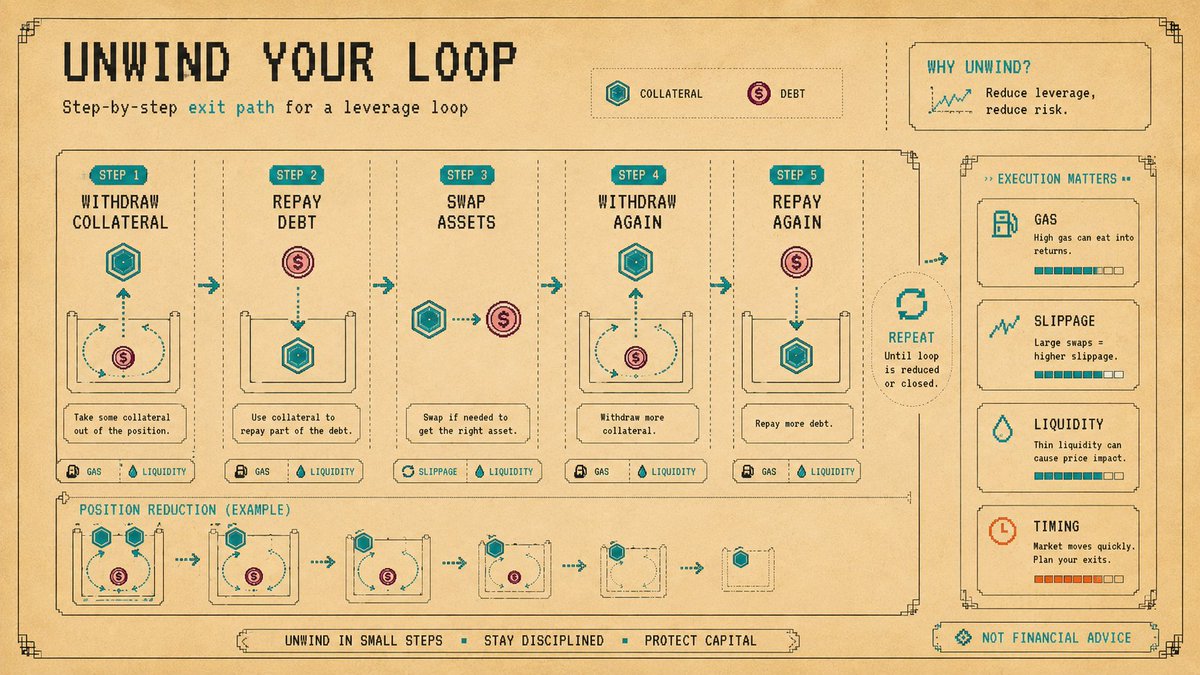
To close the position, you may need to unwind several steps.
Withdraw collateral.
- Repay debt.
- Swap assets.
- Withdraw again.
- Repay again.
Each step can involve gas fees, slippage, price impact, and timing risk.
If the market is calm, this may be manageable.
But during stress, exiting can become expensive.
- Gas can spike.
- Liquidity can thin out.
- Borrow rates can rise.
- Collateral prices can move quickly.
This is why exit planning matters even more in loops.
A position that is easy to enter but hard to exit is not simple.
It is a trap if you do not understand the exit path.
Looping Stablecoins Is Not Automatically Safe
Some beginners think loops are safe if stablecoins are involved.
This is not always true.
Stablecoin loops can reduce price volatility, but they introduce other risks.
- Stablecoins can depeg.
- Borrow rates can rise.
- Incentives can disappear.
- Utilization can spike.
- The protocol can change risk parameters.
- Liquidity can become tight.
So stablecoin loops may be less exposed to asset price movement, but they are still exposed to system risk and interest rate risk.
Stable does not mean risk-free.
It means a different risk profile.
Looping Volatile Assets Is More Fragile
Loops involving volatile assets are usually more sensitive.
- If your collateral asset drops quickly, your Health Factor can weaken fast.
- If your borrowed asset rises against you, your debt becomes more expensive.
- If both happen together, the position can deteriorate quickly.
This is why volatile loops need much larger safety buffers.
They also require more active monitoring.
For beginners, this is usually not the right starting point.
Understanding the mechanism is useful.
Using it without experience is dangerous.
Position Size Matters
The more leveraged a position is, the less room it has for error.
Position size is not just about how much money you put in.
It is about how much total exposure the strategy creates.
A user may think they are using $10,000.
But after looping, the effective exposure may be much larger.
This matters because risk follows exposure.
If exposure is larger than you think, the downside is also larger than you think.
Before entering any loop, you should understand the real position size.
Not just your initial deposit.
The whole structure.
Risk Limits Before Entering
A loop should never be opened without predefined limits.
- You should know your maximum acceptable LTV.
- You should know your minimum acceptable Health Factor.
- You should know the borrow rate where the strategy stops making sense.
- You should know how much yield comes from real demand and how much comes from incentives.
- You should know how you will unwind the position.
- You should know what market event forces you to reduce risk.
If you do not know these before entering, you will probably make decisions emotionally later.
And emotional decisions in leveraged positions are usually expensive.
What to Monitor in a Leverage Loop
A leverage loop needs more monitoring than a simple lending position.
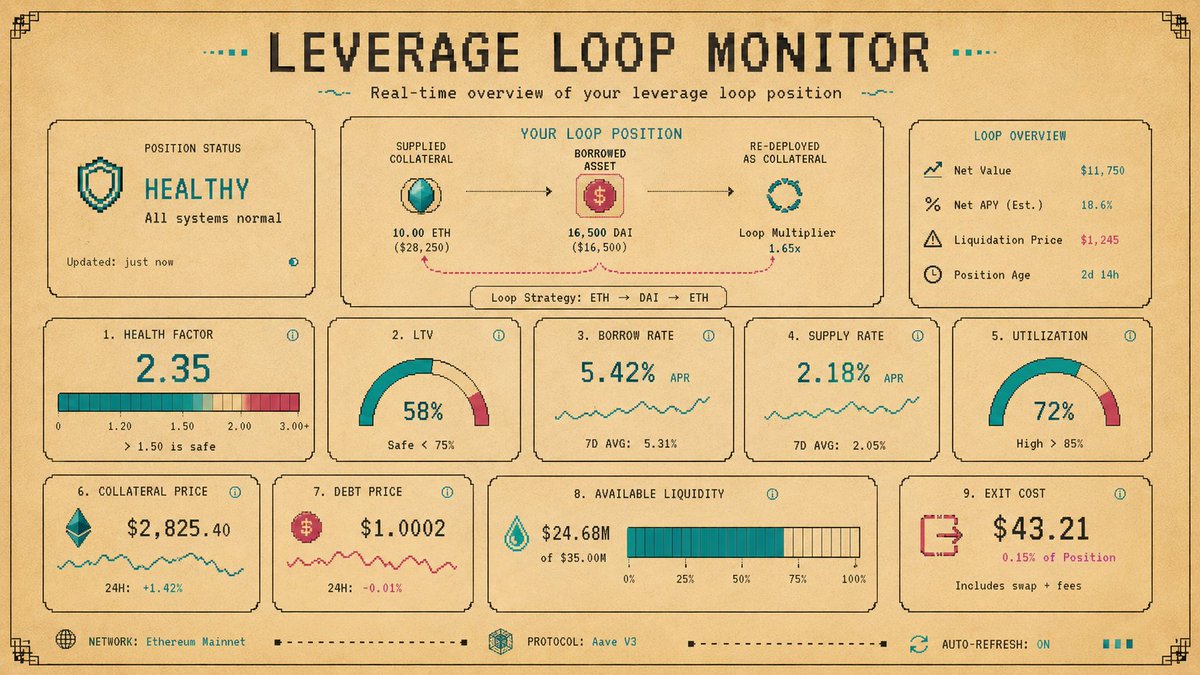
You should track:
- Health Factor.
- LTV.
- Liquidation price or liquidation range.
- Borrow rate.
- Supply rate.
- Utilization.
- Incentive status.
- Collateral price.
- Debt asset price.
- Available liquidity.
- Exit cost.
- This may sound like too much.
- That is the point.
- Leverage loops are not passive strategies.
If a strategy requires active monitoring and you cannot monitor it, it may not be appropriate for you.
Common Beginner Mistakes
The first mistake is thinking leverage creates free yield.
It does not. It creates larger exposure through debt.
The second mistake is ignoring interest rate risk.
A strategy that works at a 4% borrow rate may fail at 15%.
The third mistake is borrowing too close to the maximum.
A thin safety buffer is dangerous in any borrow position, but especially in a loop.
The fourth mistake is trusting incentives too much.
Rewards can disappear faster than the risk.
The fifth mistake is not planning the exit.
If you do not know how to unwind the loop, you do not really understand the position.
The sixth mistake is using volatile collateral without enough buffer.
Volatility and leverage are a dangerous combination.
The seventh mistake is treating stablecoin loops as risk-free.
Stablecoins reduce one type of risk, but they do not remove all risk.
The eighth mistake is only watching APY.
In loops, APY can hide the structure underneath.
Simple Leverage Loop Checklist
Before entering a leverage loop, ask yourself:
- What asset am I supplying?
- What asset am I borrowing?
- Am I increasing exposure or only farming incentives?
- What is my real total exposure?
- What is my LTV?
- What is my Health Factor?
- What happens if collateral falls 10%?
- What happens if collateral falls 30%?
- What happens if the borrow rate doubles?
- What happens if incentives disappear?
- How do I unwind the loop?
- How much will exiting cost?
- Can I monitor this position?
- At what point will I reduce risk?
If you cannot answer these clearly, you are not ready for leverage.
The Correct Mental Model
A leverage loop is not a yield machine.
It is a risk machine with potential upside.
That may sound harsh, but it is the correct mental model.
The loop can increase exposure.
It can increase yield.
It can improve capital efficiency.
But it also increases fragility.
Every layer adds dependency.
- Dependency on collateral value.
- Dependency on borrow cost.
- Dependency on liquidity.
- Dependency on incentives.
- Dependency on your ability to monitor and exit.
Once you see the structure clearly, leverage stops looking like a shortcut.
It starts looking like a tool.
And tools are useful only when you understand what they can break.
Core Insight
Leverage does not create free yield.
It stacks risk on top of risk.
A simple borrow position already has liquidation risk and interest rate risk.
A leverage loop combines those risks and makes the position more sensitive to market changes.
If everything goes well, leverage can improve returns.
If conditions change, it can accelerate losses.
That is why leverage should be approached with distance, limits, monitoring, and an exit plan.
The question is not:
“How much can I loop?”
The better question is:
How much stress can this position survive before it breaks?
One Minute Summary For Lazies
Leverage means using borrowed capital to increase exposure. In DeFi, a leverage loop usually means supplying collateral, borrowing against it, using the borrowed asset to increase the position, and repeating the process.
Loops can increase exposure, yield, or capital efficiency, but they also amplify risk. They combine liquidation risk from collateral movement with interest rate risk from changing borrow costs. If incentives disappear, borrow rates rise, collateral falls, or liquidity dries up, the loop can become fragile quickly.
A leverage loop is not passive income. It is an active risk position. Before entering one, you need to understand total exposure, Health Factor, borrow cost, utilization, incentives, exit path, and worst-case scenarios.
Can you explain the model?
Does looping create free yield?
No. It increases gross supply and debt while adding rate, liquidation, protocol and execution risk.
What is the central economic question?
Whether sustainable supply return and incentives exceed borrowing cost, fees and risk over the holding period.
What’s Next?
Now we understand the main lending stack.
- We covered supply and borrow.
- We covered LTV, Health Factor, and liquidation.
- We covered interest rates, utilization, and market balance.
And now we covered leverage loops.
The next part of the series moves to another major layer of DeFi usability:
Layer 2 networks.
So far, we mostly focused on what happens inside DeFi protocols.
Next, we will ask a broader question:
Why do users move to different networks in the first place?
That leads us to the next article:
What Are Layer 2 Networks and Why Do They Exist?
Because DeFi is not only about protocols.
It is also about the infrastructure where those protocols live.
Originally published on X · 2026-05-31
 Post on X
 Telegram