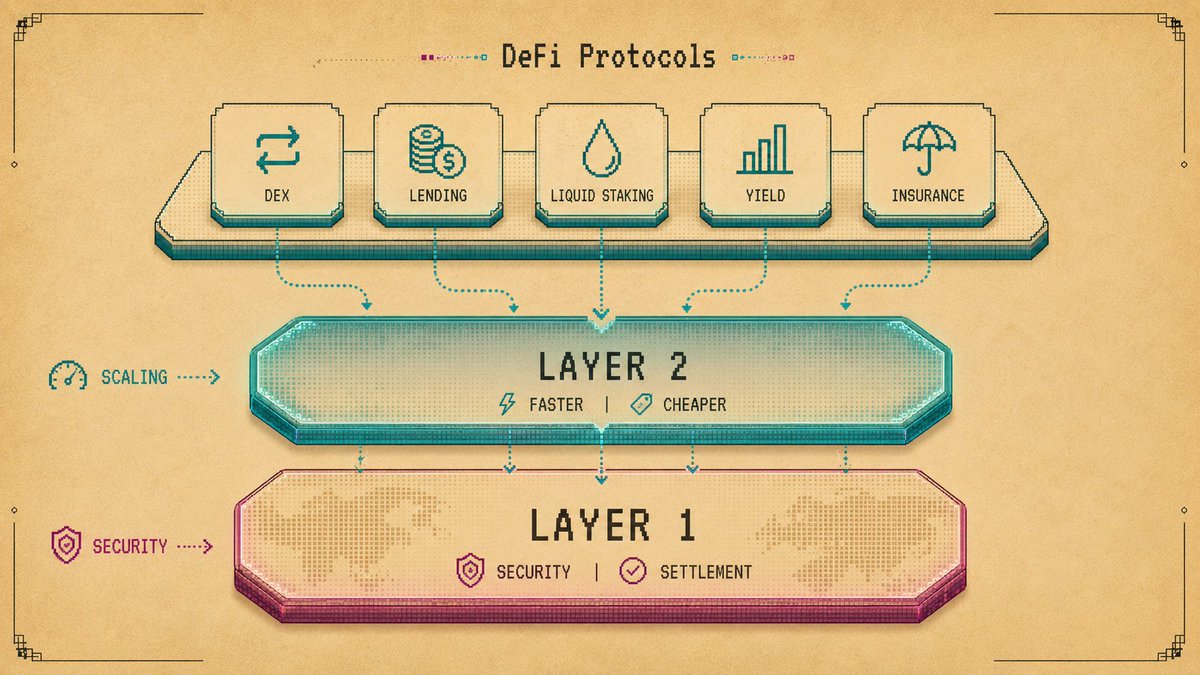
Layer 2 moves execution while Layer 1 anchors settlement.
Follow a transaction from an L2 through batching, proofs and settlement—and map the new risks introduced by scaling layers.
So far, we have mostly focused on what happens inside DeFi protocols.
We learned how wallets sign transactions, how tokens work, how swaps happen, how liquidity pools price trades, how LPs earn fees, how lending markets work, how liquidations happen, how interest rates change, and how leverage loops amplify risk.
But all of those actions need one thing before they can exist:
A blockchain network.
A swap does not happen in the air.
A lending position does not live inside a website.
An LP position is not stored inside the interface you use.
The website is only the front end.
The actual action happens on blockchain infrastructure.
Until now, we mostly talked about DeFi protocols.
Now we need to talk about the infrastructure layer underneath them.
That brings us to two important concepts:
Layer 1 and Layer 2.
The goal of this article is simple:
To understand why Layer 1 blockchains exist, why they can become expensive or slow, and why Layer 2 networks were created.
Lesson mapNavigate this lessonExplore all 25 sections
See the model before the details.
Use the flow, the L1-vs-L2 explorer and the comparison table as a map while you read.
- 01User transacts on L2
- 02Sequencer orders
- 03Transactions batch
- 04Proof or data posts
- 05L1 settles
Adjust the controls to begin.
| Layer | Primary job | Key trade-off |
|---|---|---|
| Layer 1 | Security, data and settlement | Limited base-layer capacity |
| Layer 2 | Faster and cheaper execution | Sequencer, bridge and proof dependencies |
| Sidechain | Independent execution and consensus | Separate security model |
| Bridge | Moves representations across domains | Contract and message risk |
Why This Topic Matters
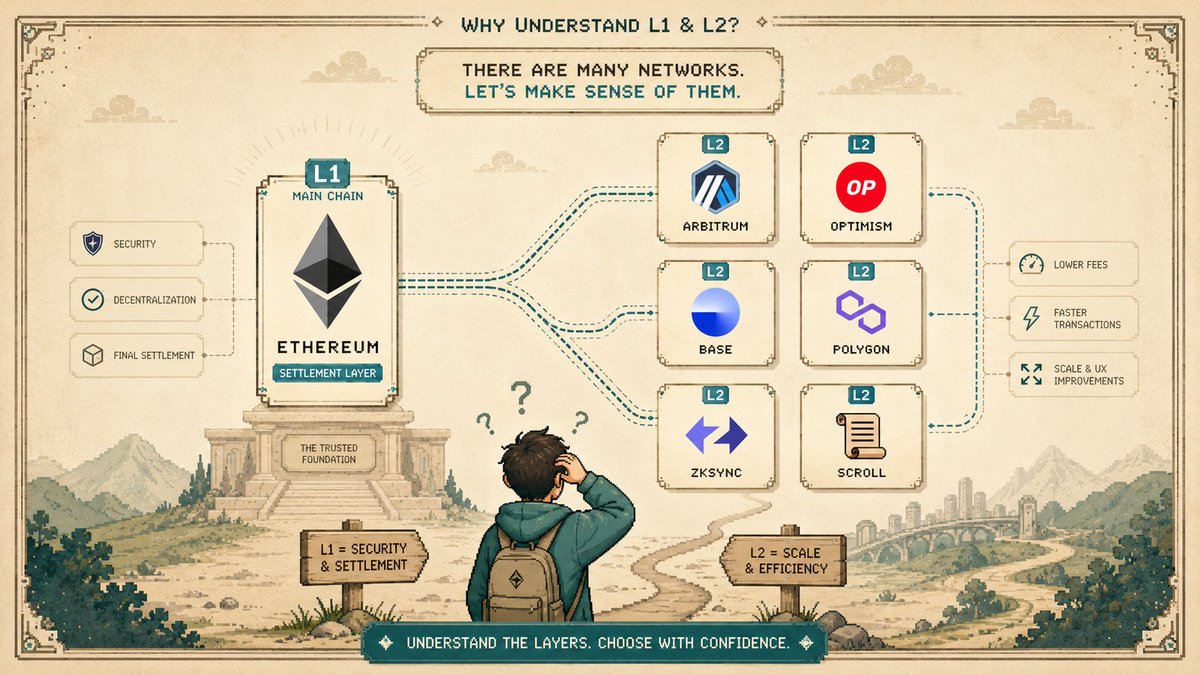
Beginners often experience Layer 2 networks before they understand them.
They open a DeFi app and see different network options:
- Ethereum.
- Arbitrum.
- Optimism.
- Base.
- Polygon.
- zkSync.
- Scroll.
Then they ask a very normal question:
“Why are there so many networks?”
“Why is this transaction cheaper here than on Ethereum?”
“If this is all DeFi, why do I need to switch networks?”
These are not small details.
They are part of understanding how DeFi actually works.
Because DeFi is not only about protocols.
It is also about where those protocols live.
A lending protocol on Ethereum and a lending protocol on a Layer 2 may look similar from the interface.
You may still see the same buttons:
Deposit.
Borrow.
Repay.
Withdraw.
But under the hood, the cost, speed, security assumptions, liquidity, bridge dependencies, and user experience can be very different.
So before we use L2s, we need the mental model.
And to understand L2s, we first need to understand L1s.
What Is a Layer 1?
A Layer 1 is the base blockchain network.
It is the main chain where transactions are recorded, validated, and finalized according to the rules of that blockchain.
Examples include Ethereum, Bitcoin, Solana, Avalanche, and many others.
But instead of memorizing examples, focus on the role.
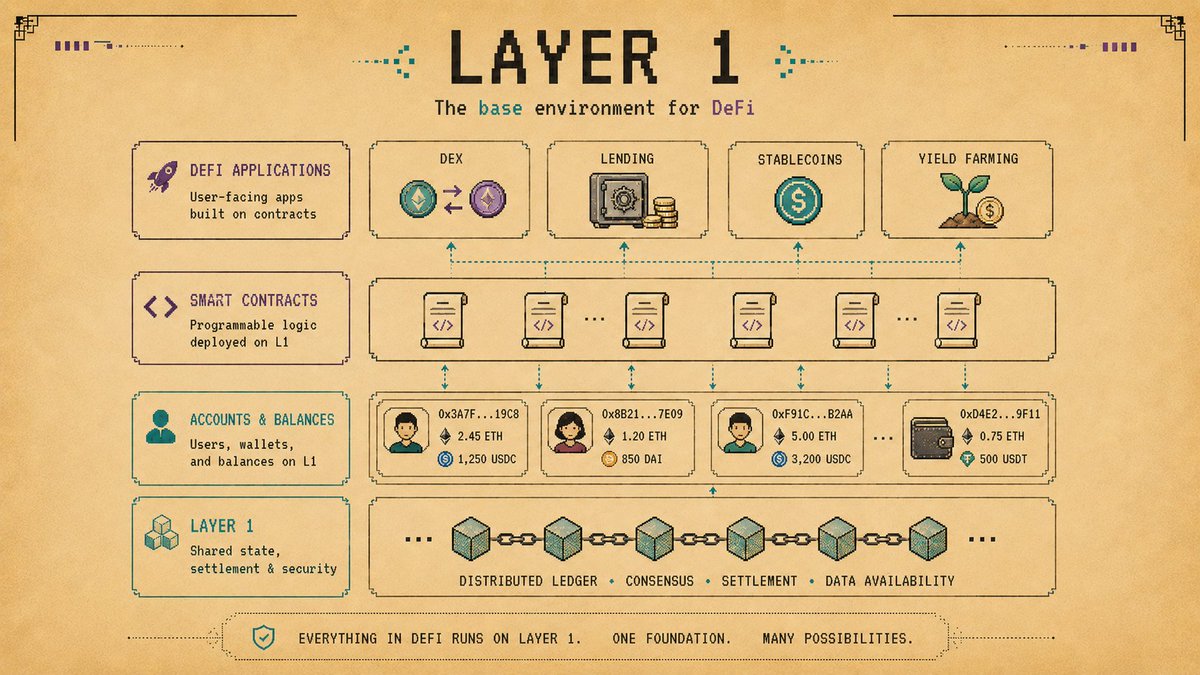
A Layer 1 is the foundation layer.
It provides the basic environment where accounts, balances, transactions, smart contracts, and state changes can exist.
For DeFi, the most important version of this is a smart contract Layer 1.
A smart contract L1 lets developers deploy programs directly onto the blockchain.
Those programs can become DEXs, lending protocols, stablecoin systems, NFT marketplaces, DAOs, bridges, and many other applications.
So a Layer 1 is not just a coin.
It is an execution and settlement environment.
The simple mental model:
Layer 1 is the base city where DeFi applications are built.
Why Did Layer 1 Blockchains Exist in the First Place?
To understand L1s, we need to go back to the original problem crypto tried to solve.
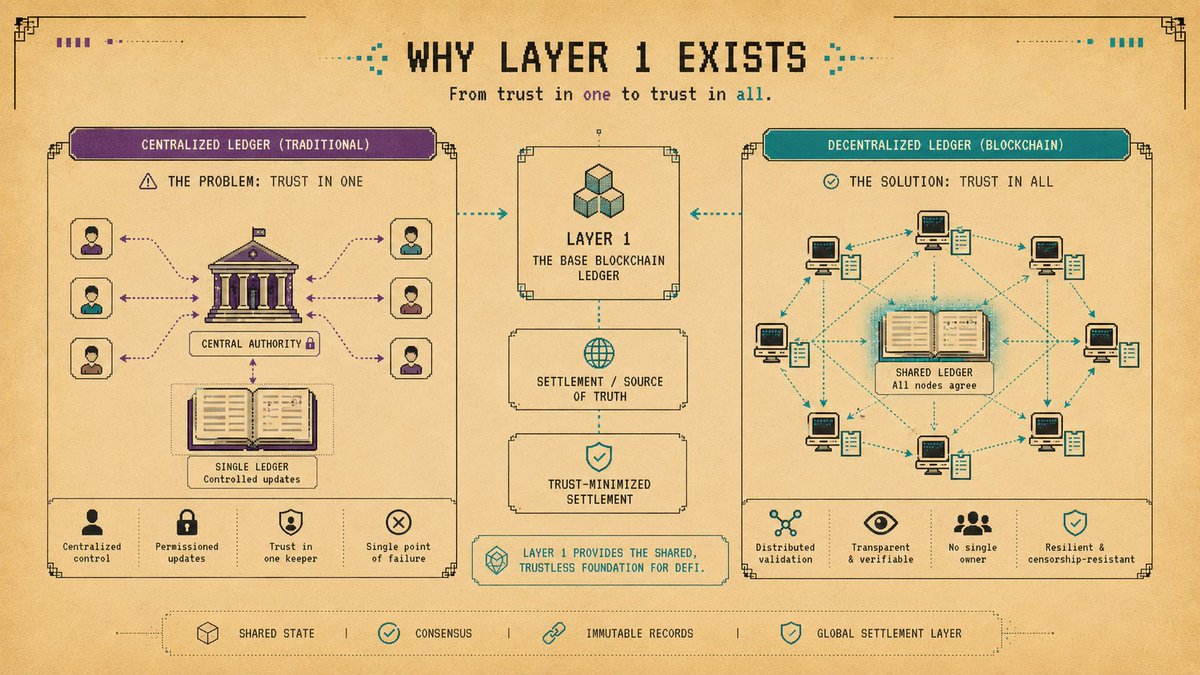
Before blockchains, digital money had a trust problem.
If money is just digital information, who prevents the same money from being spent twice?
In traditional finance, the answer is a central authority.
A bank updates the ledger.
A payment company checks balances.
A clearing system settles transfers.
Crypto introduced a different idea:
What if a network could maintain a shared ledger without relying on one central operator?
That is the basic reason Layer 1 blockchains exist.
They create a shared system where participants can agree on the state of the ledger.
- Who owns what?
- Which transaction happened first?
- Which transaction is valid?
- What is the current state of the system?
A Layer 1 blockchain is the network that answers these questions.
For Bitcoin, the main focus was digital money and settlement.
For Ethereum, the idea expanded into programmable settlement through smart contracts.
That change mattered because smart contracts made DeFi possible.
Once money and code could live on the same public settlement layer, financial applications could be built without a traditional middleman.
That is the foundation of DeFi.
What Does a Layer 1 Actually Do?
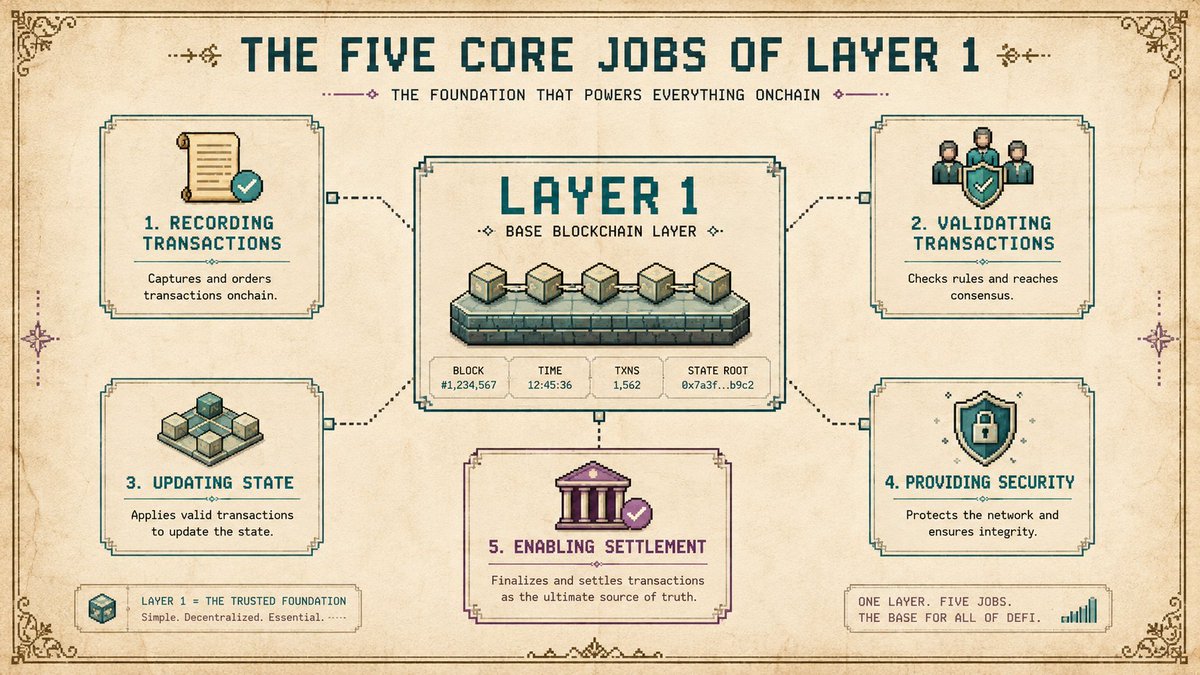
A Layer 1 has a few core responsibilities.
First, it records transactions.
When users send assets, interact with contracts, swap tokens, or borrow from a protocol, those actions become transactions.
Second, it validates transactions.
The network checks whether the transaction follows the rules.
Does the wallet have enough funds?
Is the signature valid?
Is the smart contract call allowed?
Third, it updates the state.
State means the current condition of the blockchain.
- Who owns which tokens?
- How much liquidity is in a pool?
- What is your collateral balance?
- What is your debt?
Fourth, it provides security.
The network makes it difficult for someone to rewrite history, fake balances, or break the rules.
Fifth, it provides settlement.
Settlement means the system eventually agrees that a transaction is final enough to rely on.
For DeFi, this is critical.
A lending protocol cannot work if balances are uncertain.
A DEX cannot work if trade outcomes can be easily reversed.
A stablecoin cannot work if ownership is unclear.
So L1 is the foundation that gives DeFi a shared source of truth.
The Problem: Blockspace Is Limited
Now we get to the main issue.
Layer 1 blockchains have limited capacity.
They cannot process infinite transactions at once.
- Every transaction needs space.
- Every smart contract interaction needs computation.
- Every state update needs to be verified and stored by the network.
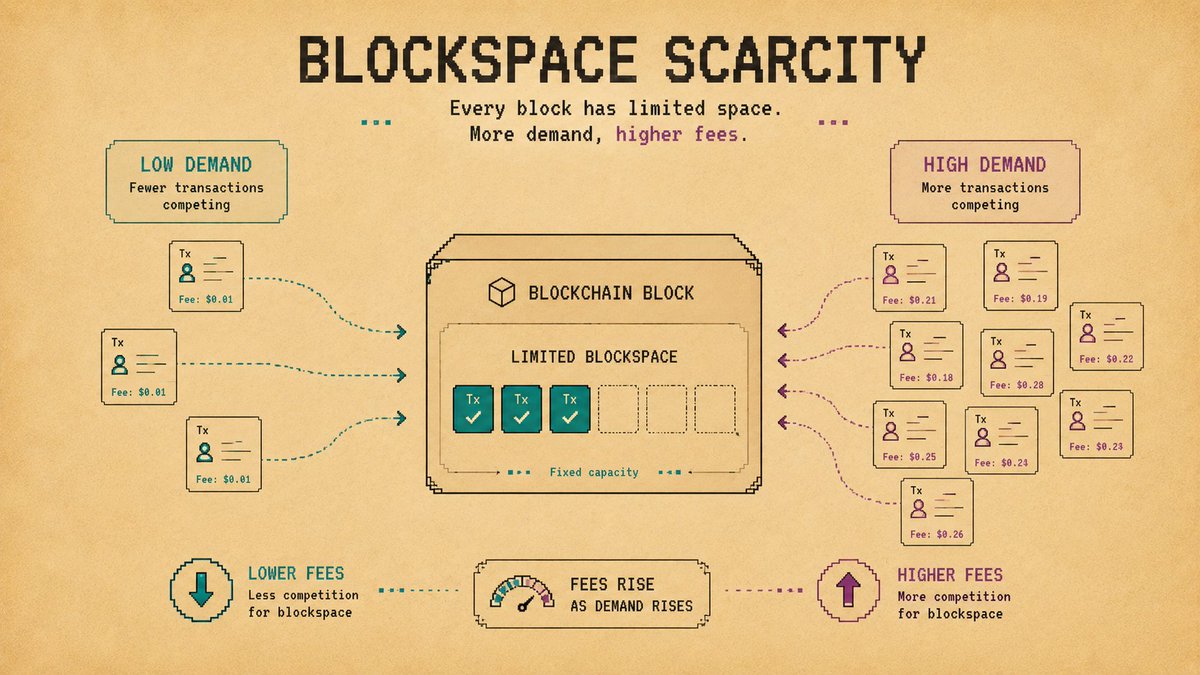
This limited capacity is often called blockspace.
Blockspace is like digital real estate inside a block.
When few people want to use the network, blockspace is easy to access.
Transactions are cheaper.
Confirmation can feel smooth.
But when many people want to use the network at the same time, blockspace becomes scarce.
Users compete to get their transactions included.
Fees rise.
Small transactions become uneconomical.
Simple actions like swapping, approving, depositing, borrowing, or claiming rewards can become expensive.
This is where the user starts asking:
“Why does this transaction cost so much?”
The answer is usually:
Because demand for blockspace is high, and blockspace is limited.
Why Not Just Make Layer 1 Faster?
This is the obvious beginner question.
- If Layer 1 is expensive or slow, why not simply increase capacity?
- Why not make bigger blocks?
- Why not process more transactions per second?
- Why not make fees lower by design?
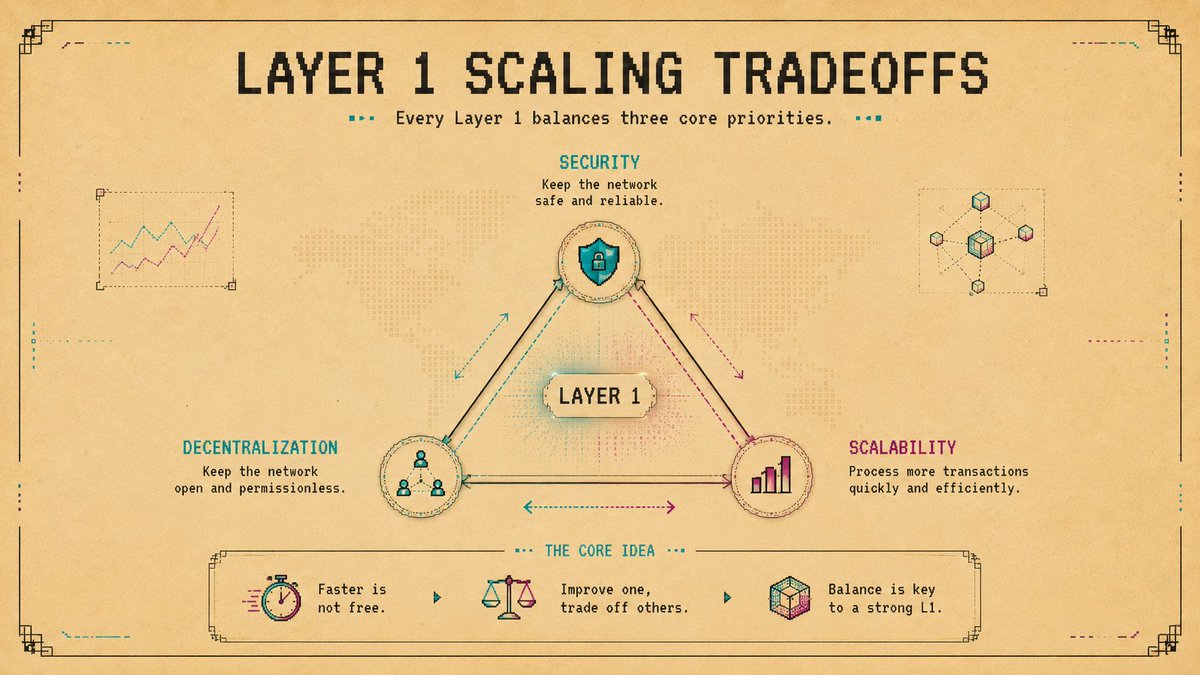
The reason is that blockchains are not only trying to be fast.
They are also trying to be secure, decentralized, and verifiable.
- If a blockchain makes blocks too large or hardware requirements too high, fewer people can run nodes.
- If fewer people can verify the chain, the network becomes more centralized.
- If the network becomes too centralized, the trust model changes.
So scaling a Layer 1 is not just a technical question.
It is a tradeoff question.
More throughput can come at the cost of decentralization.
More decentralization can limit throughput.
More security can make the system slower or more expensive.
For a beginner, the simple version is enough:
Layer 1 blockchains are limited because every transaction must be processed, verified, and stored by the base network.
That gives security.
But it also creates capacity limits.
The Core Problem for DeFi Users
DeFi needs frequent interaction.
A simple user may need to:
- Approve a token.
- Swap an asset.
- Add liquidity.
- Remove liquidity.
- Deposit collateral.
- Borrow.
- Repay debt.
- Claim rewards.
- Bridge assets.
- Rebalance positions.
Each of these actions can require an on-chain transaction.
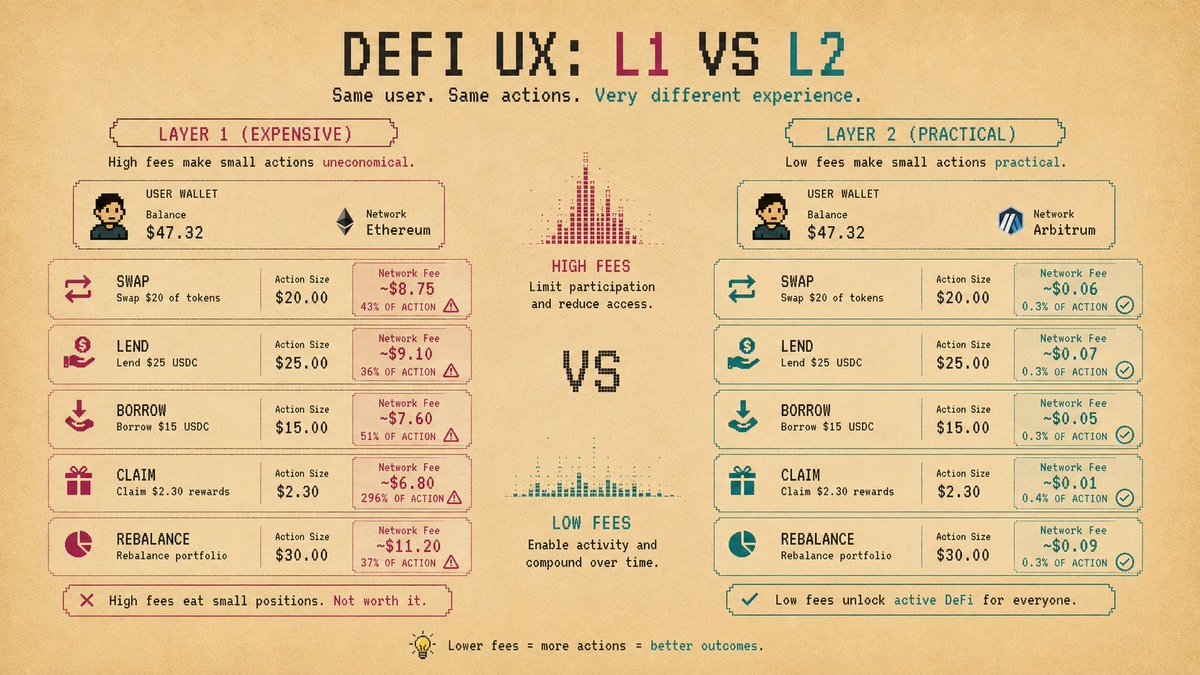
If every action happens directly on an expensive L1, many users get priced out.
This becomes a major problem for DeFi adoption.
A whale may not care about a $30 transaction fee.
But a beginner with $100 definitely cares.
If the fee is too high, small users cannot learn, experiment, or manage positions efficiently.
That is one of the main reasons Layer 2 networks matter.
They make DeFi interaction cheaper and faster for more users.
What Is a Layer 2?
A Layer 2 is a network built on top of, or connected to, a Layer 1.
Its goal is to improve scalability.
In simple terms, a Layer 2 tries to move some activity away from the crowded base layer while still using the base layer for security, settlement, or data availability depending on the design.
The beginner mental model:
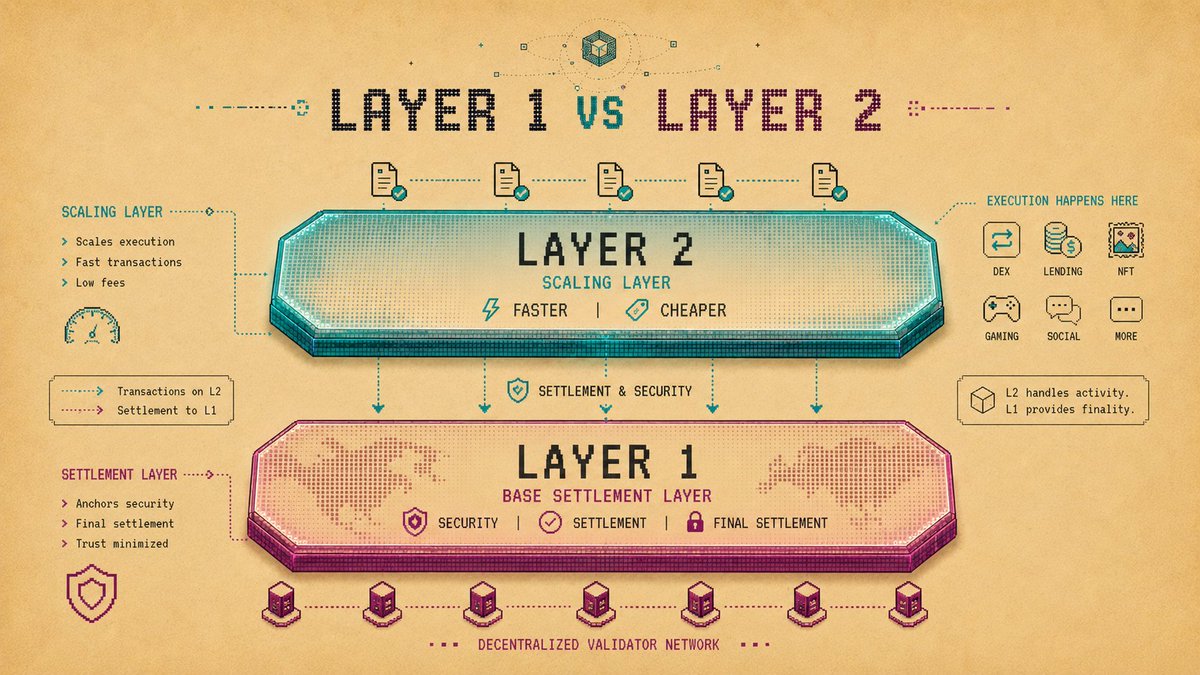
Layer 1 is the base settlement layer.
Layer 2 is the scaling layer that makes transactions cheaper and faster.
Instead of forcing every user interaction to happen directly on the L1, the L2 processes many interactions more efficiently.
Then it connects back to the L1 in some way.
This is why L2s can feel like separate networks in your wallet while still being linked to the base chain.
You may switch from Ethereum mainnet to an L2 network, but the L2 is still connected to Ethereum’s broader settlement and security model.
The exact connection depends on the type of L2.
But the purpose is clear:
Make blockchain usage cheaper, faster, and more accessible.
A Simple Analogy
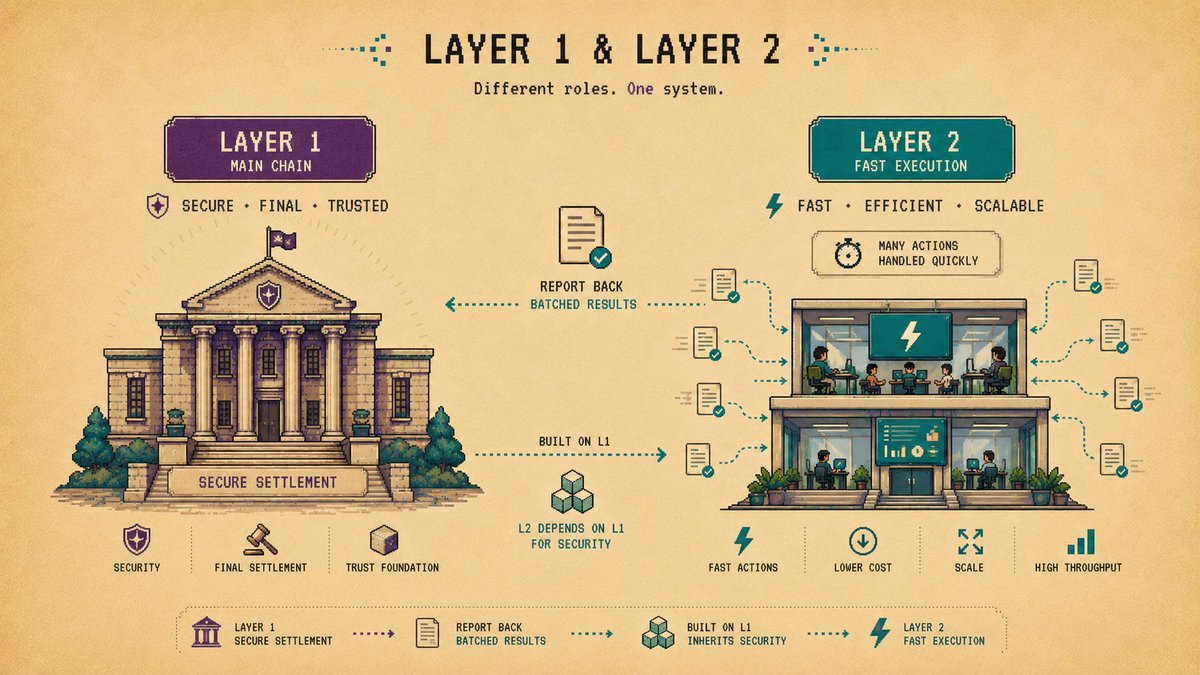
Imagine Layer 1 as a very secure courthouse.
Every important record can be finalized there.
But the courthouse is expensive and slow because everyone wants to use it.
Now imagine Layer 2 as a specialized office that handles many smaller actions quickly.
It processes activity more efficiently, organizes the results, and then sends important summaries or proofs back to the courthouse.
The courthouse remains the base authority.
The office makes the system usable at scale.
This is not a perfect analogy, but it captures the basic idea.
Layer 1 provides the strong base.
Layer 2 improves usability.
How Does an L2 Make Transactions Cheaper?
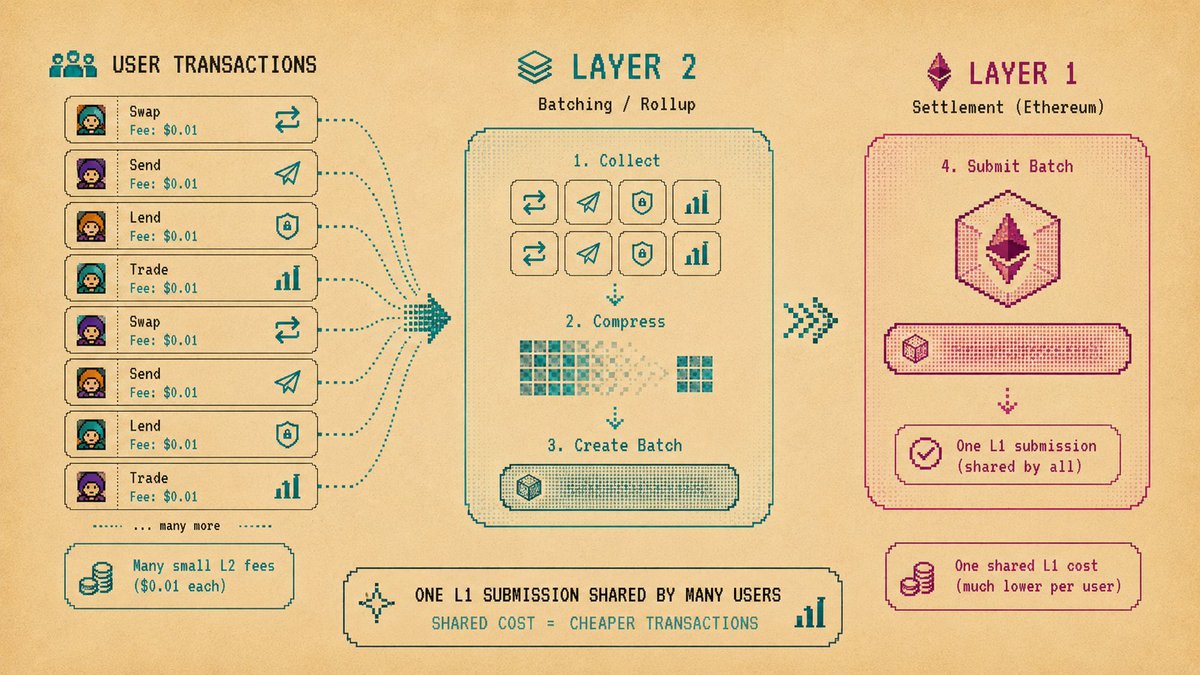
The simple answer is batching.
Instead of every transaction being handled individually on the L1, an L2 can process many transactions together and submit compressed information back to the L1.
This spreads the cost across many users.
If one L1 transaction can represent many L2 transactions, each user effectively pays less.
This is why L2 transactions are often much cheaper than L1 transactions.
The L2 is not making computation magically free.
It is organizing and compressing activity more efficiently.
The result for users is simple:
Lower fees.
Faster confirmations.
More practical DeFi usage.
That is why L2s became important for swaps, lending, gaming, NFTs, payments, and other high-frequency on-chain actions.
Rollups: The Main L2 Model
There are different scaling designs, but rollups are one of the most important L2 models.
A rollup executes transactions outside the main L1 environment, then posts transaction data or proof-related information back to the L1.
This last part is more important than it sounds.
The reason a rollup is considered a real L2, and not just another separate network, is that it stays connected to the base layer.
One of the key ideas here is data availability.
Data availability means the information needed to verify what happened on the rollup is made available in a way that users or observers can check.
This matters because if users cannot verify what happened, they are trusting the operator much more.
If a network processes transactions somewhere else but does not make the data available through the base layer or a secure data availability system, it becomes a different kind of scaling design with different assumptions.
For beginners, the simple idea is:
Rollups try to scale execution while keeping a strong connection to the base chain.
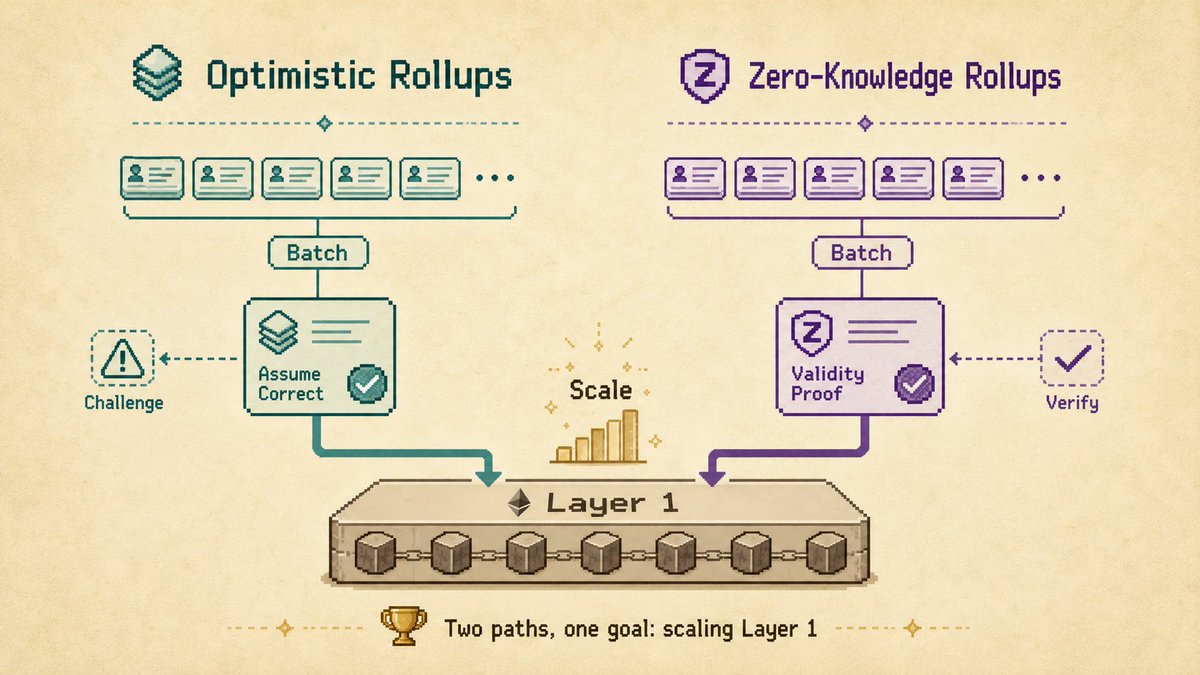
There are two major types beginners often hear about:
- Optimistic rollups
- Zero-knowledge rollups
Do not worry about the deep technical details yet.
For now, the basic difference is enough.
Optimistic rollups assume transactions are valid unless someone challenges them during a dispute window.
That dispute window is also why optimistic rollups can have long withdrawal delays back to the L1, often around seven days.
The system needs time to let anyone challenge an invalid transaction before the withdrawal is finalized.
Zero-knowledge rollups use cryptographic proofs to show that transactions were processed correctly.
Because the proof can be verified directly, ZK-rollups generally do not need the same long challenge window.
Withdrawals back to the L1 can be much faster, depending on the design.
Both models try to solve the same big problem:
How can we process more transactions without forcing every single action to fully burden the base chain?
The details differ.
The goal is similar.
Rollups are not the only scaling design.
You may also come across terms like validiums, plasma, and state channels.
They all try to solve scaling in different ways, with different tradeoffs around data availability, exit guarantees, and trust assumptions.
For a beginner, the important point is this:
Rollups are currently one of the most common and most established L2 models in the Ethereum ecosystem.
The other designs exist.
But most beginner DeFi users will meet rollups first.
L2 Is Not the Same as a Separate L1
This is an important distinction.
A separate Layer 1 is its own base chain.
It has its own validators, security model, consensus, and ecosystem.
An L2 is different because it is designed to rely on an underlying L1 in some way.
For example, many Ethereum L2s are built to inherit parts of Ethereum’s security and settlement model.
That does not mean every L2 is identical.
It also does not mean every L2 has the same risk level.
But the conceptual difference matters.
A separate L1 is another base network.
An L2 is a scaling environment connected to a base network.
From a user perspective, both may look like networks inside a wallet.
But structurally, they are not the same thing.
Sidechains: The Category Beginners Often Confuse With L2s
There is also a third category that beginners often confuse with L2s:
Sidechains
A sidechain is a separate blockchain that runs in parallel to an L1 and connects to it through a bridge.
But it does not inherit the L1’s security in the same way a rollup tries to.
A sidechain usually has its own validator set and its own consensus.
Polygon PoS is the most common example beginners recognize.
In wallets, Polygon PoS may sit next to Arbitrum, Optimism, or Base.
So many users assume it is the same kind of network.
Structurally, it is not.
Polygon PoS is a sidechain.
Polygon also has a separate network called Polygon zkEVM, which is an L2.
That distinction matters.
When you see a network in your wallet, the practical question is not only:
“Is it cheaper?”
The better question is:
“What security model am I using?”
Is it an L2?
Is it a sidechain?
Is it a separate L1?
Each answer comes with different assumptions.
What Actually Happens When You Use an L2?
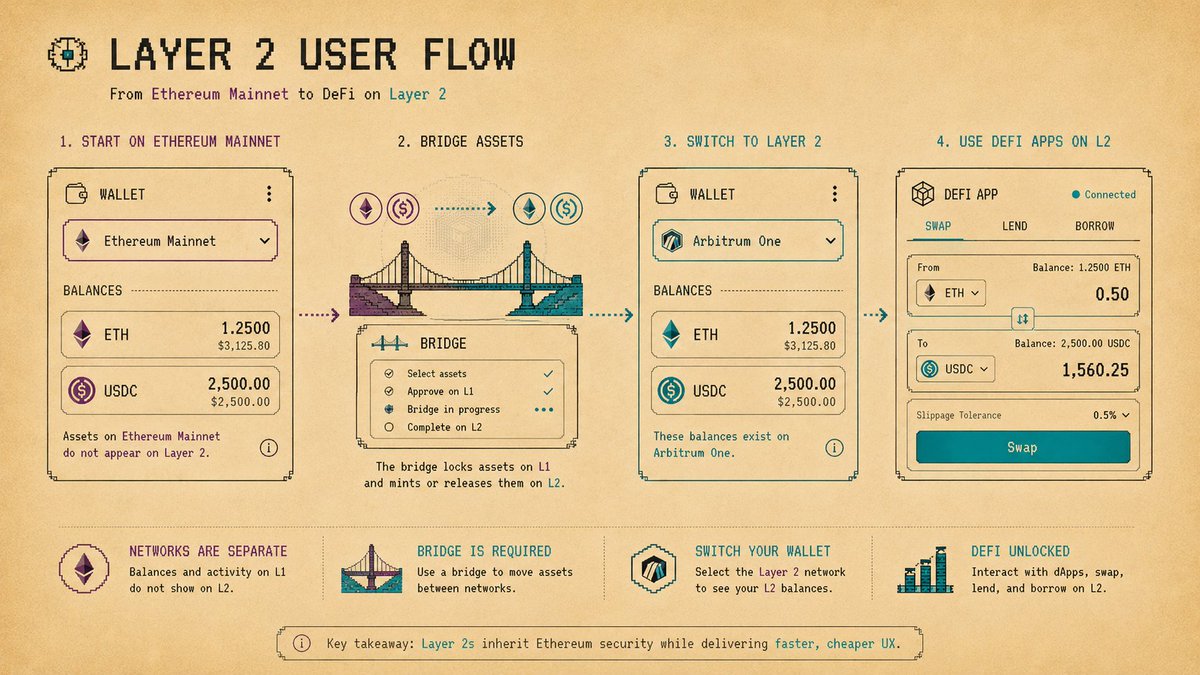
From the user side, using an L2 may feel simple.
You switch networks in your wallet.
You open a DeFi app.
You approve a token.
You swap, lend, borrow, or add liquidity.
Choose an option to begin.
The interface may feel similar to using Ethereum mainnet.
But under the hood, the transaction is happening on the L2 environment.
The L2 processes the transaction.
Your balance changes on that L2.
The L2 eventually reports, proves, or settles information back to the L1 depending on its design.
This is why your assets on Ethereum mainnet and your assets on an L2 are not automatically the same balance.
If you have USDC on Ethereum mainnet, that does not automatically mean you have USDC on every L2.
Networks have separate states.
You need to move assets between them through a bridge or another transfer mechanism.
That bridge topic is important enough to deserve its own article.
And that is exactly where we will go next.
Why Users Move to L2s
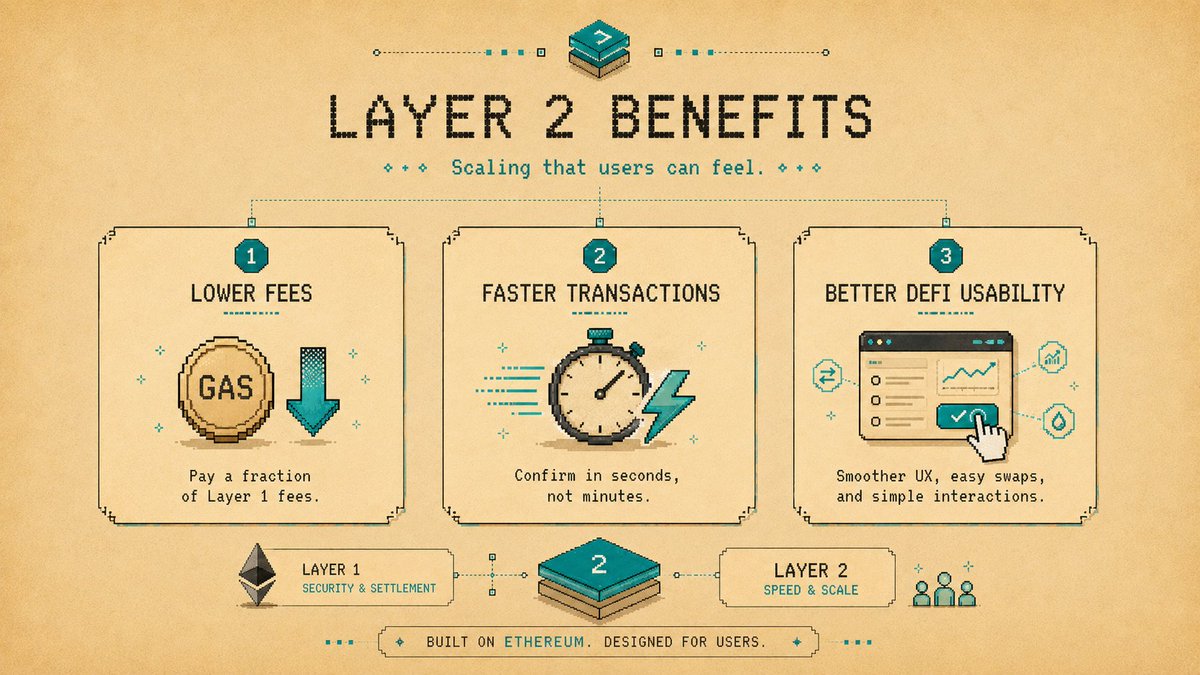
Users move to L2s for practical reasons.
The first reason is lower fees.
If an L1 transaction is expensive, an L2 can make smaller transactions more realistic.
The second reason is speed.
L2 transactions often feel faster from the user perspective.
The third reason is better DeFi usability.
Strategies that are too expensive on L1 may become practical on L2.
The fourth reason is experimentation.
Beginners can learn with smaller amounts when fees are lower.
The fifth reason is ecosystem access.
Some apps, incentives, communities, or markets may exist mainly on a specific L2.
So L2s are not only technical upgrades.
They change what users can realistically do.
If fees are too high, DeFi becomes a game for larger wallets.
If fees are low, more users can participate, test, learn, and manage positions.
The Main Benefits of L2s
L2s usually offer three main benefits.
First, lower transaction costs.
This makes frequent DeFi interactions more practical.
Second, faster user experience.
Transactions can feel smoother and more responsive.
Third, more scalable application design.
Apps can support more activity without relying only on expensive L1 blockspace.
For DeFi, this matters a lot.
- A lending position may require multiple interactions.
- An LP position may need rebalancing.
- A trader may need several swaps.
- A user may need to claim, repay, adjust, or exit.
If every action is expensive, active management becomes difficult.
L2s make more active DeFi usage possible.
The Tradeoff: L2s Also Add New Risks
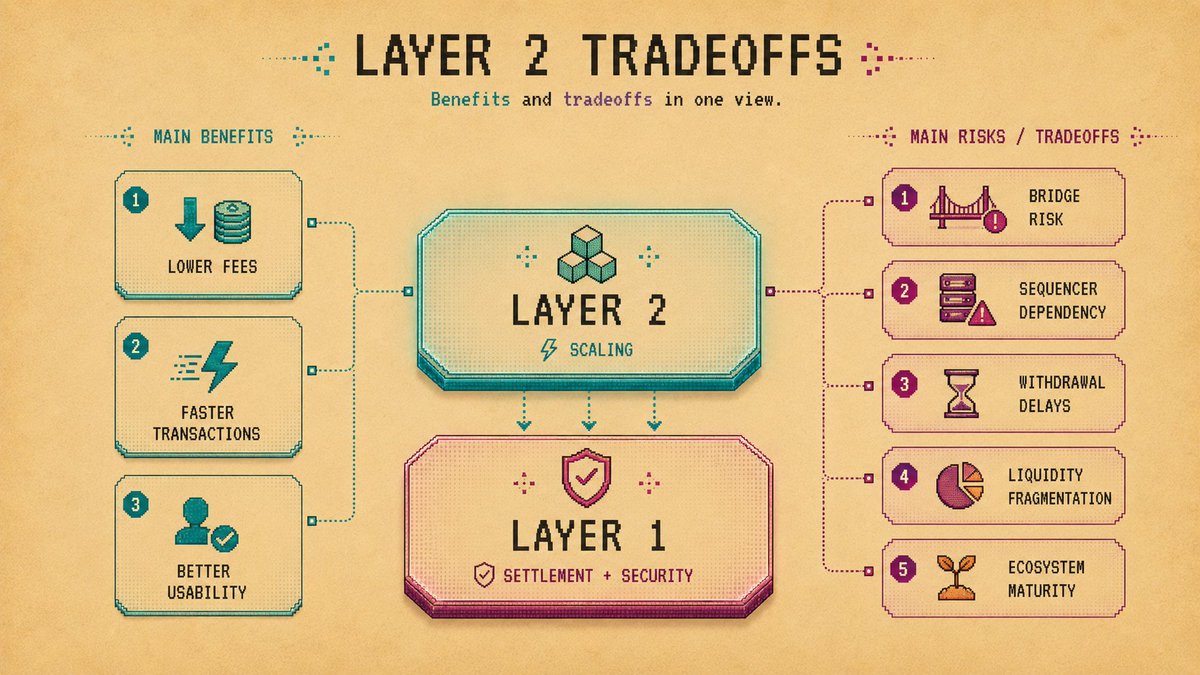
L2s improve usability, but they are not risk-free.
They add new layers of complexity.
The first risk is bridge dependency.
To move assets between L1 and L2, users often need bridges.
Bridges have their own risks, which we will cover in the next article.
The second risk is sequencer dependency.
Many L2s use a sequencer to order transactions.
If the sequencer has problems, the network experience can be affected.
It is also important to know that many popular L2s still rely on a centralized or semi-centralized sequencer today.
That means transaction ordering may depend on one main operator or a limited set of operators.
This does not automatically make the network unsafe.
But it is an assumption users should be aware of.
The third risk is withdrawal delay.
Some L2 designs may require waiting periods when withdrawing back to L1.
This is more common with optimistic rollups, where the dispute window can be around seven days.
ZK-rollups generally have shorter withdrawal delays, depending on the design.
Native bridges usually follow these rules.
Third-party bridges may offer faster exits, but they introduce their own trust and security assumptions.
The fourth risk is liquidity fragmentation.
Liquidity can be split across many networks.
The same token may have different liquidity conditions on different chains.
The fifth risk is ecosystem maturity.
Newer L2 ecosystems may have younger protocols, less liquidity, or more experimental infrastructure.
So L2s are useful.
But they still require risk awareness.
The correct mental model is not:
“L2 is cheaper, so it is automatically better.”
The better model is:
“L2 makes usage cheaper and faster, but it introduces additional network and bridge assumptions.”
Liquidity Fragmentation
Liquidity fragmentation is one of the most important ideas for DeFi users.
If liquidity is spread across many networks, each network has its own market conditions.
ETH/USDC liquidity on one L2 may not be the same as ETH/USDC liquidity on another L2.
A lending market on one chain may have different rates than the same asset market on another chain.
A stablecoin may have deep liquidity on one network and weak liquidity on another.
This affects execution.
- It affects slippage.
- It affects borrowing rates.
- It affects liquidation risk.
- It affects exit planning.
This is why network choice matters.
Choosing a network is not only about gas fees.
It is also about liquidity depth, protocol maturity, bridge safety, and ecosystem risk.
L2 Does Not Remove the Need for Security Habits
Lower fees can create a psychological trap.
When transactions are cheap, users may click more casually.
- They may approve more contracts.
- They may test more apps.
- They may bridge more often.
- They may interact with newer protocols without enough caution.
But cheap transactions do not make bad transactions safe.
- A malicious approval is still dangerous.
- A fake interface is still dangerous.
- A bad bridge is still dangerous.
- A weak protocol is still dangerous.
- A depeg is still dangerous.
So all the security habits from earlier articles still apply.
- Check the URL.
- Check the network.
- Check the token contract.
- Understand the approval.
- Use small test transactions when needed.
- Revoke unnecessary permissions.
L2 makes DeFi easier to use.
It does not remove user responsibility.
Common Beginner Mistakes
The first mistake is thinking all networks are the same.
They are not.
Each network has its own liquidity, risks, apps, and assumptions.
The second mistake is confusing L2s with completely separate L1s.
They may look similar in a wallet, but structurally they are different.
The third mistake is confusing sidechains with L2s.
Some networks that look like L2s in your wallet are actually sidechains with their own validators and security model.
Lower fees do not automatically mean something is an L2.
The fourth mistake is ignoring bridge risk.
If you moved assets to an L2, the bridge path matters.
The fifth mistake is assuming cheaper means safer.
Lower fees improve usability.
They do not improve security by themselves.
The sixth mistake is forgetting that balances are network-specific.
USDC on Ethereum mainnet and USDC on an L2 are not the same balance in your wallet.
The seventh mistake is ignoring liquidity depth.
A token may exist on an L2 but still have weak liquidity.
The eighth mistake is not keeping gas tokens on the network.
To transact on a network, you need the correct gas asset for that network.
The ninth mistake is rushing into incentives.
Many L2 ecosystems use incentives to attract users.
But incentives can bring risk, short-term capital, and crowded trades.
How Mature Is This L2?
Not all L2s are at the same level of decentralization.
The community often uses an informal framework called Stage 0, Stage 1, and Stage 2 to describe how much an L2 still depends on its development team versus running in a more trust-minimized way.
Stage 0 means the L2 is still highly dependent on the team behind it.
The team may control upgrades, operate key infrastructure, or intervene in important parts of the system.
Stage 1 means some guardrails are in place.
Users have stronger guarantees, but the team may still have meaningful control in some areas.
Stage 2 means the L2 is closer to fully trust-minimized.
Upgrades are more restricted, exits are better protected, and the team has less ability to change the rules.
Many L2s are still evolving through these stages.
For users, the general rule is simple:
The earlier the stage, the more you are trusting the team behind the L2, not only the cryptography.
This does not mean you should never use early-stage L2s.
It means you should understand what you are trusting before moving serious capital.
Simple L2 Checklist
Before using an L2, ask yourself:
If you cannot answer these questions, slow down.
Using an L2 is not hard.
But using it blindly is risky.
The Correct Mental Model
Layer 1 is the base settlement layer.
It provides the foundation for transactions, smart contracts, state, and security.
Layer 2 is the scaling layer.
It makes blockchain usage cheaper and faster by processing activity more efficiently and connecting back to the base layer.
L1 gives DeFi its foundation.
L2 makes DeFi more usable.
But L2s do not remove risk.
They shift some costs down and add new assumptions.
That is the tradeoff.
So the correct mental model is:
L1 is where the system gets its base security and settlement.
L2 is where users get cheaper and faster execution.
Both matter.
Core Insight
Layer 2 networks exist because Layer 1 blockspace is limited.
Layer 1s provide security, settlement, and a shared source of truth.
But when too many users want to use the same base layer, fees rise and small transactions become harder.
L2s improve usability by moving activity into a more scalable environment while staying connected to the base layer.
That makes DeFi cheaper and faster for users.
But cheaper does not mean risk-free.
L2s introduce bridge risk, sequencer assumptions, liquidity fragmentation, withdrawal delays, and ecosystem differences.
The question is not only:
“Which network is cheaper?”
The better question is:
“What assumptions am I accepting by using this network?”
One Minute Summary For Lazies
Layer 1 is the base blockchain network.
It records transactions, updates state, runs smart contracts, provides security, and acts as the settlement layer.
But L1 blockspace is limited.
When demand is high, fees rise and small DeFi actions become expensive.
Layer 2 networks exist to make blockchain usage cheaper and faster.
They process activity more efficiently and connect back to the base layer in different ways.
This makes DeFi more usable, especially for smaller users and frequent interactions.
But L2s are not risk-free.
They add bridge dependency, sequencer assumptions, liquidity fragmentation, possible withdrawal delays, and different ecosystem risks.
L2 is not simply a better L1.
It is a scaling layer with its own tradeoffs.
Can you explain the model?
Is every faster EVM network an Ethereum Layer 2?
No. Sidechains can use independent consensus and security; an L2 inherits settlement guarantees through a defined mechanism.
Does using an L2 remove wallet security duties?
No. Network selection, contract verification, approvals, bridges and signing discipline still matter.
What’s Next?
Now we understand why users move to Layer 2 networks.
Lower fees.
Faster transactions.
Better DeFi usability.
But this raises the next important question:
How do assets move between networks?
If your ETH is on Ethereum mainnet, how does it appear on an L2?
If your USDC is on one network, how do you move it somewhere else?
That leads us to one of the most important and risky parts of DeFi infrastructure:
Bridges.
In the next article, we will cover:
Bridge 101: Cross-Chain Transfers and Their Real Risks
Because moving assets between networks is not just a transfer.
It is a trust and security decision.
Originally published on X · 2026-06-04
 Post on X
 Telegram