
Stable is a target, not a guarantee.
See how redemption, collateral and arbitrage support a peg—and where each stablecoin model can break.
The word stablecoin is one of the most frequently heard terms in the DeFi world. For many users, a stablecoin simply looks like a digital dollar equal to 1 USD.
In reality, however, a stablecoin is not a dollar. It is a financial mechanism. That mechanism contains different designs, incentives, and risks.
In this article we will answer three important questions:
- How does a stablecoin actually stay stable?
- Who maintains the peg?
- Where do the risks begin?
Understanding these questions will help you better understand almost every action you take when using DeFi.
Lesson mapNavigate this lessonExplore all 23 sections
See the model before the details.
Use the flow, the peg-pressure explorer and the comparison table as a map while you read.
- 01Backing or collateral
- 02Redemption path
- 03Arbitrage incentive
- 04Market price
- 05Peg restored—or stressed
| Model | Stability mechanism | Primary failure pressure |
|---|---|---|
| Fiat-backed | Issuer reserves and redemption | Reserve, issuer or access risk |
| Crypto-collateralized | Onchain overcollateralization | Collateral crash and liquidation |
| Algorithmic | Incentives and supply rules | Confidence spiral |
| Hybrid | Multiple mechanisms | Combined complexity |
If a redeemable stablecoin trades above its peg, creating and selling new units can pull the market price back toward the reference value.
Why This Topic Matters
In the DeFi ecosystem, most activity revolves around stablecoins.
- When you swap on a DEX you usually measure prices in stablecoins
- When you lend or borrow in lending protocols you typically use stablecoins
- On the LP side, stable to stable pools are often the starting point
- In derivatives markets, collateral is often a stablecoin
For many users, stablecoins function like cash in DeFi.
But even "cash" carries risk in DeFi.
The biggest danger with stablecoins is that people start to treat them like a bank balance.

What Is a Stablecoin?
A stablecoin is a blockchain token designed to stay close in value to a reference asset, most commonly the US dollar.
In the early years of crypto there was a major problem: volatility. The value of Bitcoin and other crypto assets could rise or fall very quickly. As a result, traders needed a dollar like asset to operate within the market.
One of the first widely used stablecoins was Tether (USDT), introduced in 2014. The goal was simple: create a token on blockchain that stays close to the value of one dollar. Over time stablecoins became one of the most important pieces of infrastructure in the crypto market.
Today stablecoins are not only used for trading. They are fundamental building blocks in many DeFi protocols.
Some of the most widely used stablecoins today include:
- USDT (Tether) – one of the earliest and historically the largest stablecoin
- USDC (USD Coin) – a model that works more closely with financial institutions
- DAI – crypto collateralized with a more decentralized design
- FRAX – a model that combines algorithmic and collateral mechanisms
All of these stablecoins aim to stay close to 1 dollar, but the mechanisms they use to achieve this goal are very different.
Another important point is that stablecoins do not always have to be pegged to the US dollar.
Some stablecoins are pegged to other currencies or assets.
Examples include:
- EURC – a stablecoin pegged to the euro (issued by Circle)
- EURe – another euro based stablecoin
- XSGD – a stablecoin pegged to the Singapore dollar
- TRYB – a stablecoin pegged to the Turkish lira
- PAXG – a token pegged to the price of gold
These assets still follow the stablecoin concept, but the reference asset is something other than USD.
The correct mental model is this:
Stablecoin = a token that tries to stay close to a specific reference asset.
The critical point is the following:
What makes a stablecoin stable is not its name, but the mechanism behind it.
Correct mental model:
Stablecoin = a token with a value stabilization mechanism
Why Do People Hold Stablecoins Instead of Dollars in a Bank?
Many beginners ask the following question:
"If a stablecoin stays close to 1 dollar, why would people hold the crypto version instead of simply holding dollars in a bank?"
There are several reasons.
1. On chain usability
Stablecoins operate directly on blockchain networks, which means they can be used inside DeFi protocols.
Examples include:
- lending
- liquidity providing
- derivatives
- yield strategies
Traditional bank dollars cannot directly interact with these systems.
2. Fast and global transfers
Stablecoins can be sent anywhere in the world within minutes as long as there is an internet connection.
International bank transfers are often:
- slower
- more expensive
- sometimes inaccessible
3. Access for people without banking services
In many parts of the world people have limited access to bank accounts.
Stablecoins can be used with nothing more than a crypto wallet.
In some countries stablecoins have effectively started functioning as a digital dollar infrastructure.
4. DeFi yields
Stablecoins can be used in DeFi protocols to generate yield.
Examples include:
- earning interest through lending protocols
- providing liquidity
- running yield strategies
Bank deposits usually do not offer this level of flexibility.
However there is an important difference:
Bank dollars come with legal and financial protections. Stablecoins carry technical and market risks.
Stablecoins are therefore not identical replacements for bank dollars. They are on chain financial instruments.
Why Have Stablecoins Grown So Much?
Stablecoins have become one of the largest use cases in the crypto ecosystem.
Their main uses include:
- Trading (pricing unit on exchanges)
- DeFi collateral
- On chain dollar transfers
- Dollar alternatives in high inflation countries
- Cross border payments
For this reason the total supply of stablecoins has grown into the hundreds of billions of dollars and they now serve as core infrastructure for many DeFi systems.

What Is a Peg?
A peg means that a stablecoin's price stays close to its reference value, usually 1 USD.
The important detail is this:
A peg does not maintain itself automatically.
The peg survives because of market incentives and arbitrage opportunities.
For the peg to work, the following market behavior needs to exist:
- If the price becomes 1.01, someone sells
- If the price becomes 0.99, someone buys
Who are these participants?
Most of the time they are arbitrage traders and professional market participants. Their goal is not to protect the system but to profit from price differences. That profit motive indirectly helps maintain the peg.
Example:
When the stablecoin trades at 1.01
If the market price is 1.01 the following opportunity appears:
- Some actors mint new stablecoins at 1 dollar through the system or through redemption
- They sell those tokens on the market at 1.01
- The 0.01 difference becomes profit
This selling pressure pushes the price back toward 1.00.
When the stablecoin trades at 0.99
If the price drops to 0.99 another opportunity appears:
- Traders buy the stablecoin at 0.99
- If redemption is available they exchange it for assets worth 1 dollar
- The difference becomes profit
This buying pressure pushes the price upward again.
The peg is therefore not maintained by a single institution.
It is maintained by traders chasing arbitrage opportunities.
Two mechanisms enable this behavior.
Redemption
In theory redemption is one of the mechanisms that helps maintain the peg. In practice most retail users cannot redeem directly.
Many issuers only allow redemption for:
- institutional clients
- large minimum amounts
As a result the peg is often maintained not through direct redemption but through secondary market arbitrage.
If a token can ultimately be redeemed for assets worth 1 dollar, the price tends to stay close to that level.
Arbitrage
If the price drops to 0.99, buying at 0.99 and converting to 1 dollar creates profit.
If the price rises to 1.01, minting at 1 dollar and selling at 1.01 creates profit.
These profit opportunities constantly push the price toward equilibrium.
Can individual users also buy at 0.99 and sell at 1.01?
In theory yes. In practice these opportunities close very quickly. Professional traders and bots constantly monitor multiple exchanges and liquidity pools and remove these price differences within seconds.
For this reason the actors maintaining the peg are usually arbitrage bots and professional market makers, not individual users.
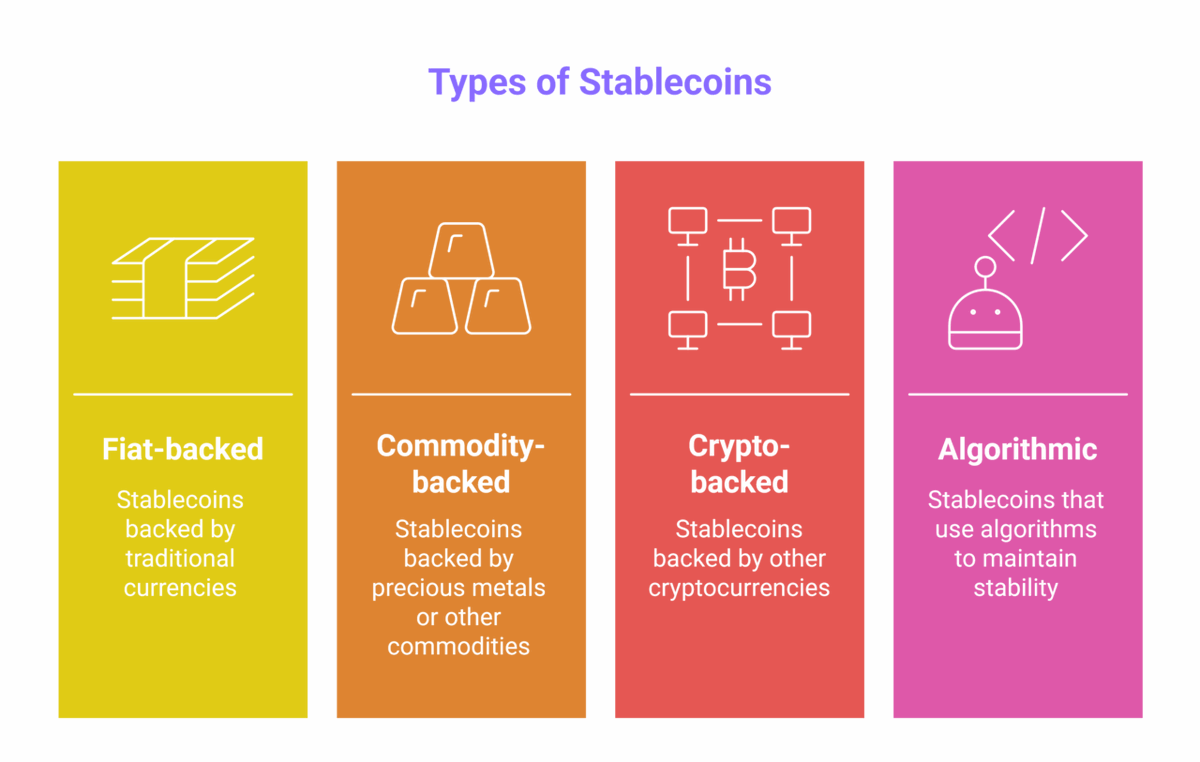
Types of Stablecoins
All stablecoins share the same goal: keeping the price close to 1 dollar. However the mechanisms used to achieve this goal are very different. Understanding this difference is critical because stablecoin risks usually originate from the underlying mechanism.
In general we can group stablecoins into four categories.
1) Fiat Backed Stablecoins
This is the simplest model.
The core idea is that a company claims to hold 1 dollar or dollar equivalent assets as reserves for every stablecoin issued.
Basic flow:
- A user sends 1 dollar to the system
- The system mints 1 stablecoin
- When the user redeems the stablecoin they receive 1 dollar back
This model resembles a custody model similar to deposits.
Examples include:
- USDT (Tether)
- USDC (USD Coin)
These stablecoins are typically backed by assets such as:
- bank deposits
- short term government bonds
- cash equivalent financial instruments
The key risk question becomes:
Do the reserves actually exist and can they be accessed during a crisis?
Issuers often publish reserve reports or attestations to increase transparency.
However an important distinction exists.
If a stablecoin website says "attestation" instead of "audit", this matters.
An attestation usually confirms that reserves existed at a certain point in time.
A full financial audit examines the entire financial structure of a company.
Attestation does not automatically mean full transparency.
Users should therefore ask additional questions:
- How much of the reserves are actual cash?
- How much is held in short term financial instruments?
- Can redemption function during a crisis?
2) Crypto Collateralized Stablecoins
In this model stablecoins are created by locking crypto collateral on chain.
The system typically requires overcollateralization.
For example:
To mint 1 dollar worth of stablecoin a user might need to lock 1.5 dollars worth of crypto assets.
This buffer exists because crypto prices are volatile.
Example:
- DAI
Users lock assets such as ETH as collateral to mint DAI.
If the value of the collateral falls too far the system triggers liquidation to maintain stability.
3) Algorithmic Stablecoins
Algorithmic models attempt to maintain the peg using economic incentives and supply adjustments instead of direct collateral.
Basic idea:
- If price rises above 1 dollar supply increases
- If price falls below 1 dollar supply decreases
In theory this stabilizes the price.
In practice these models can be fragile because they rely heavily on market confidence.
4) Hybrid Models
Some stablecoins combine multiple mechanisms.
For example a system may use:
- partial collateral
- algorithmic supply adjustments
Example:
- FRAX
Key takeaway
From the outside stablecoins may look identical.
But the systems behind them can be completely different.
The most important question in DeFi becomes:
"What mechanism protects this stablecoin's peg?"
Examples:
- USDT uses a fiat backed reserve model
- USDC uses a similar reserve model with reported holdings in cash and short term government debt
- DAI uses crypto collateral and liquidation mechanisms
- FRAX uses a hybrid model
Stablecoins may look similar but their security assumptions can be very different.
Native vs Bridged Stablecoins
A common beginner mistake is the following belief:
"USDC is the same everywhere."
This is incorrect.
Choose an option to begin.
Assets that share the same name and symbol can have different security models.
Native stablecoin
The version originally issued on its primary blockchain.
Bridged stablecoin
A version moved to another chain through a bridge.
Typical mechanism:
- The original asset is locked on the first chain
- A representation token is minted on another chain
These tokens effectively act as receipts for locked assets.
If a bridge is hacked or compromised the wrapped asset may lose its backing.
Mental model:
Native stablecoin = original asset
Bridged stablecoin = representation of a locked asset
The Same Stablecoin on Different Networks
Stablecoins can exist across multiple blockchains.
For example USDC exists on:
- Ethereum
- Arbitrum
- Base
- Solana
These versions may differ in:
- liquidity
- adoption
- DeFi integrations
This means the network matters as much as the token name.
Freeze and Blacklist Permissions
Many large stablecoins are issued by centralized companies.
Companies behind tokens such as USDT and USDC may retain certain contract level permissions.
One of these permissions is the ability to freeze or blacklist addresses.
Process example:
- An address is blacklisted
- Transfers from that address are blocked
- Tokens remain visible in the wallet but cannot move
These features may be used for:
- freezing stolen funds after hacks
- legal enforcement requests
- sanctions compliance
This creates an important distinction.
A wallet may belong to you, but the token contract may still control transfer permissions.
Self custody does not always mean censorship resistance.
Practical tip
When interacting with DeFi you must hold a small amount of the native network coin such as ETH, BNB, or MATIC.
Stablecoins cannot pay transaction fees.

Where Does Stablecoin Yield Come From?
Stablecoin yield typically comes from three sources. In DeFi yield does not appear magically. It always comes from fees, borrowing activity, or incentives.
Understanding the source of yield helps evaluate whether returns are sustainable.
1) Lending interest
Users borrow stablecoins in lending protocols.
Borrowers pay interest which is distributed to liquidity providers.
Example:
- You deposit 1,000 USDC
- Another user borrows those funds
- The borrower pays interest
- That interest is distributed to depositors
Protocols include:
- Aave
- Compound
- Maker
2) DEX trading fees
DEX users pay fees when swapping tokens.
Liquidity providers receive a portion of those fees.
Example:
- You provide liquidity to a USDC / DAI pool
- Traders swap tokens through the pool
- Each trade generates a fee
- Those fees are distributed to liquidity providers
DEX examples include:
- Uniswap
- Curve
- Balancer
3) Liquidity incentives
Some protocols distribute additional tokens to attract liquidity.
Users may earn both trading fees and incentive tokens.
However these incentives are not always sustainable.
Important question:
"Is the yield coming from real economic activity or from temporary incentives?"
Two Real World Cases: When Stablecoins Break
Terra UST (2022)
UST was an algorithmic stablecoin linked to the LUNA token economy.
When market confidence collapsed a large wave of selling began. The mechanism failed and the system entered a death spiral.
UST fell from 1 dollar to near zero within days.
USDC and Silicon Valley Bank (2023)
In March 2023 a portion of USDC reserves was held at Silicon Valley Bank which failed.
Panic spread in the market and USDC briefly traded near 0.88 USD.
After government intervention the peg returned to 1 dollar.
Even major stablecoins can experience short term instability.
Technical Risk vs Economic Risk
Stablecoin risks can be grouped into two categories: technical risks and economic risks.
Technical risks
- smart contract bugs
- oracle failures
- bridge exploits
- admin key abuse
Economic risks
- panic selling
- liquidity drying up
- collateral collapse
- loss of peg
The key question always remains:
Will the peg mechanism survive under stress? Slippage warning
Even stablecoin swaps can experience slippage.
For example swapping 1000 USDT for USDC may return only 980 USDC in a low liquidity pool.
Always check:
- slippage settings
- liquidity depth
- trade size
Can you explain the model?
Is a one-dollar price itself proof of safety?
No. Safety depends on the mechanism that supports redemption, collateral and market confidence.
Why does arbitrage matter?
It gives market participants an incentive to buy below or sell above the reference value when redemption works.
Summary For Lazies
Stablecoin is not a dollar.
Stablecoin is a financial system that attempts to imitate a dollar.
Stablecoins are tokens whose stability depends on underlying mechanisms.
Native and bridged stablecoins are not identical.
Higher yield usually implies higher risk.
Originally published on X · 2026-03-04
 Post on X
 Telegram