
Interest is the market price of scarce pool liquidity.
Follow utilization through the rate curve to understand why supply yield and borrowing cost can change quickly.
In the previous article, we covered LTV, Health Factor, and liquidation risk.
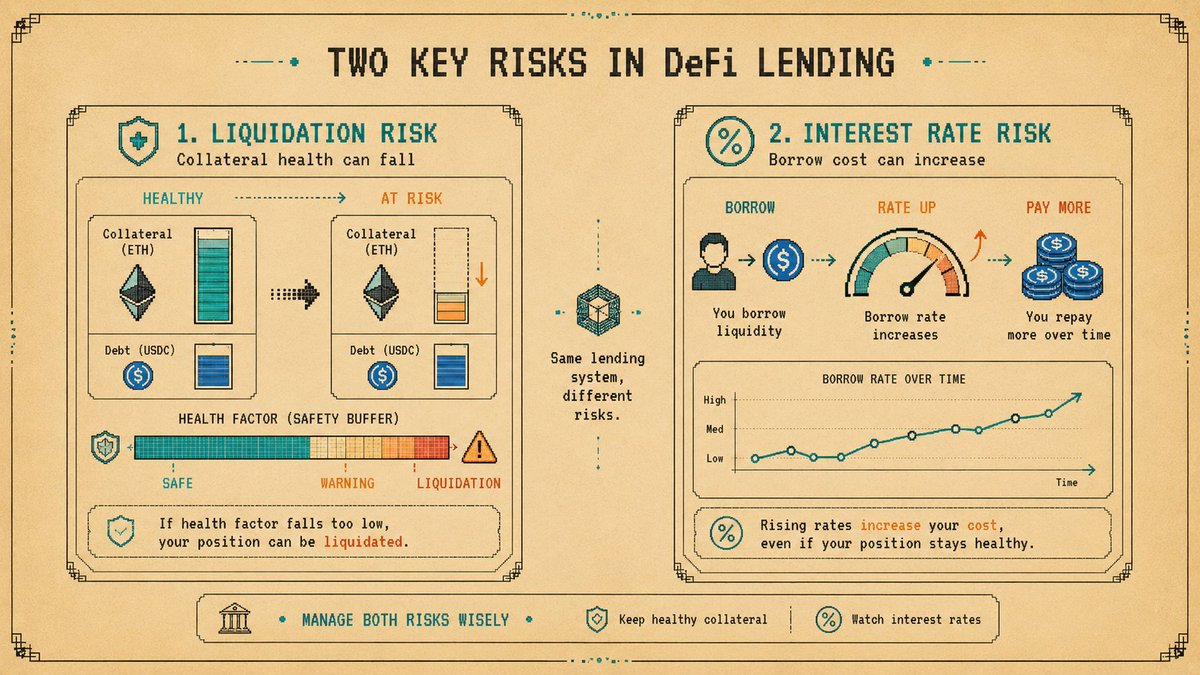
That article focused on the collateral side of borrowing. We explained how a borrow position can become risky when collateral value falls, debt value rises, or the Health Factor moves closer to the liquidation zone.
But liquidation is not the only risk in DeFi lending.
There is another moving part that beginners often ignore:
Interest.
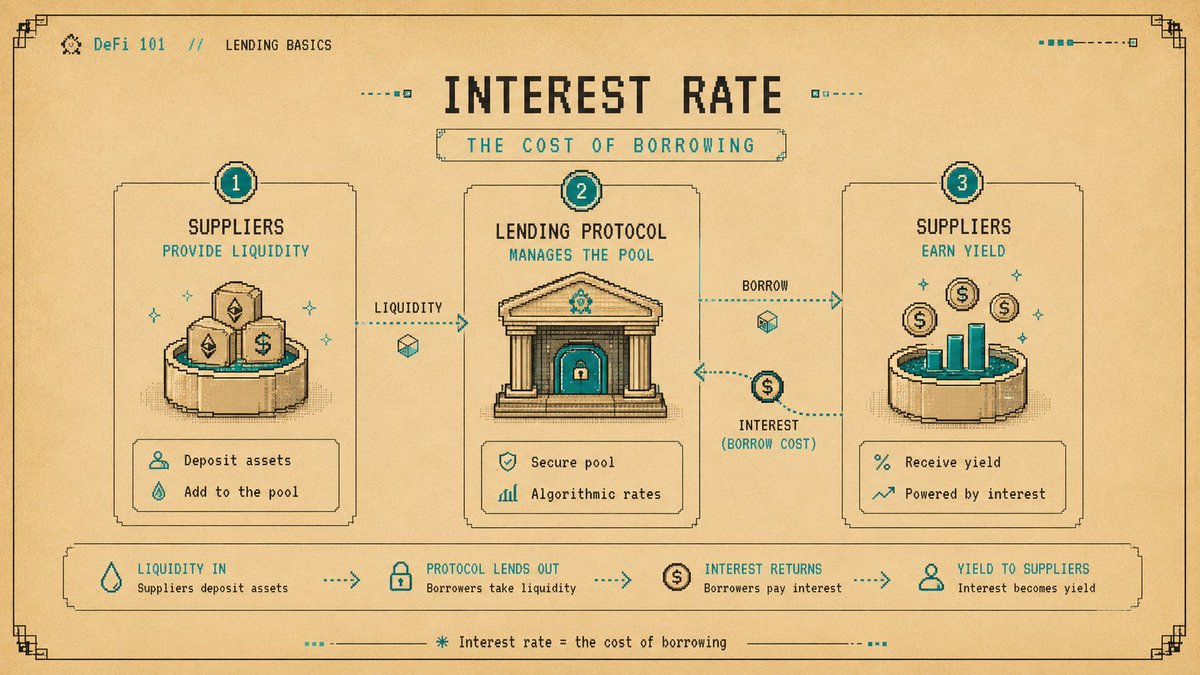
In simple terms, interest is the cost of borrowing.
When you borrow from a lending protocol, you are not only responsible for maintaining enough collateral. You are also responsible for the cost of keeping that debt open.
And in DeFi, that cost can change.
A borrow position that looks reasonable today may become expensive tomorrow if market conditions change.
That is what this article is about.
We are going to answer one simple question:
How are interest rates formed in DeFi lending protocols?
To understand that, we need to understand one of the most important concepts in lending:
Utilization.
Lesson mapNavigate this lessonExplore all 20 sections
See the model before the details.
Use the flow, the interest-rate curve and the comparison table as a map while you read.
- 01Supplied liquidity
- 02Borrower demand
- 03Utilization rises
- 04Borrow rate adjusts
- 05Supply yield follows
Adjust the controls to begin.
| Pool condition | Utilization | Likely rate pressure |
|---|---|---|
| Abundant idle liquidity | Lower | Borrow rates tend to remain lower |
| Balanced pool | Moderate | Rates compensate suppliers and borrowers |
| Liquidity scarce | High | Borrow rates can rise sharply |
| Near exhaustion | Very high | Withdrawals and new borrowing become stressed |
Why This Topic Matters
In the last article, we learned that a borrow position has a health side.
If your collateral becomes too weak compared to your debt, liquidation can happen.
That is the first major risk.
But even if your position is far from liquidation, your debt still has a cost.
That cost is the borrow rate.
Many beginners open a borrow position, see a low rate, and assume that number will stay the same.
This is a dangerous assumption.
In many DeFi lending protocols, borrow rates are variable. They move based on supply, demand, and how much liquidity is available in the market.
So the question is not only:
“Will I get liquidated?”
The second question is:
“Can I afford this debt if the interest rate changes?”
That question becomes even more important when users start building advanced strategies, especially leverage loops.
Before we get there, we need to understand how the cost of borrowing is created.
What Is Interest in DeFi Lending?
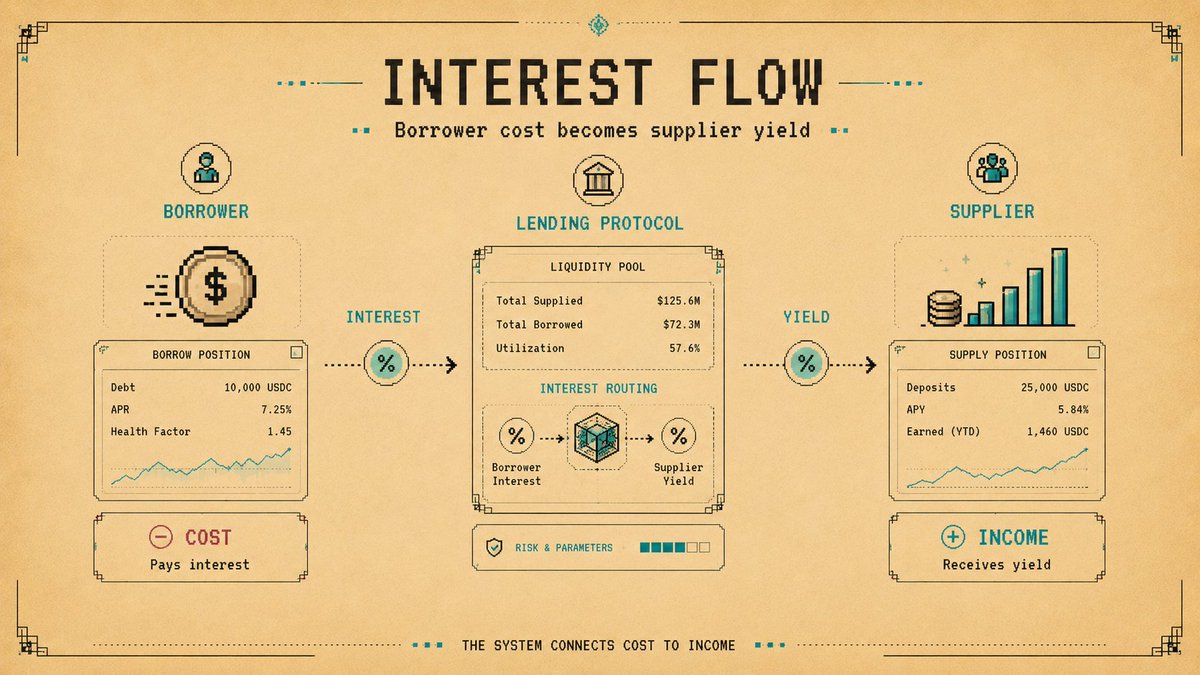
Interest is the price paid for using someone else’s capital.
If you borrow an asset, interest is your cost.
If you supply an asset, interest is one source of your yield.
Same system. Two different perspectives.
For the borrower:
Interest is what I pay to use capital.
For the supplier:
Interest is what I earn because someone else is using my capital.
This is the basic relationship.
A lending protocol connects these two sides.
Suppliers provide assets to the market. Borrowers take assets from that market and pay interest. The protocol manages the rules between them.
So when you see lending yield, the first question should always be:
Who is paying for this yield?
In a healthy lending market, the answer is usually simple.
Borrowers are paying.
Yield Does Not Come From Nowhere
This point is important enough to repeat.
Yield is not magic.
If a supplier earns yield, that yield usually comes from a borrower paying interest.
In DeFi, beginners often look at APY as if it is just a reward number on a screen.
But APY is a result of market activity.
Someone wants to borrow. Someone is willing to supply. The protocol sets a rate between them.
That is why the right question is not only:
What is the APY?
The better question is:
Why does this APY exist?
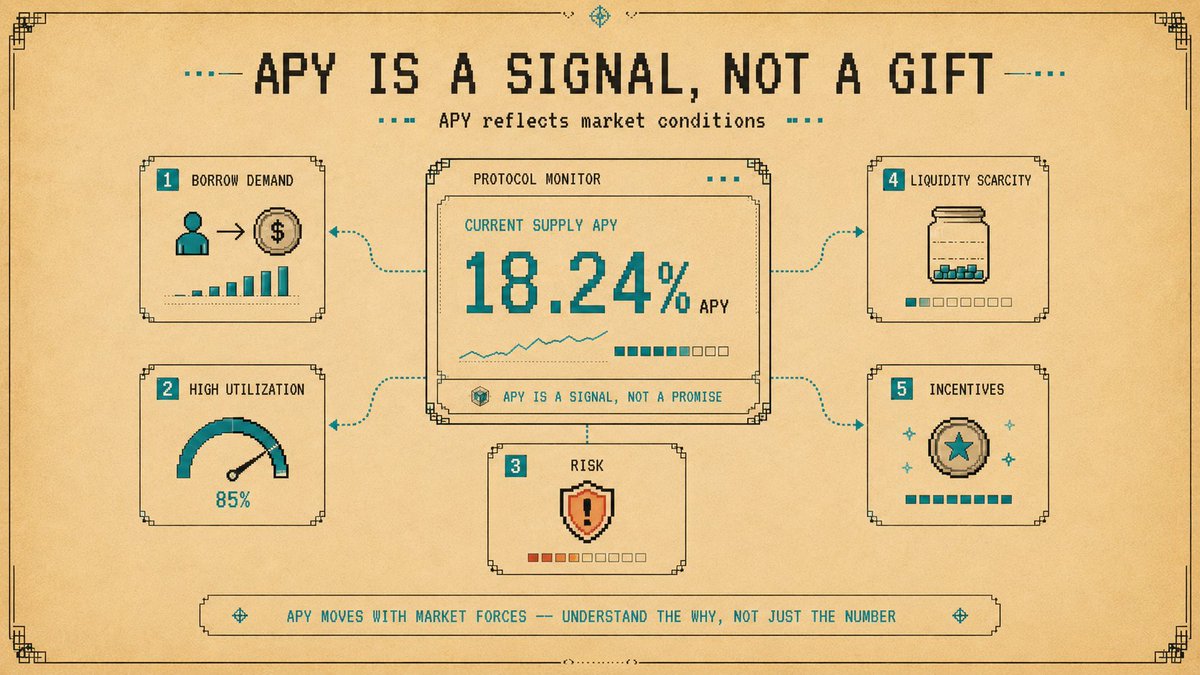
If the APY is low, maybe borrow demand is low.
If the APY is high, maybe demand is high, liquidity is scarce, the asset is risky, or incentives are temporarily boosting the number.
High yield is not always a gift.
Very often, it is a signal.
What Is Utilization?
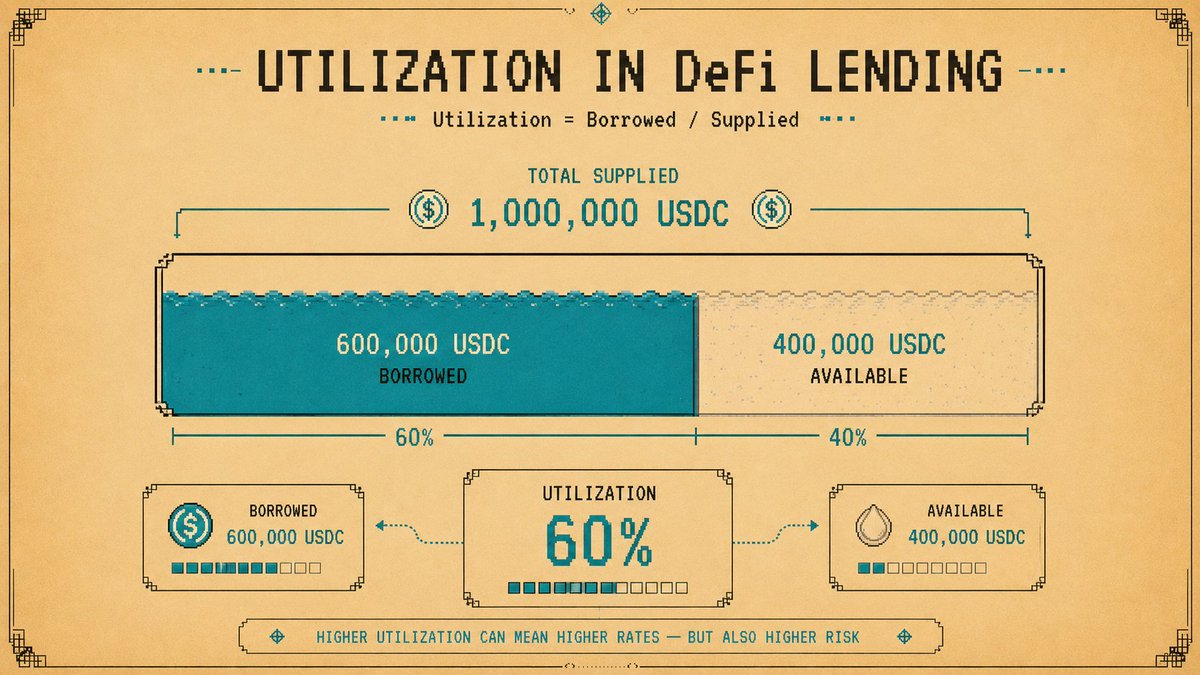
Utilization shows how much of the supplied capital is currently being borrowed.
It is one of the most important numbers in DeFi lending.
Choose an option to begin.
Simple example:
A lending market has 1,000,000 USDC supplied.
Borrowers have borrowed 600,000 USDC.
Utilization is 60%.
That means 60% of the available USDC is currently being used by borrowers.
The remaining 40% is still available liquidity.
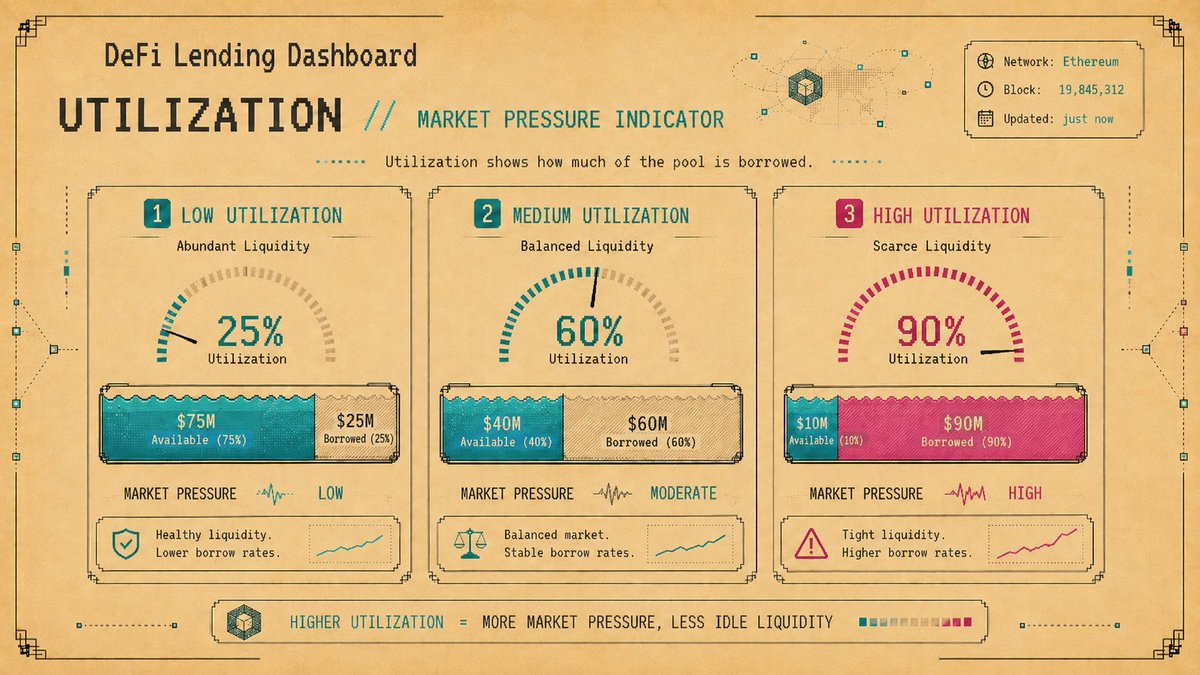
The beginner mental model is simple:
Low utilization means liquidity is abundant.
High utilization means liquidity is getting scarce.
This matters because interest rates are usually designed to react to utilization.
When utilization changes, rates can change.
Why Utilization Affects Interest Rates
Imagine a market where a lot of USDC is supplied, but only a small amount is borrowed.
Capital is abundant.
Borrowers are not competing aggressively for it.
In that environment, the borrow rate is usually lower.
Now imagine the opposite.
A lot of users want to borrow USDC, and most of the supplied USDC is already being used.
Available liquidity is shrinking.
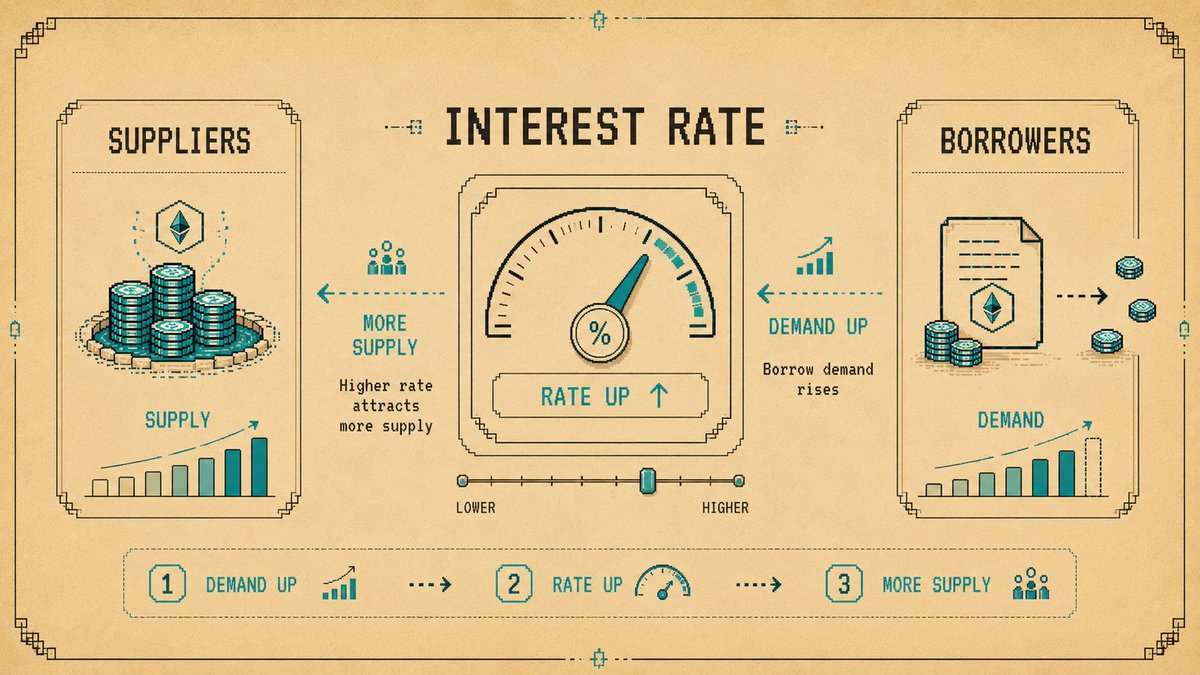
In that environment, the protocol usually increases the borrow rate.
Why?
Because higher rates do two things.
First, they make borrowing more expensive, which can reduce demand.
Second, they make supplying more attractive, which can bring more liquidity into the market.
This is the balancing mechanism.
Interest rates are not random decoration on the interface.
They are part of how the market balances supply and demand.
Interest Rate Is the Price of Liquidity
This is the core idea of the article.
In DeFi lending, interest rate is the price of liquidity.
If liquidity is easy to access, the price is usually lower.
If liquidity becomes scarce, the price usually rises.
That is why utilization matters so much.
Utilization tells you how much pressure exists inside a lending market.
A market with low utilization is relaxed.
A market with high utilization is tight.
A market with extremely high utilization can become fragile.
This is true for both sides.
Borrowers may face higher costs.
Suppliers may earn more, but they may also face liquidity risk if too much of the market is borrowed.
So utilization is not just a technical metric.
It is a health signal for the lending market.
Interest Rate Curves
Most DeFi lending protocols do not manually choose a new interest rate every minute.
Instead, they use an interest rate model.
A simple way to think about it:
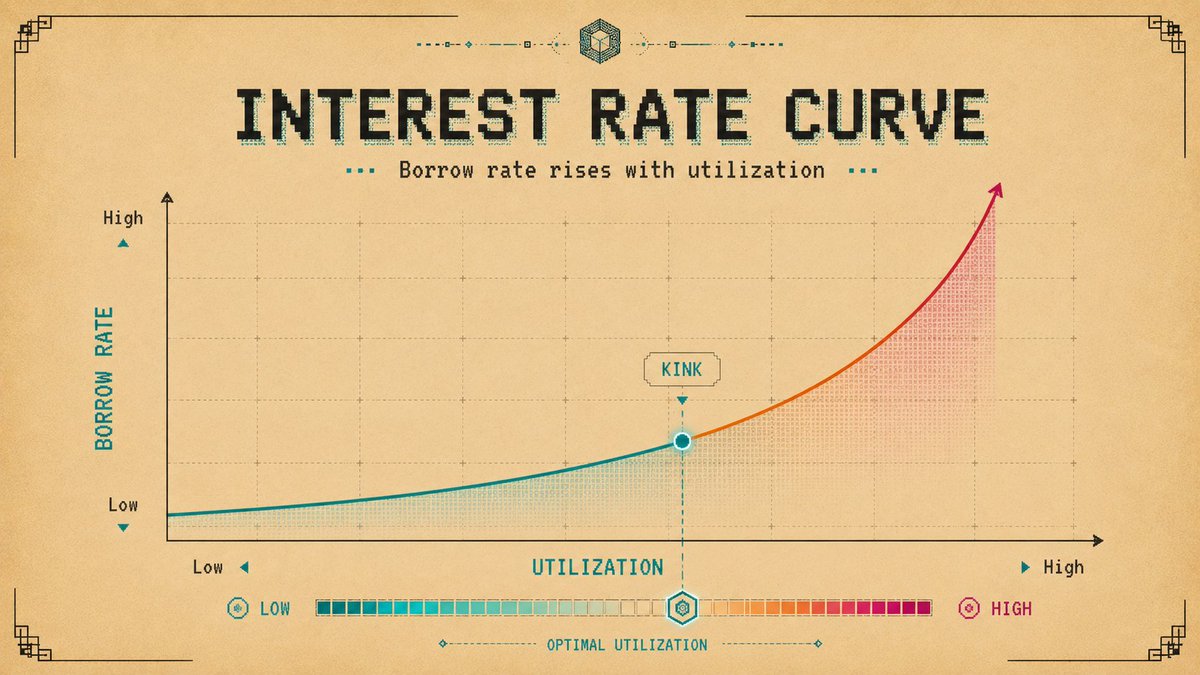
The protocol has a curve that reacts to utilization.
When utilization is low, the borrow rate is low.
As utilization rises, the borrow rate rises.
But the increase is usually not always smooth forever.
Many lending models have an important point where the rate starts increasing much faster.
This point is often called the optimal utilization point or the kink.
You do not need to memorize the technical formula.
The beginner version is enough:
The protocol is comfortable with a certain amount of borrowed liquidity.
But if too much liquidity gets borrowed, the protocol raises rates aggressively to protect the market.
Why?
Because if almost everything is borrowed, there may not be enough liquidity left for suppliers who want to withdraw.
So the curve pushes the market back toward balance.
Supply Rate vs Borrow Rate
Beginners often assume that if borrowers pay 10%, suppliers earn 10%.
That is not usually how it works.
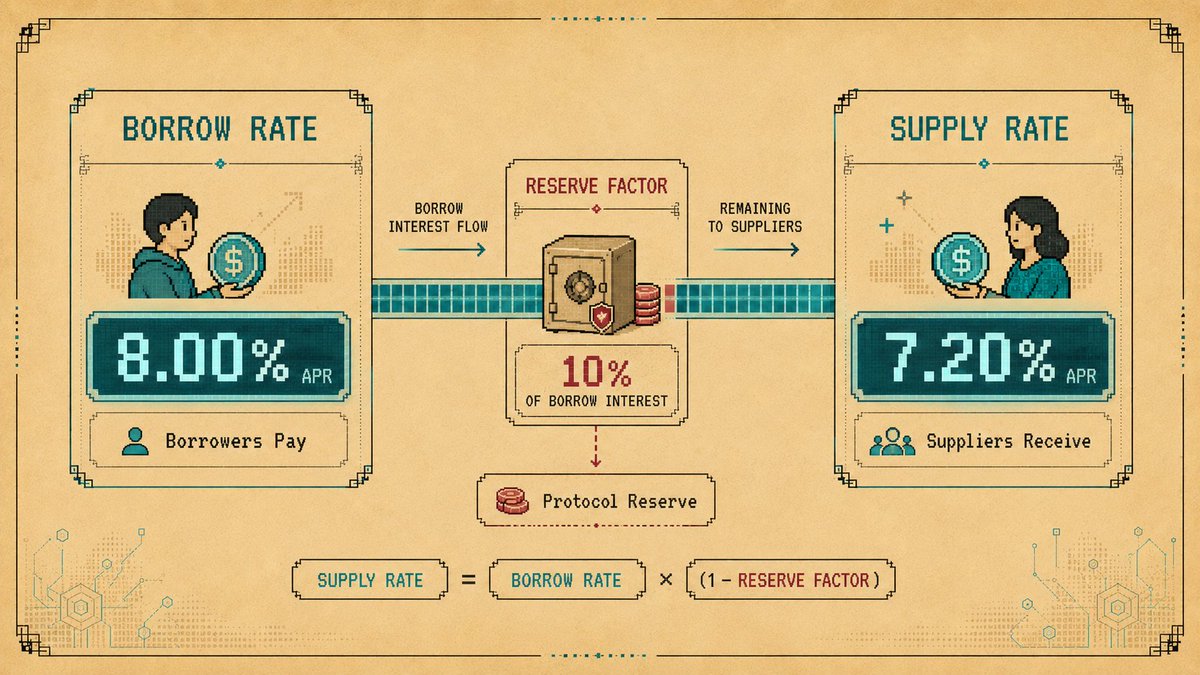
The borrow rate and the supply rate are related, but they are not the same.
Borrow rate is what borrowers pay.
Supply rate is what suppliers earn.
The supply rate is usually lower than the borrow rate.
Why?
Because not all supplied capital is borrowed at the same time.
If only 50% of the supplied capital is being used, then the interest paid by borrowers is spread across the supplier side according to the protocol’s mechanics.
Also, the protocol may take a portion as a reserve factor.
So the supplier does not simply receive the full borrow rate.
A useful mental model:
Supplier yield depends on borrow demand, utilization, protocol fees, and sometimes incentives.
This is why you should not look at supply APY in isolation.
You need to ask what is creating it.
Variable Rates
Many DeFi lending markets use variable interest rates.
That means the rate can change after you open your position.
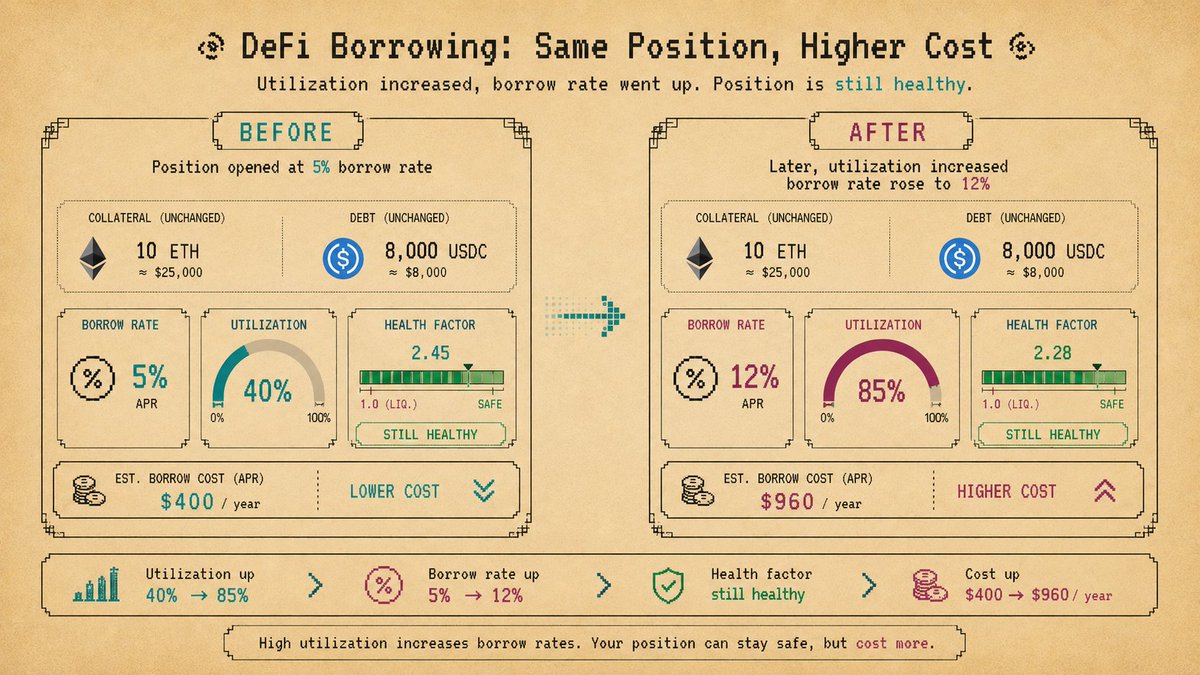
You might borrow at 5% today.
But if utilization rises, the borrow rate may later move to 12%, 20%, or even higher in extreme conditions.
This matters because your strategy may be built around the original rate.
If the cost of debt rises, the same position can become much less attractive.
You may not be liquidated.
Your Health Factor may still look fine.
But the debt may become expensive enough that the position no longer makes sense.
This is interest rate risk.
Interest Rate Risk
Interest rate risk means the cost of your debt can change in a way that hurts your position.
Example:
You borrow USDC at a 4% rate.
You use that borrowed USDC in another strategy that you expect to earn 9%.
At first, the difference looks attractive.
You are paying 4% and expecting 9%.
But then borrow demand rises.
Utilization increases.
Your borrow rate moves from 4% to 14%.
Now the position is different.
You are no longer paying 4% to earn 9%.
You may be paying more than the strategy earns.
You were not liquidated.
But the economics changed.
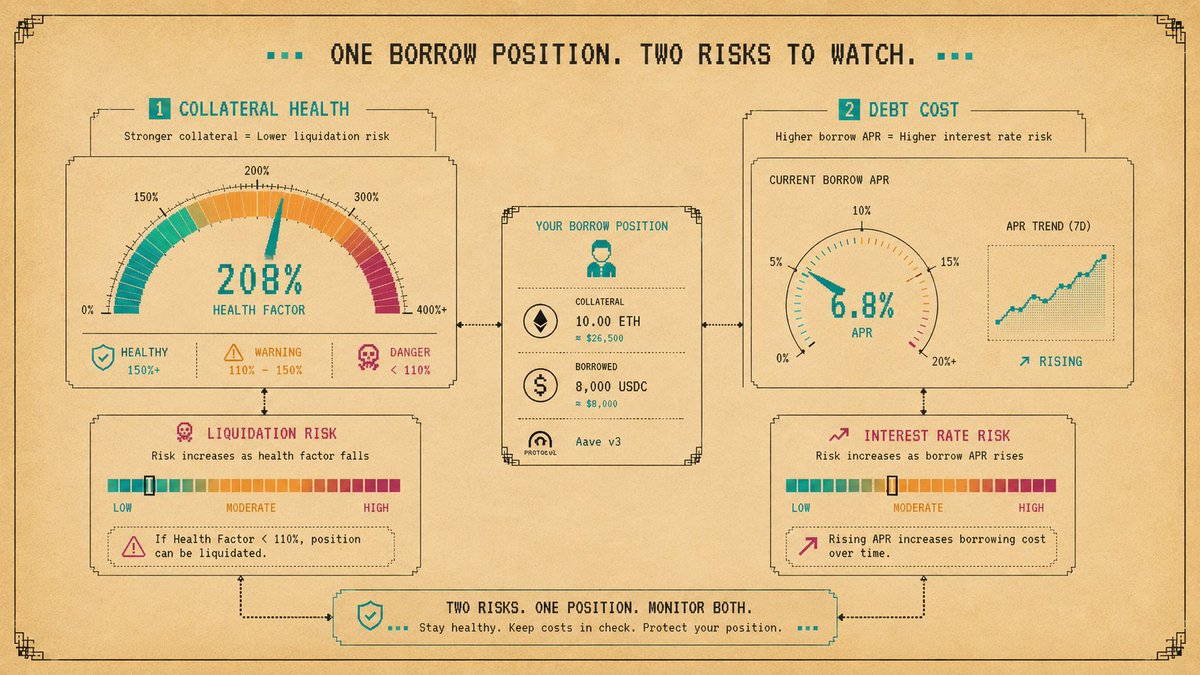
This is why a borrow position needs monitoring even when the collateral side looks healthy.
Liquidation risk comes from collateral and debt values.
Interest rate risk comes from the changing cost of debt.
Both matter.
Why High Supply APY Exists
When beginners see high supply APY, they often think:
“Great opportunity.”
Sometimes it might be.
But the better first reaction is:
“Why is this yield high?”
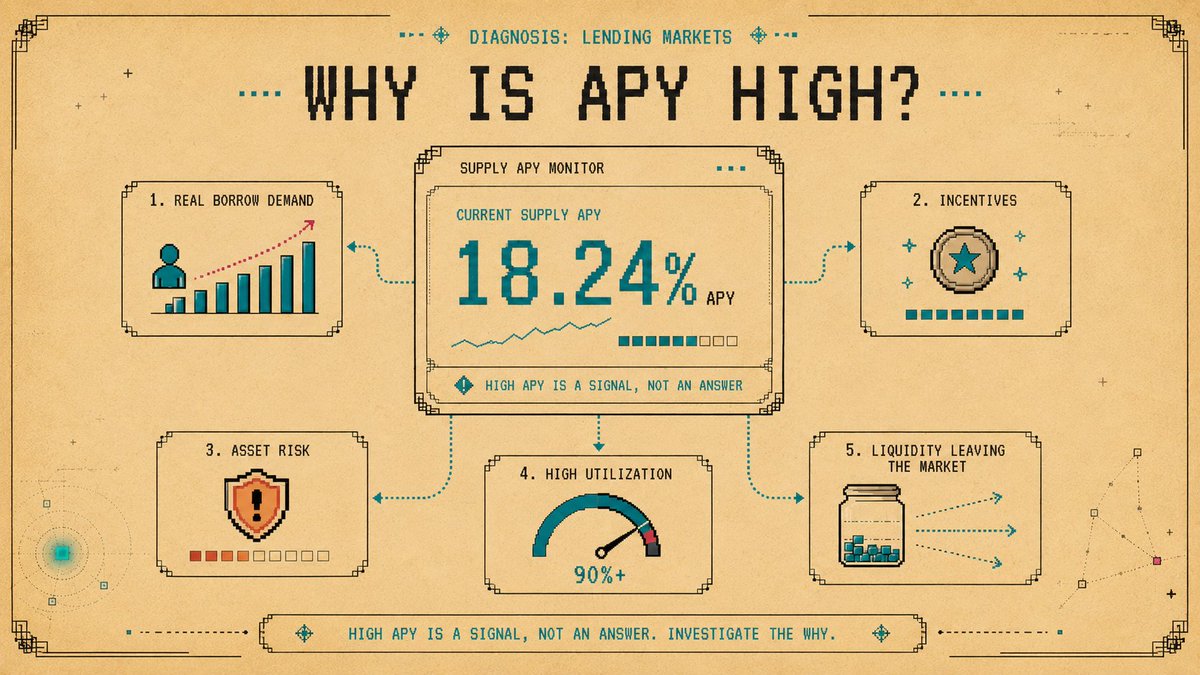
High supply APY can exist for several reasons.
Borrow demand may be very strong.
Utilization may be high.
The asset may be risky.
Liquidity may have left the market.
The protocol may be giving extra token incentives.
The market may be temporarily imbalanced.
Each reason means something different.
If high APY comes from real borrow demand, that is one thing.
If it comes from temporary incentives, that is another.
If it comes from panic, low liquidity, or asset risk, that is something else entirely.
So high yield should not be read as free money.
It should be read as information.
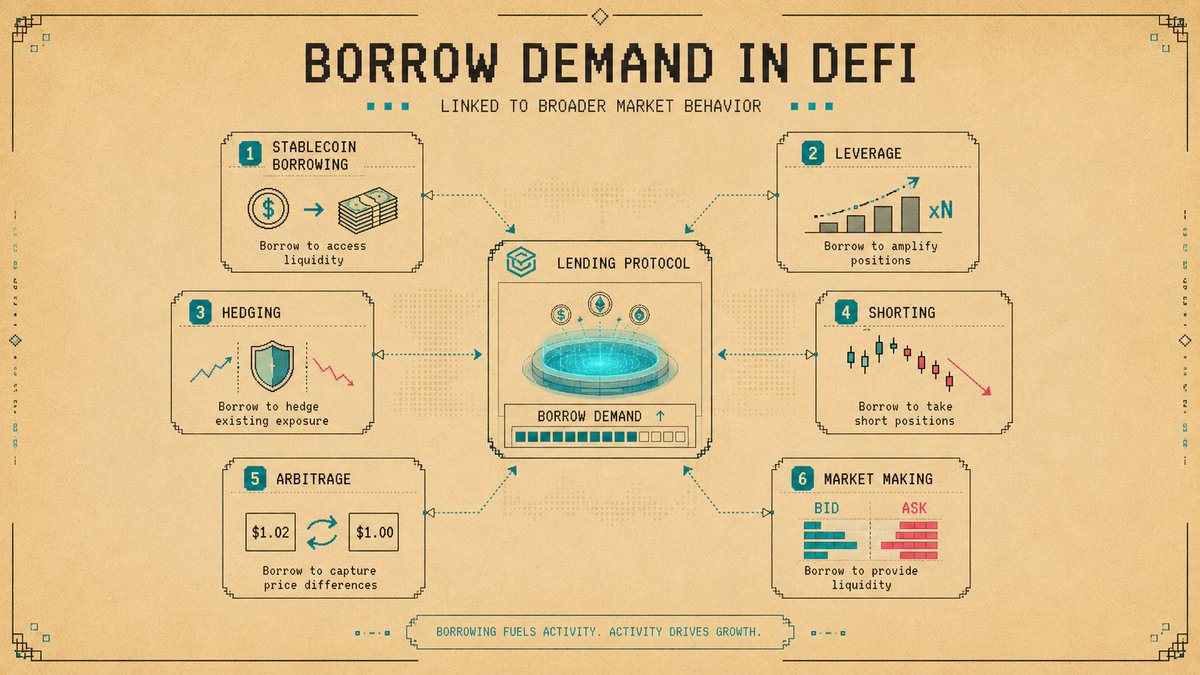
Why Borrow Demand Increases
To understand interest rates, you also need to understand why people borrow.
Borrow demand is not random.
Users may borrow stablecoins because they want liquidity without selling their main asset.
They may borrow stablecoins to increase exposure elsewhere.
They may borrow to enter another strategy.
They may borrow because they expect the return on another opportunity to be higher than the borrow cost.
Volatile assets can also be borrowed.
A user might borrow ETH to hedge.
A trader might borrow an asset to short it.
A market maker might borrow assets for liquidity or arbitrage.
So when demand to borrow an asset rises, it usually reflects something happening in the broader market.
That is why rates can change quickly.
Lending markets are not isolated.
They react to market behavior.
Liquidity Crunch
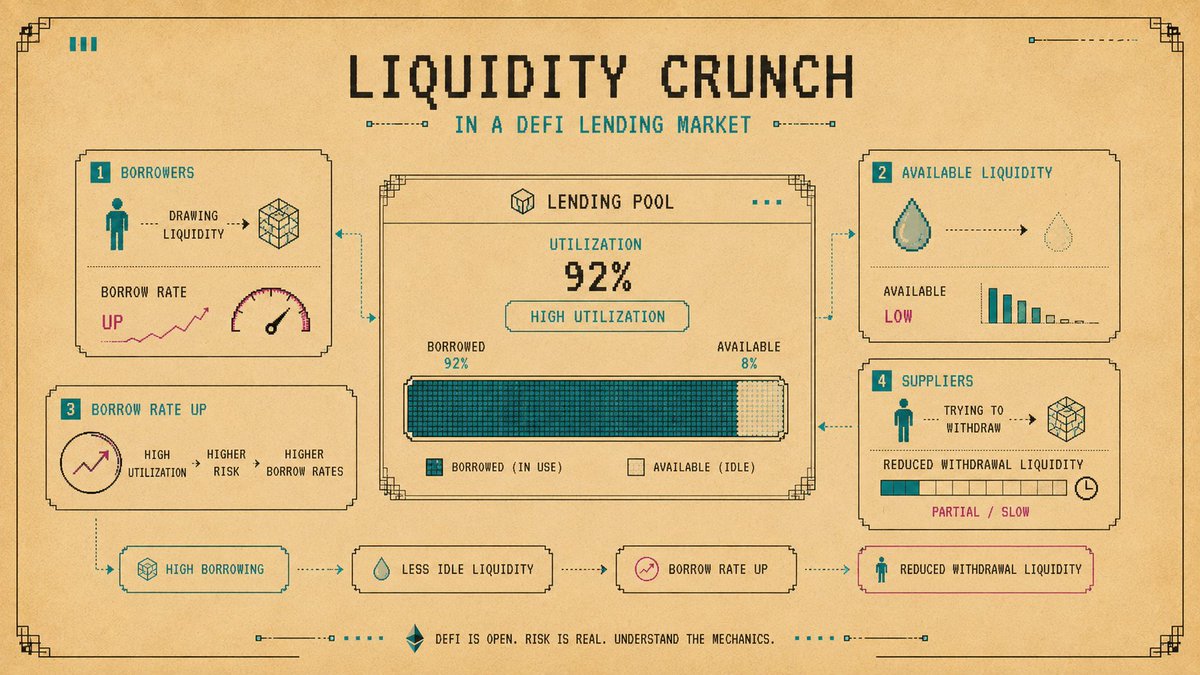
High utilization can create a liquidity crunch.
A liquidity crunch means too much of the available capital is being used, and the market has less free liquidity left.
For borrowers, this can mean rising interest rates.
For suppliers, it can mean something else:
They may not be able to withdraw as easily if most of the liquidity is currently borrowed.
This is an important beginner lesson.
Supplying to a lending protocol is not the same as putting money in a simple savings account.
You are supplying liquidity to a market.
If that liquidity is heavily used, the market may become tighter.
This does not always mean something is broken.
But it does mean you should understand what utilization is showing you.
When utilization is very high, both sides should pay attention.
Borrowers should watch the rate.
Suppliers should watch available liquidity.
Incentives vs Real Borrow Demand
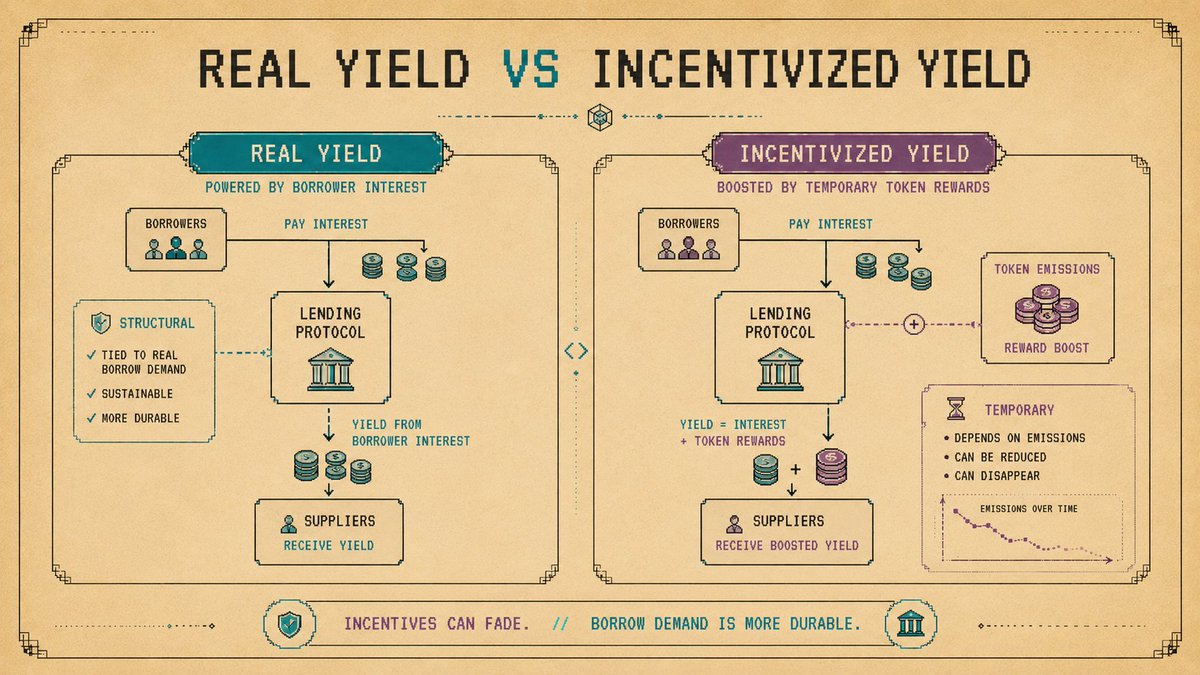
Not all APY comes from the same source.
Some yield comes from real borrowing activity.
Borrowers pay interest, and suppliers earn part of that interest.
But some yield may come from incentives.
A protocol may distribute extra tokens to suppliers or borrowers to attract liquidity.
This can make APY look much higher than the base lending market would naturally produce.
Example:
The real supply yield might be 3%.
But with token incentives, the interface may show 15%.
That does not automatically make it bad.
But it changes the question.
You should ask:
- Is this yield coming from real borrow demand?
- Or is it being subsidized by token rewards?
- If rewards stop, what does the APY look like?
This distinction matters because incentives can disappear.
Real borrow demand is usually more meaningful than temporary rewards.
What Borrowers Should Track
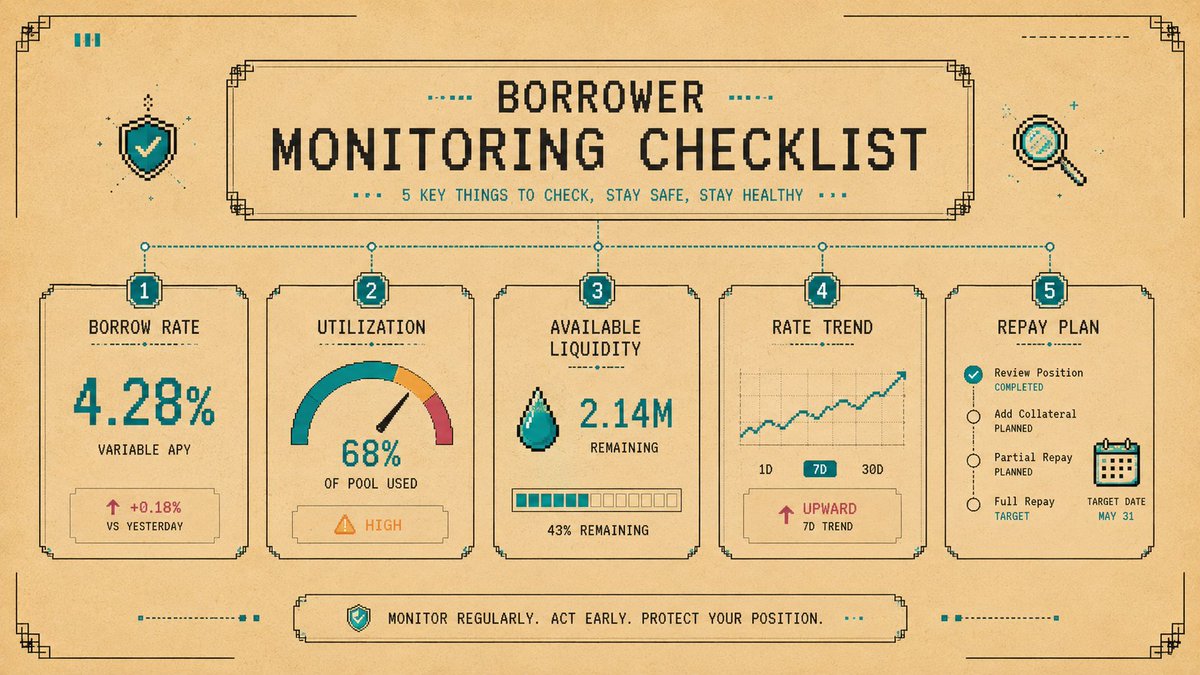
If you borrow from a DeFi lending protocol, you should not only track Health Factor.
You should also track the cost of debt.
Useful questions:
- What is the current borrow rate?
- Is the rate variable?
- What is the current utilization?
- Has utilization been rising recently?
- Why is borrow demand increasing?
- Is there enough available liquidity?
- What happens if the borrow rate doubles?
- At what rate does this position stop making sense?
- When will I repay?
These questions sound boring.
But debt is boring until it becomes expensive.
And in DeFi, that can happen faster than beginners expect.
Common Beginner Mistakes
The first mistake is looking only at APY.
A high supply APY or low borrow APY means nothing unless you understand why it exists.
The second mistake is assuming the borrow rate will stay the same.
Variable rates can move.
The third mistake is ignoring utilization.
Utilization is one of the clearest signals of pressure inside a lending market.
The fourth mistake is confusing incentives with real yield.
Token rewards can make a market look more attractive than it really is.
The fifth mistake is borrowing for a long period without checking the rate.
A position can remain safe from liquidation but become economically bad.
The sixth mistake is not planning for rate spikes.
If your strategy only works when the borrow rate stays low, the strategy is fragile.
The seventh mistake is thinking suppliers have no risk.
Suppliers also need to understand utilization, available liquidity, asset risk, and protocol risk.
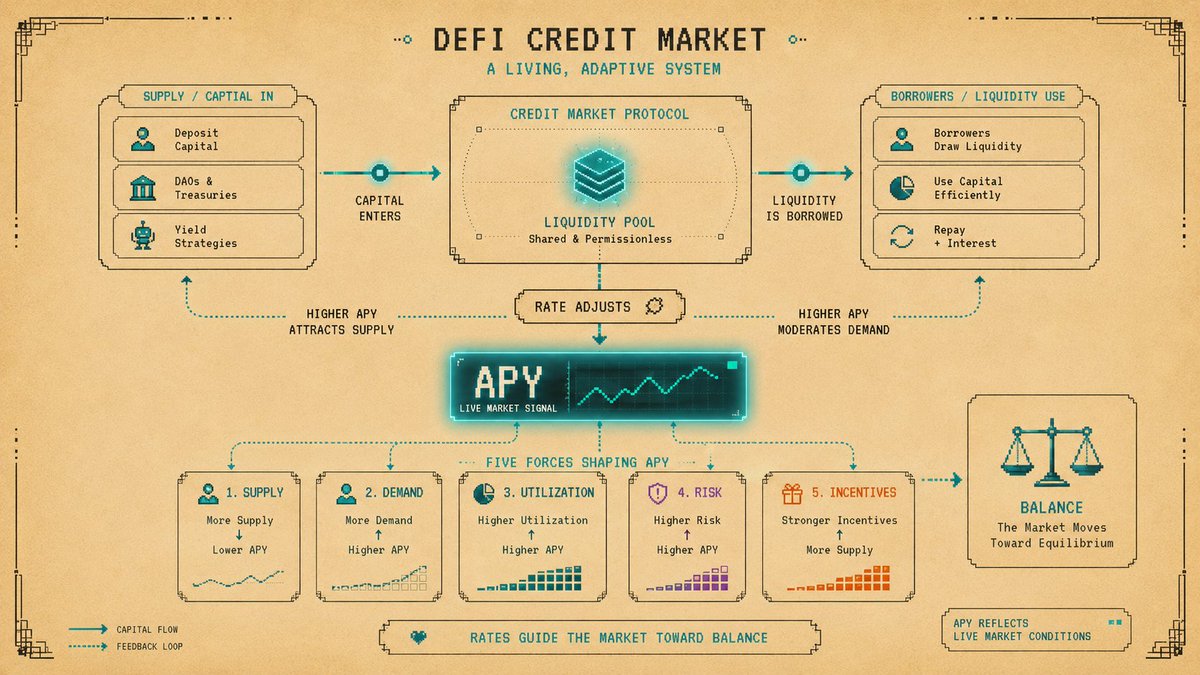
The Correct Mental Model
A lending market is not a static pool of money.
It is a live credit market.
Capital enters.
Capital gets borrowed.
Rates adjust.
Liquidity becomes abundant or scarce.
Suppliers react.
Borrowers react.
The protocol uses interest rates to keep the market balanced.
So the correct mental model is not:
“This protocol gives me 8% APY.”
The better mental model is:
“This market currently pays 8% because of the relationship between supply, demand, utilization, risk, and incentives.”
That is a completely different way to read DeFi.
You stop seeing APY as a reward.
You start seeing it as a signal.
Core Insight
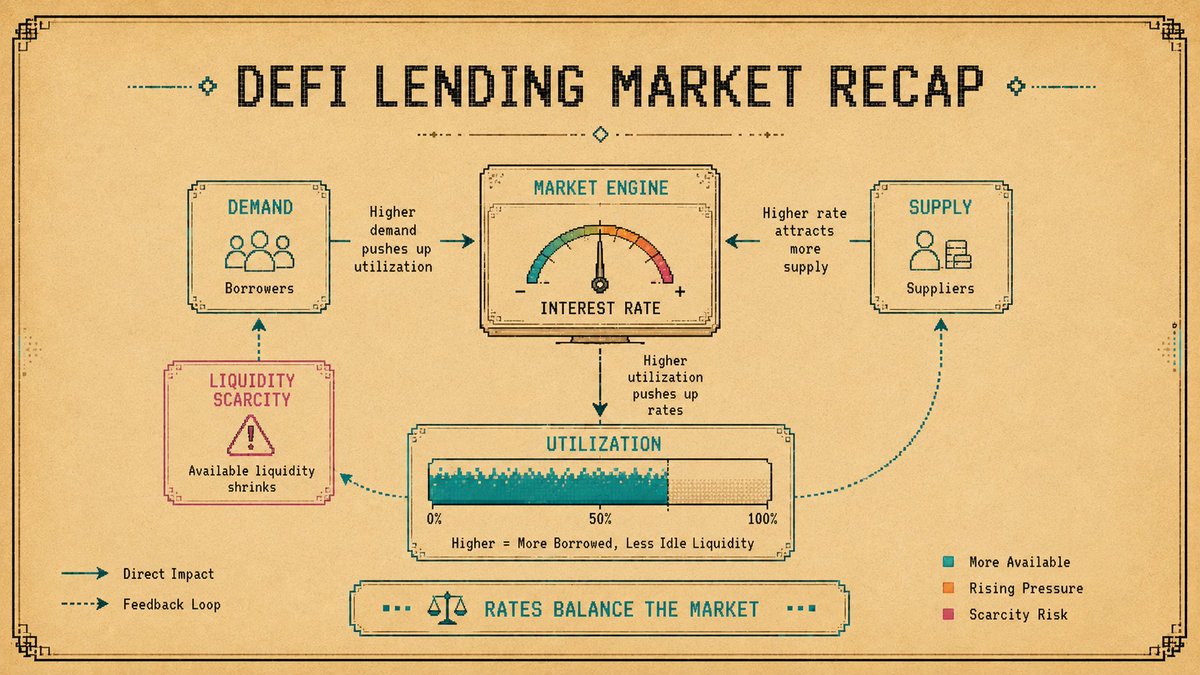
Interest rate is not decoration.
It is the price of liquidity.
Utilization tells you how scarce that liquidity is.
When liquidity is abundant, borrowing is usually cheaper.
When liquidity becomes scarce, borrowing becomes more expensive.
For suppliers, higher rates can mean more yield.
For borrowers, higher rates mean more cost.
For the protocol, rates are a balancing mechanism.
Once you understand this, lending dashboards start to look different.
APY is no longer just a number.
It is a story about supply, demand, risk, and liquidity.
One Minute Summary For Lazies
Interest is the cost borrowers pay to use capital. For suppliers, it becomes a source of yield. In DeFi lending, rates are usually driven by utilization, which shows how much of the supplied capital is currently borrowed. Low utilization means liquidity is abundant. High utilization means liquidity is becoming scarce.
As utilization rises, borrow rates usually rise too. This helps balance the market by making borrowing more expensive and attracting more supply. But it also creates interest rate risk. A borrow position can become more expensive over time even if it is not close to liquidation.
High APY is not automatically good. It can come from real borrow demand, high utilization, asset risk, liquidity shortages, or temporary token incentives. The right question is not only “what is the APY?” The better question is “why does this APY exist?”
Can you explain the model?
Does supply yield come from nowhere?
No. It primarily comes from borrower interest, adjusted by utilization, reserves and incentives.
Why can a variable borrow rate rise suddenly?
Utilization can cross a steeper region of the protocol’s interest-rate curve.
What’s Next?
Now we understand two major parts of borrowing.
In the previous article, we learned the collateral side:
LTV, Health Factor, and liquidation risk.
In this article, we learned the cost side:
Interest rates, utilization, and the price of liquidity.
The next step is where these two worlds meet.
That leads us to leverage loops.
A leverage loop uses lending markets to repeatedly supply, borrow, and supply again.
It can increase exposure and yield.
But it also combines liquidation risk with interest rate risk.
Originally published on X · 2026-05-25
 Post on X
 Telegram