Last Monday, we had a pretty clear idea of what to watch in crypto: the Fed, PCE, earnings, and a major options expiry. Then Binance happened.
Roughly $6.3 billion was stolen in what became the largest crypto hack on record. And suddenly, everything we had been watching felt a little less important.
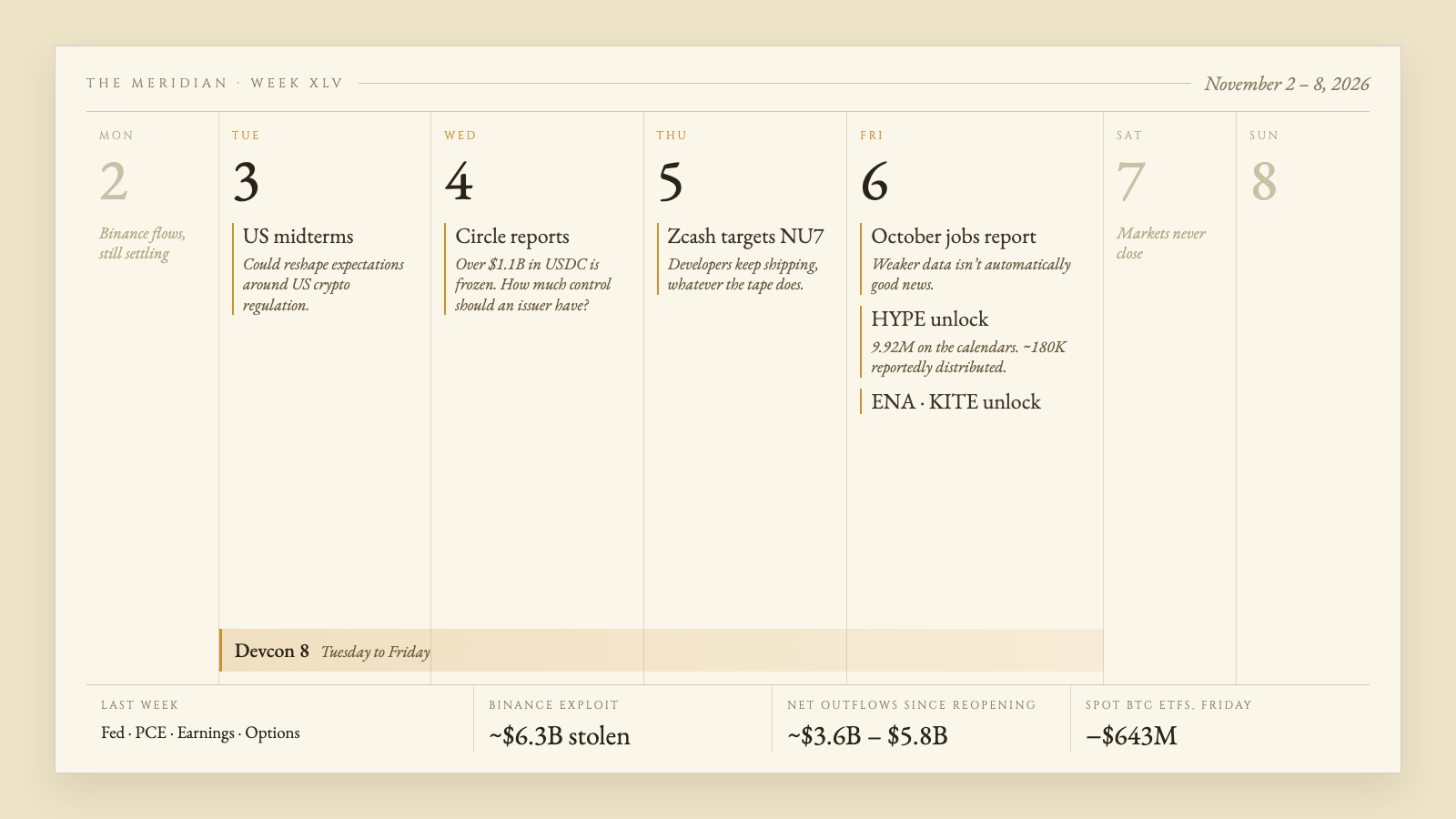
That's something I've been thinking about as we enter another packed week. November 2–8 brings the US midterm elections on Tuesday, the October jobs report on Friday, Circle's earnings, Devcon 8, and several major token unlocks.
Plenty of catalysts. But I'm more interested in how the market reacts to them than in the events themselves.
After Binance
Take Binance, for example. According to DefiLlama, roughly $5.8B in net outflows followed the reopening of withdrawals. Other trackers put it closer to $3.6B. Meanwhile, spot Bitcoin ETFs recorded around $643M in outflows on Friday, the biggest daily outflow since June.
The question I'm asking isn't whether Binance can replace the stolen funds. It's whether confidence returns at the same speed.
Liquidity can come back relatively quickly. Trust usually takes longer.
Friday: 9.92M, or 180K?
Then there's the token unlock situation. $ENA, $KITE, and several others have new supply scheduled this week. But $HYPE is the one I find particularly interesting.
Unlock calendars show roughly 9.92M HYPE unlocking on November 6, worth somewhere between $870M and $925M depending on the tracker. Sounds terrifying, right? Except the team has reportedly committed to distributing closer to 180K tokens.
That's exactly why I don't like treating unlock dashboards as automatic sell-pressure indicators.
The number everyone shares and the number that actually reaches the market can tell very different stories.
Circle, and the freeze question
Circle's earnings on Wednesday might be even more interesting. We've spent years talking about stablecoins as the foundation of DeFi.
But Circle says it has now frozen more than $1.1B in USDC tied to the Binance exploit, and I think there's a more important conversation to have.
How much control should a stablecoin issuer have? And how do we balance that control with the security people expect from financial infrastructure?
I'm curious whether Circle addresses this alongside its usual revenue and growth metrics.
Macro still matters
Tuesday's elections could reshape expectations around US crypto regulation. Friday's employment report could shift the market's expectations for the Fed's next move.
And weaker economic data isn't automatically good news for risk assets, even when traders start hoping for easier monetary policy.
Devcon 8 runs from Tuesday to Friday in Mumbai, and Zcash is targeting its NU7 upgrade on Thursday.
I actually like that contrast. While traders are busy reacting to liquidity, politics, and short-term supply, developers are still working on infrastructure that might matter years from now.
That's the strange thing about crypto. The market can spend an entire week worrying about what happens tomorrow while the technology keeps moving toward something much further away.
So I'm entering this week with a fairly simple mindset.
Last week reminded me that the biggest risks rarely announce themselves in advance. Maybe the more useful skill is learning to recognize what changes after they arrive.
Sources
Reporting on the exploit is still developing, and trackers disagree. Where they do, both figures are shown.
- Binance outflows: DefiLlama, Binance CEX transparency; CNBC, $3.64B in net outflows.
- Spot Bitcoin ETFs: CoinDesk, $643M out on Friday.
- USDC frozen: American Banker, the stablecoin freeze dilemma.
- HYPE unlock: Tokenomist, 9,916,667 HYPE on November 6; COINOTAG, 180,000 HYPE.
- Devcon 8: Ethereum Foundation, Devcon Mumbai.
 Post on X
 Telegram