
The pair you choose defines the risk you accept.
Compare volatile, mixed and stable pools through correlation, fee opportunity and downside behavior.
In previous articles, we clarified a few key ideas:
- A liquidity pool is not a vault, it is a pricing engine
- Being an LP is not the same as holding tokens, you are constantly exposed to rebalancing
- Impermanent loss is not a bug, it is a natural outcome of the system
Now we go one step further.
The question is no longer:
“What is LP?”
The real question is:
“When should you be an LP, and in which pool?”

Lesson mapNavigate this lessonExplore all 18 sections
See the model before the details.
Use the flow, the pool-type explorer and the comparison table as a map while you read.
- 01Choose pair
- 02Assess correlation
- 03Estimate organic volume
- 04Review incentives
- 05Size and monitor
Adjust the controls to begin.
| Pool type | Typical behavior | Main risk |
|---|---|---|
| Volatile / volatile | High movement and fee opportunity | Divergence and token-specific risk |
| Volatile / stable | Directional exposure with stable side | Rebalancing into the falling asset |
| Stable / stable | Lower expected divergence | Depeg and issuer risk |
| Correlated assets | Tighter relative movement | Correlation can break under stress |
Why This Topic Matters
Being an LP is not one single thing.
Different pool types create completely different risk profiles.
With the same capital, you can:
- earn relatively stable returns
- or experience significant opportunity cost
The difference comes from:
- the pair you choose
- the market conditions
LP is a strategy.
Overview of LP Strategies
First, a quick clarification:
What does volatile mean?
An asset that moves fast and aggressively in price.
Examples:
- ETH
- BTC
- SOL
- most altcoins
What does stable mean?
An asset expected to stay close to a fixed value, usually around 1 USD.
Examples:
- USDC
- USDT
- DAI
- EURC
This distinction matters because:
Risk in LP comes from price movement.
There are three main categories:
- Volatile / Volatile
- Volatile / Stable
- Stable / Stable
Each one is a different game.
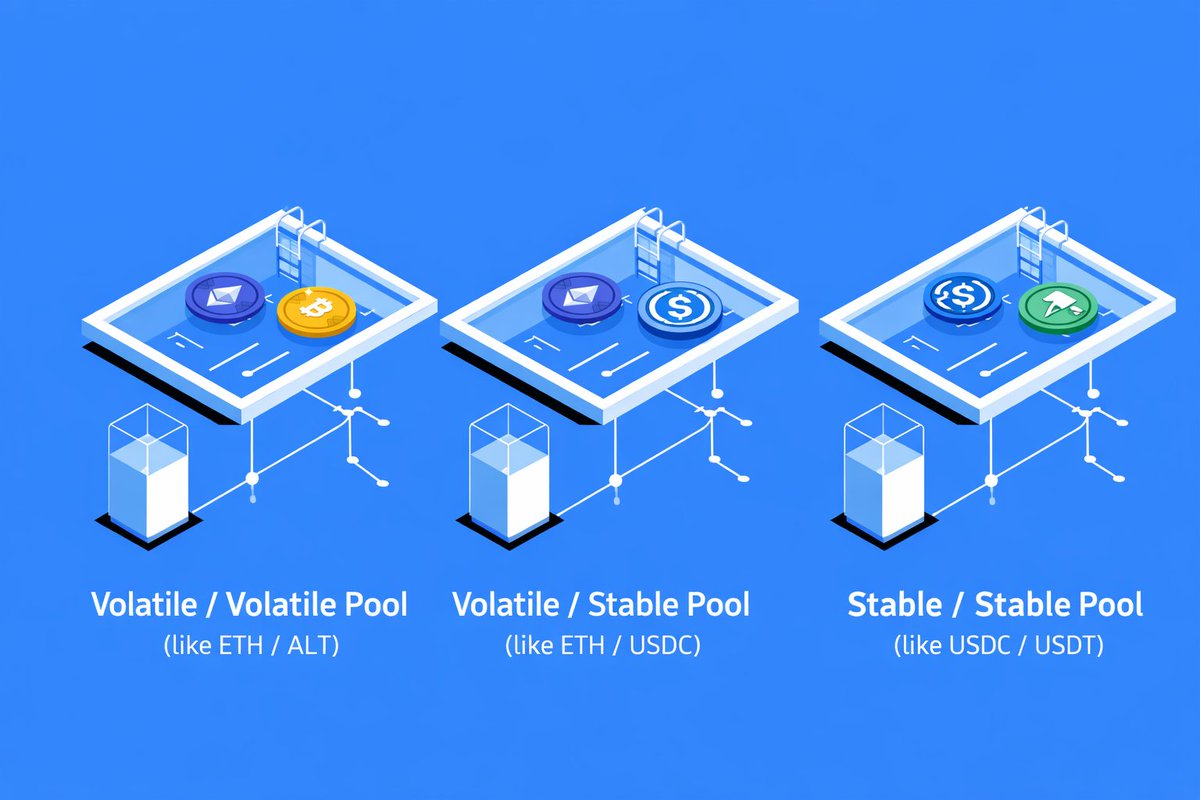
1. Volatile / Volatile Pool (like ETH / ALT)
In this type of pool, both sides are volatile, which means you are taking risk on both sides. As prices diverge, the system continuously rebalances, and this increases impermanent loss. So it is not just about whether price goes up or down, but how the two assets move relative to each other.
This structure works best in sideways markets.
Sideways market means:
A market where price moves within a range without a clear upward or downward trend. It goes up and down but stays within a band for a long time.
In these conditions, there is constant trading activity, which generates volume and fees for LPs. However, when a strong trend starts, the system sells the winning asset and accumulates the losing one, which creates significant opportunity cost.
Simple Scenarios (ETH / ALT)
- Both assets go up → IL occurs but is usually tolerable, you still profit but less than holding
Note: You might still be in profit. However, because LP continuously sells the rising asset, you earn less than if you had simply held the tokens.
- One asset goes up, the other goes down → worst case, IL grows rapidly and creates serious opportunity cost
- Both assets stay flat → best case, you earn fees with almost no downside
- One stays flat, the other moves → moderate IL, usually some opportunity cost
When does it make sense?
- Sideways markets
- High volume pairs
When does it not make sense?
- Strong directional trends
- Newly launched or highly volatile tokens
2. Volatile / Stable Pool (like ETH / USDC)
In this model, only one side is volatile, so the risk is more controlled. It resembles a partially hedged position. The system continuously does the following on your behalf: it sells the volatile asset when price rises and buys it back when price falls.
This makes the structure feel more balanced. However, there is a key trade-off. In strong upward trends, you do not capture the full upside because the system keeps reducing your exposure to the rising asset.
When does it make sense?
- Mild trends or choppy markets
- When you want to earn fees while controlling risk
When does it not make sense?
- Parabolic moves
- Large news-driven volatility
3. Stable / Stable Pool (like USDC / USDT)
In these pools, the goal is not price appreciation but fee generation from volume. Since the assets move closely together, impermanent loss is usually very low under normal conditions.
This is often seen as a more defensive strategy. However, it is not risk-free. Risks such as depeg events and centralized controls like freeze or blacklist still exist.
When does it make sense?
- Uncertain or volatile markets
- When you want to park capital
When does it not make sense?
- Strong bull markets due to opportunity cost
Key Comparison
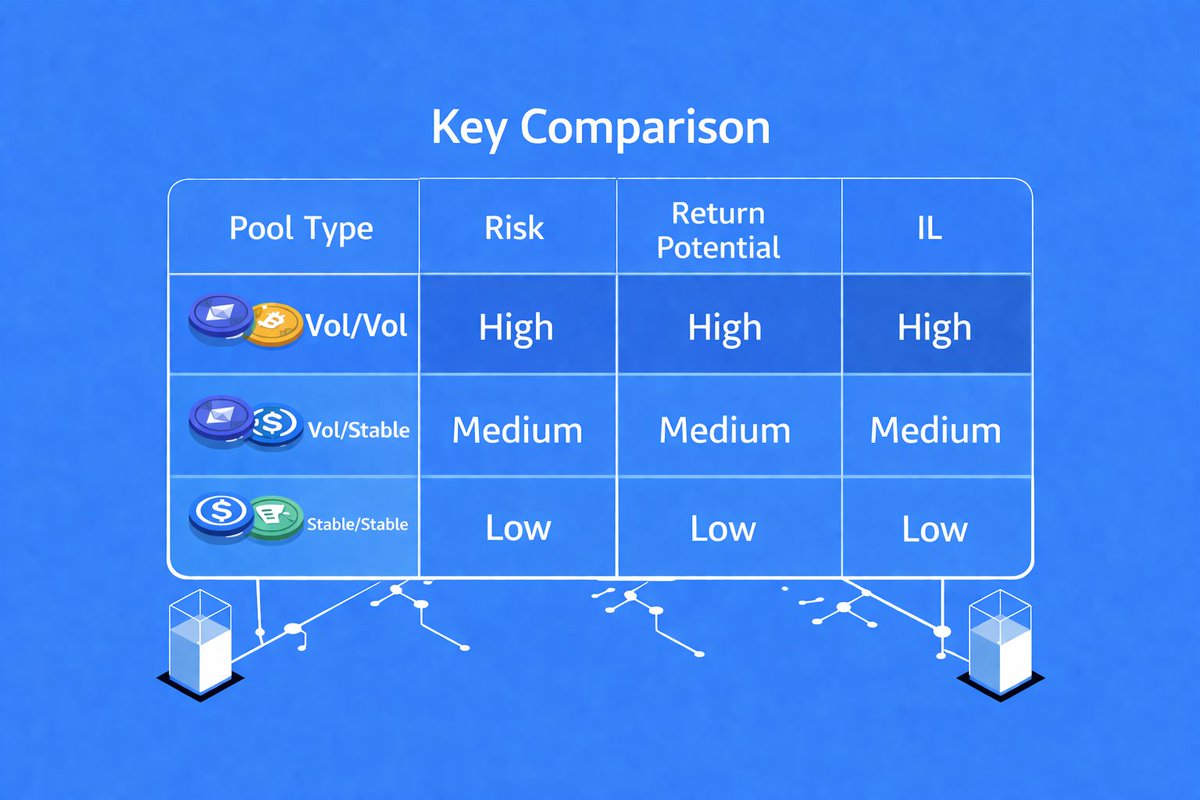
Important point:
High APY does not mean a good strategy.
Is Stable / Stable the safest?
At first glance, it seems so.
- Lower volatility
- Lower IL
- More stable returns
But this does not mean it is safe.
Things to watch:
- Depeg risk
- Centralized control
- Systemic risk such as issuer or reserves
So:
Stable / Stable means lower volatility, not zero risk.
The risk shifts from price movement to system design.
The Most Important Truth
LP is not a yield product.
LP is a market position.
Each pool type represents a different position.
Critical Concept: Correlation
Most beginners miss this.
One of the most important factors is:
Do the assets move together?
The real question is:
When one goes up, what does the other do?
Because the main driver of impermanent loss is:
Price divergence.
High Correlation
- ETH / stETH
- stable / stable
In this case:
- assets move in similar directions
- the price gap does not widen much
Result:
- lower IL
- more stable position
Think of it simply:
They move together, so the system does not need aggressive rebalancing.
Low Correlation
- ETH / random altcoin
In this case:
- one can rise while the other falls
- the price gap widens quickly
Result:
- higher IL
- aggressive rebalancing
Think of it simply:
One pumps, the other dumps, and the system keeps selling the winner and buying the loser.
Why This Matters
The real risk in LP is not price direction.
It is how prices move relative to each other.
For example:
- ETH going up alone is not a problem
- ETH going up while the other asset drops creates the real issue
Core Takeaway
Pair selection is risk selection.
More precisely:
Correlation determines the level of impermanent loss.
If assets move together:
- less rebalancing
- lower IL
- more stable returns
If they diverge:
- more aggressive rebalancing
- higher IL
- more opportunity cost
So the real question is not where price goes.
It is how assets move relative to each other.
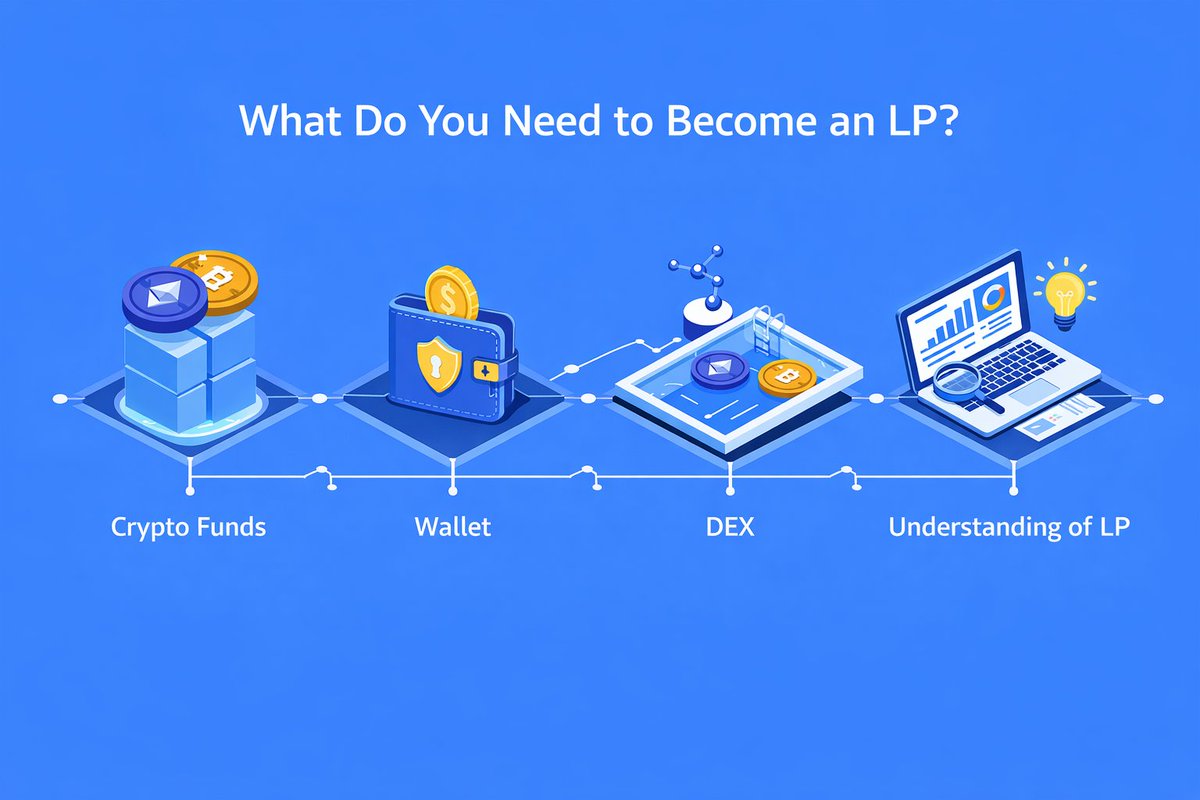
What Do You Need to Become an LP?
A common question:
I have 1 ETH and some USDC, can I be an LP?
Short answer:
Yes.
But the key detail is:
- Most pools require both assets in a specific ratio
- Usually close to 50/50 in value
So:
- If you only have ETH, you cannot LP directly
- If you have both ETH and USDC, you can
But the real question should be:
Not can I be an LP, but should I be an LP in this pair?
Entering is easy.
Choosing the right position is not.
How to Become an LP (Practical Steps)
Choose an option to begin.
Choose the network and DEX
- Ethereum, Arbitrum, Base
- Platforms like Uniswap, Curve, Balancer
Connect your wallet
- Use a non-custodial wallet
Prepare your tokens
- Match the pool requirements
- Usually a 50/50 value split
Approve tokens
- Allow the contract to use your tokens
- Always check what you are approving
Add liquidity
- Enter amounts
- Review your share and ratios
- Confirm the transaction
Monitor your position
- Pool share
- Fees earned
- Asset distribution
- Exit or rebalance if needed
Tools You Can Use
- DEX interfaces: Uniswap, Curve, Balancer...
- Aggregators: 1inch, Matcha...
- Analytics: DefiLlama, Dune, Dexscreener
Note:
The interface is just an entry point.
The actual transaction happens on the smart contract.
Using the wrong interface can be risky.
Can You Do LP on a CEX?
Yes, some centralized exchanges offer LP-like products.
Examples:
- Liquidity mining
- Earn or dual investment
- AMM pools on certain platforms
But the key difference is:
In DeFi, you provide the liquidity.
In a CEX, the exchange manages it on your behalf.
So:
In DeFi, you are part of the system.
In a CEX, you are using a product.
This means:
- You do not have custody
- Transparency is lower
- There is additional exchange risk
CEX LP is easier to use, but it is not the same as DeFi LP.
Security Notes
- Always verify the contract and the pool
- Double check URLs
- Avoid unlimited approvals when possible
LP is easy to do technically.
Doing it safely requires discipline.
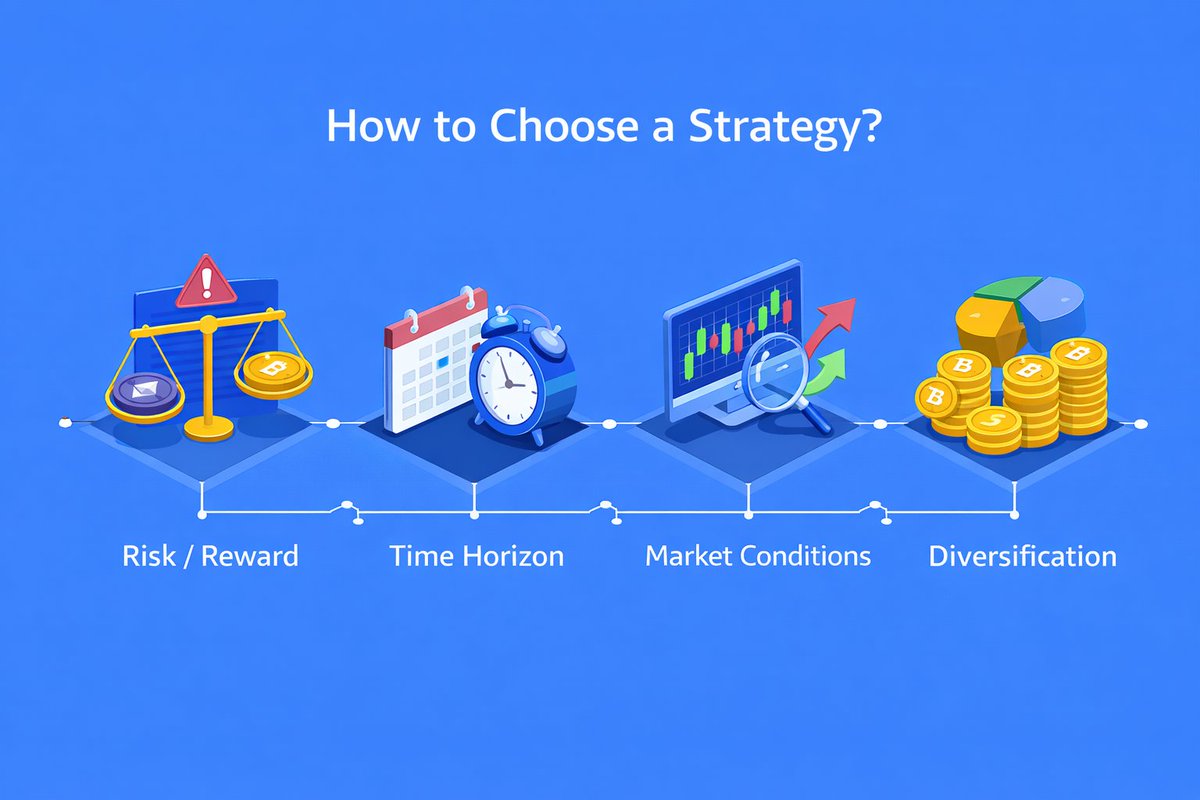
How to Choose a Strategy
Ask yourself:
- Is the market trending or sideways?
- Is volatility high or low?
- Is there sufficient volume?
- Would I hold these assets anyway?
If you cannot answer these:
You should not be LPing.
Common Mistakes
In short:
APY alone is not enough.
You must evaluate token, market, and mechanism together.
Core Insight
Success in LP is not about choosing a pool.
It is about choosing a position.
When you enter a pool, you are choosing:
- your exposure
- your rebalancing behavior
- your performance across different scenarios
You are not just providing liquidity.
You are entering a market behavior.
Examples:
- Vol/Vol means higher fee potential with higher IL risk
- Vol/Stable means more balanced but limited upside
- Stable/Stable means low volatility but different systemic risks
So:
LP is not which pool you enter.
It is which behavior you accept.
The right question is:
In which scenario does this position perform well?
If you cannot answer that:
You do not fully understand your position.
And in DeFi, that usually costs money.
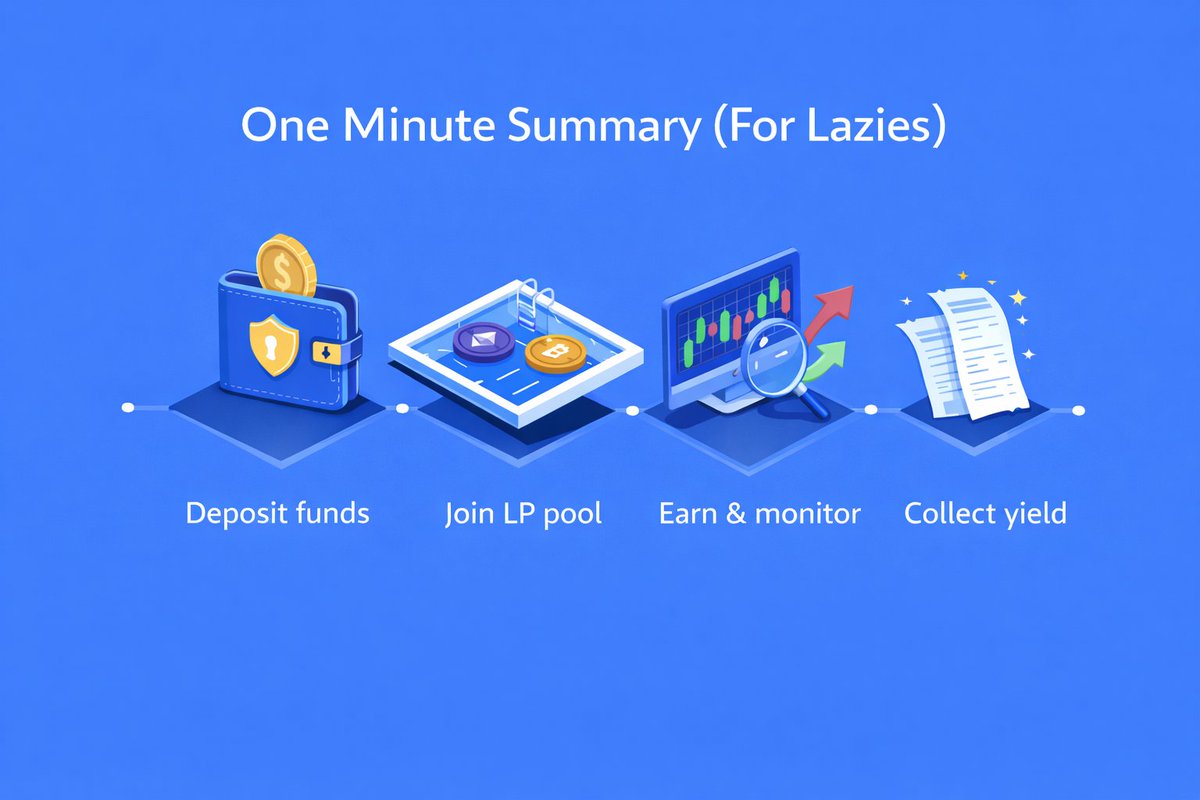
One Minute Summary For Lazies
Not all LPs are the same. The type of pool you choose defines your risk profile. Volatile/volatile pools are more aggressive and offer higher potential returns but come with higher impermanent loss. Volatile/stable pools are more balanced but limit your upside in strong trends. Stable/stable pools are more defensive and have lower volatility, but they introduce different types of risks. At the center of all of this is correlation. The more assets move together, the lower the risk. The more they diverge, the higher the risk.
Can you explain the model?
Is stable/stable LP risk-free?
No. Impermanent loss may be lower, but depeg, contract, issuer and liquidity risks remain.
Why does correlation matter?
Assets that move together usually create less reserve divergence, until that relationship breaks.
Next
What happens after you become an LP?
- how to track your position
- when to exit
- when to rebalance
Because LP is not set and forget.
LP requires active management.
Originally published on X · 2026-04-06
 Post on X
 Telegram