
Liquidity providers become the market’s inventory.
Follow assets, pool shares and fees from a depositor’s position to the trader’s swap—and map what LPs actually risk.
If a user can swap one token for another on a DEX, it means there must be reserves somewhere that make that swap possible. Those reserves live inside a structure called a liquidity pool. In this article we will not only explain what a liquidity pool is, but also what kind of position a liquidity provider, or LP, is actually taking.
This topic matters because many beginners imagine LPing in a very simple way. They assume the following model: "I put my tokens into a pool and as people swap, interest accumulates for me." That mental model is incomplete. Providing liquidity is not the same as earning traditional interest. It means placing inventory inside a pricing mechanism, earning a share of trading fees, and accepting economic risk in return.
By the end of this article one distinction should be very clear:
Holding tokens in your wallet is one thing.
Providing liquidity to a pool is something entirely different.
Lesson mapNavigate this lessonExplore all 29 sections
See the model before the details.
Use the flow, the pool explorer and the comparison table as a map while you read.
- 01LP deposits assets
- 02Pool issues share
- 03Trader swaps
- 04Pool collects fee
- 05LP share accrues value
Move the trade size to begin.
| Position | What you own | Primary exposure |
|---|---|---|
| Token holder | Fixed token quantities | Token price |
| Liquidity provider | Percentage of changing pool reserves | Price divergence, fees and pool risk |
| Trader | Swap output | Impact, slippage and fees |
| Protocol | Contract rules | Code and governance |
Why This Topic Matters
When people use a DEX they usually focus only on the interface. They choose a token, enter an amount, and click the swap button. But internally the real question is this: where exactly does the liquidity for that swap come from?
Without understanding liquidity pools, several important concepts remain incomplete:
- price impact
- slippage
- swap fees
- LP returns
- impermanent loss
- pool selection
- why some swaps are more expensive than others
More importantly, many yield opportunities in DeFi are built on top of liquidity provision. If a protocol shows you a high APY, you cannot evaluate that opportunity properly unless you understand how liquidity pools work.
Providing liquidity is not simply parking capital. It is taking a market position.
What Is Liquidity?
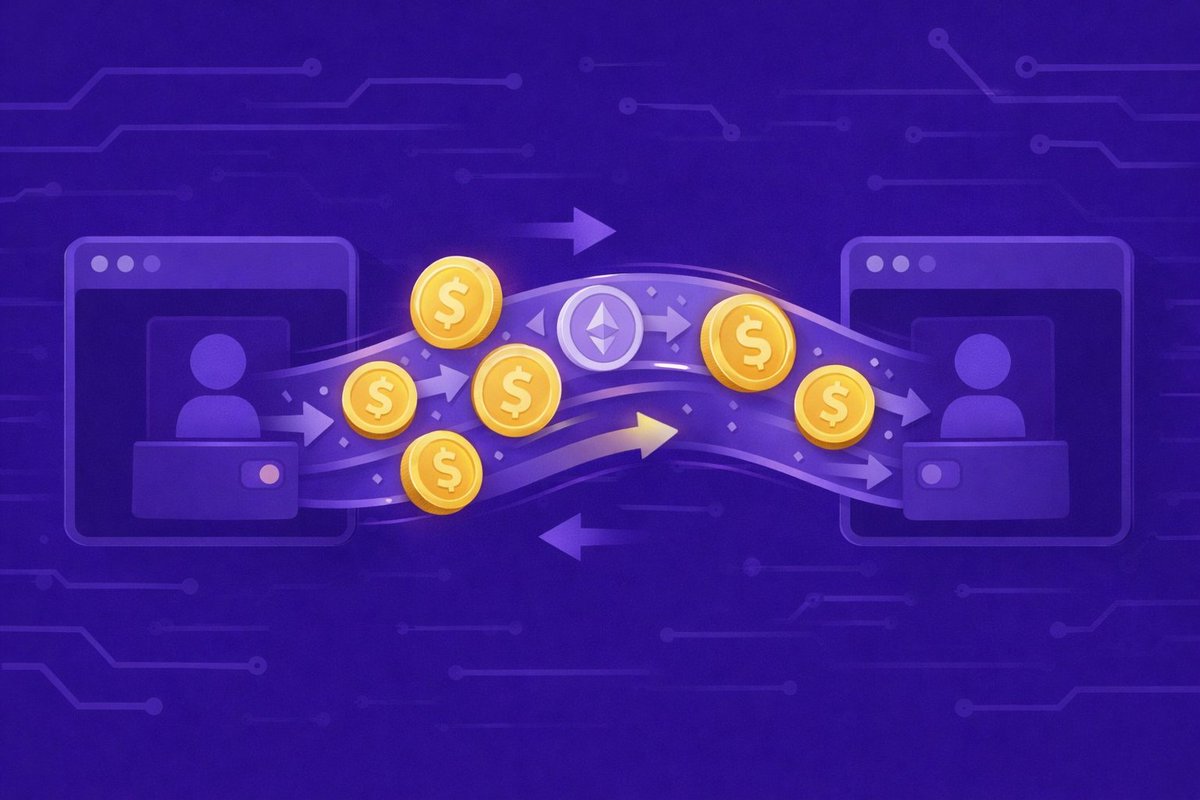
Liquidity describes how easily an asset can be bought or sold without significantly affecting its price.
Imagine you want to sell a token. If the market is deep enough, you can sell it without pushing the price down much. But if liquidity is weak, even a relatively small trade can move the price significantly. The same logic applies when buying.
Liquidity is not just about whether tokens exist in the market. The real question is this:
How efficiently can you execute a trade when you need to?
High liquidity usually leads to:
- lower price impact
- better execution
- smaller price changes during large trades
- more stable market structure
Low liquidity often leads to:
- rapid price movement
- poor execution even for smaller trades
- easier manipulation
- worse outcomes for users
A useful way to think about liquidity is this:
Liquidity is the market depth that allows trades to happen without breaking the price.
Who Provides Liquidity in Traditional Finance?
In traditional markets liquidity is often provided by market makers, professional trading firms, and participants placing orders in an order book. Buyers and sellers submit bids and asks, and prices emerge from the interaction between those orders.
Centralized exchanges operate in a similar way. User orders, market maker liquidity, and the exchange matching engine interact to produce trades.
DeFi changes this structure.
Many decentralized exchanges do not rely on an order book. Instead they use liquidity pools. This means swaps can happen against reserves stored in a smart contract rather than matching two individual users in real time.
This design creates an important shift.
In theory, anyone can become a liquidity provider.
What Is a Liquidity Pool?
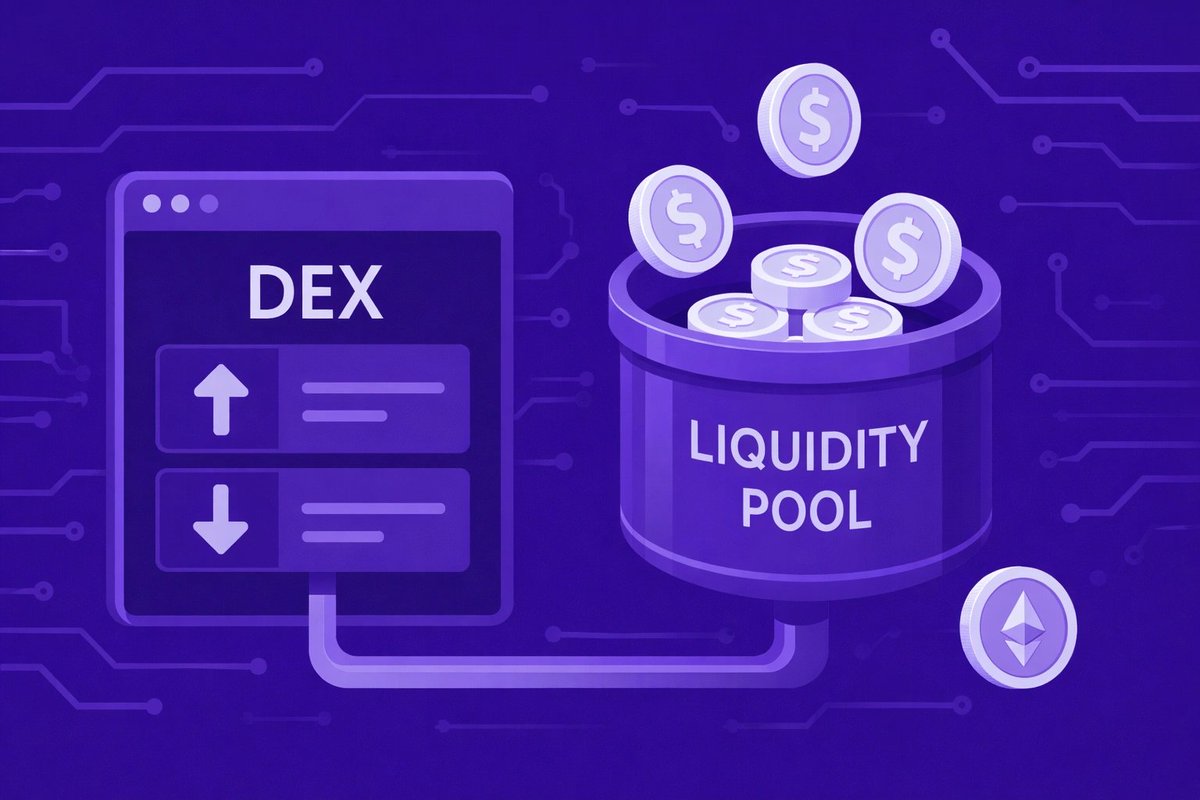
A liquidity pool is a set of token reserves stored in a smart contract that users can trade against.
In the simplest example a pool might contain two assets:
- ETH
- USDC
These tokens form the pool reserves. When a user swaps USDC for ETH, USDC enters the pool and ETH leaves the pool. When a user swaps ETH for USDC, the opposite happens.
A critical point to understand is this:
A pool is not just a container for tokens.
A pool is also:
- the source of swap execution
- part of the price discovery mechanism
- a system that determines price based on reserve ratios
In other words, the pool is not a passive vault. It is an active market mechanism.
Who Is an LP?
LP stands for liquidity provider. These are the participants who deposit assets into a pool.
An LP can be:
- an individual user
- a professional market maker
- a protocol treasury
- a yield farmer chasing incentives
Regardless of who they are, they all perform the same role.
They provide the reserves that allow swaps to happen.
Because of this, the DEX ecosystem has two fundamental participants:
- users who perform swaps
- users who provide liquidity
One group wants to trade.
The other group supplies the liquidity that makes trading possible.
A Simple Example: ETH / USDC Pool
Let us look at a simple example.
Suppose an ETH/USDC pool contains the following reserves:
- 50 ETH
- 100,000 USDC
This ratio roughly implies a price of around 2,000 USDC per ETH.
Now imagine a user swaps 2,000 USDC for ETH.
What happens?
- USDC enters the pool
- ETH leaves the pool
After the transaction the reserves change. USDC increases and ETH decreases. Because the ratio of reserves changes, the internal price of the pool also changes.
The key insight is this:
In many DEX swaps you are not matching another user's order.
You are reshaping the reserves of the pool.
How Is the Price Determined?
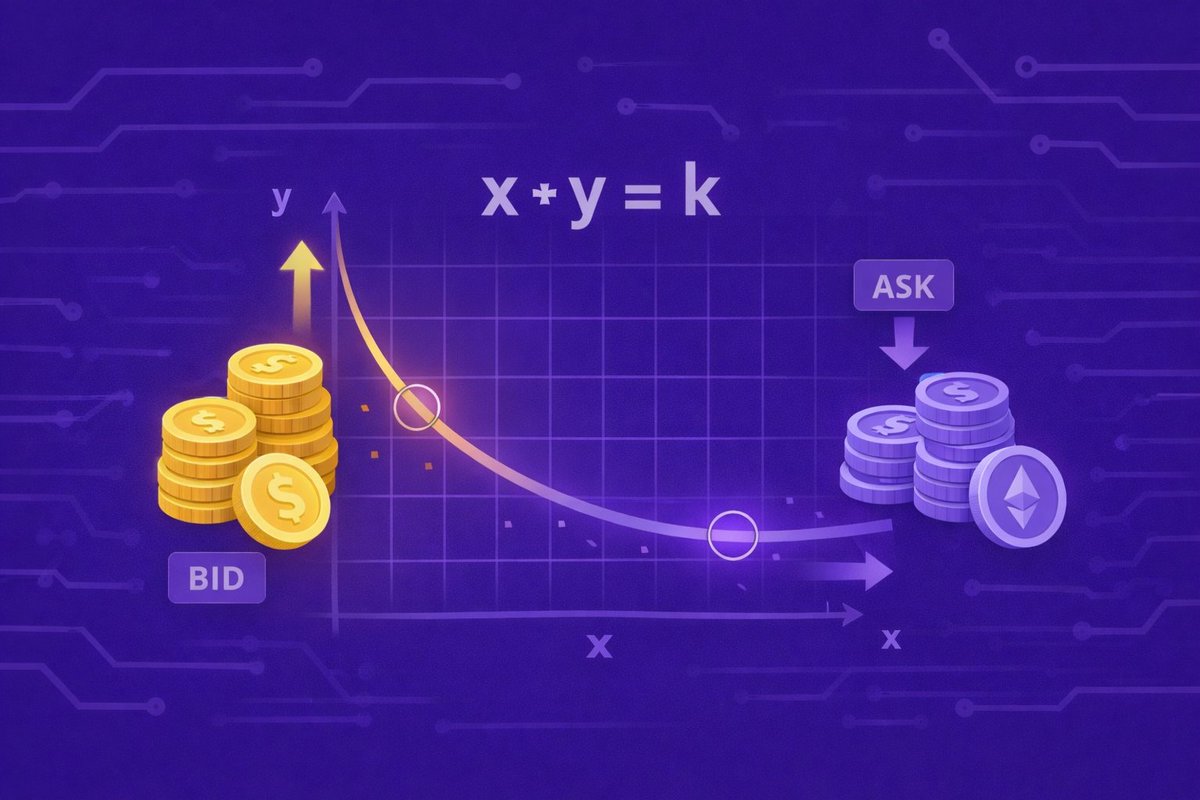
In order book markets prices are formed by bids and asks. In automated market maker systems prices are derived from the ratio of reserves.
One of the most common models is the constant product model. It is often represented as:
x * y = k
Where:
- x represents one token reserve
- y represents the other reserve
- k represents the constant relationship between them
The important intuition is simple.
When one reserve increases, the other decreases.
That shift changes the internal price.
This is the root of price impact.
Large trades distort the reserve ratio more aggressively. The more the ratio changes, the worse the execution price becomes.
That is why liquidity depth sits at the center of execution quality.
The Pool From Two Perspectives
We can look at the same pool from two perspectives.
From the trader's perspective
For a trader the pool is:
- the source of execution
- where the price comes from
- the origin of slippage and price impact
- the structure that determines execution quality
From the LP's perspective
For a liquidity provider the pool is:
- a shared reserve system where they place inventory
- a position that generates trading fees
- a dynamic portfolio whose composition changes with price
- a structure that looks passive but carries economic risk
This distinction is important. Traders interact with the pool temporarily. LPs live inside the pool.
How Do LPs Earn?
The simplest answer is this.
LPs primarily earn trading fees.
Many DEXs charge a small fee for every swap. Depending on the pool and design this might be 0.01 percent, 0.05 percent, 0.3 percent, or another level.
When a user swaps tokens they pay this fee. A portion of that fee is distributed to the liquidity providers in the pool.
Some protocols may add additional incentives such as:
- reward tokens
- farming incentives
- protocol emissions
But the core revenue model remains the same.
LP income is primarily generated by swap fees.
How Do Fees Reach LPs?
Many beginners imagine the following process.
"I deposit tokens and the protocol periodically sends me interest."
In reality the mechanism is usually different.
In many systems trading fees accumulate inside the pool. They are added to the reserves. Even if your share of the pool stays constant, the total value of the reserves may increase due to accumulated fees.
Some protocols distribute fees separately. Some require manual claiming. Others automatically reflect fees in the pool value.
But the correct mental model is this.
LP rewards do not appear magically.
They come from real economic activity. Specifically, trading volume.
Why LP Income Is Not Guaranteed
To understand this, consider a real example that happened recently on Ethereum.
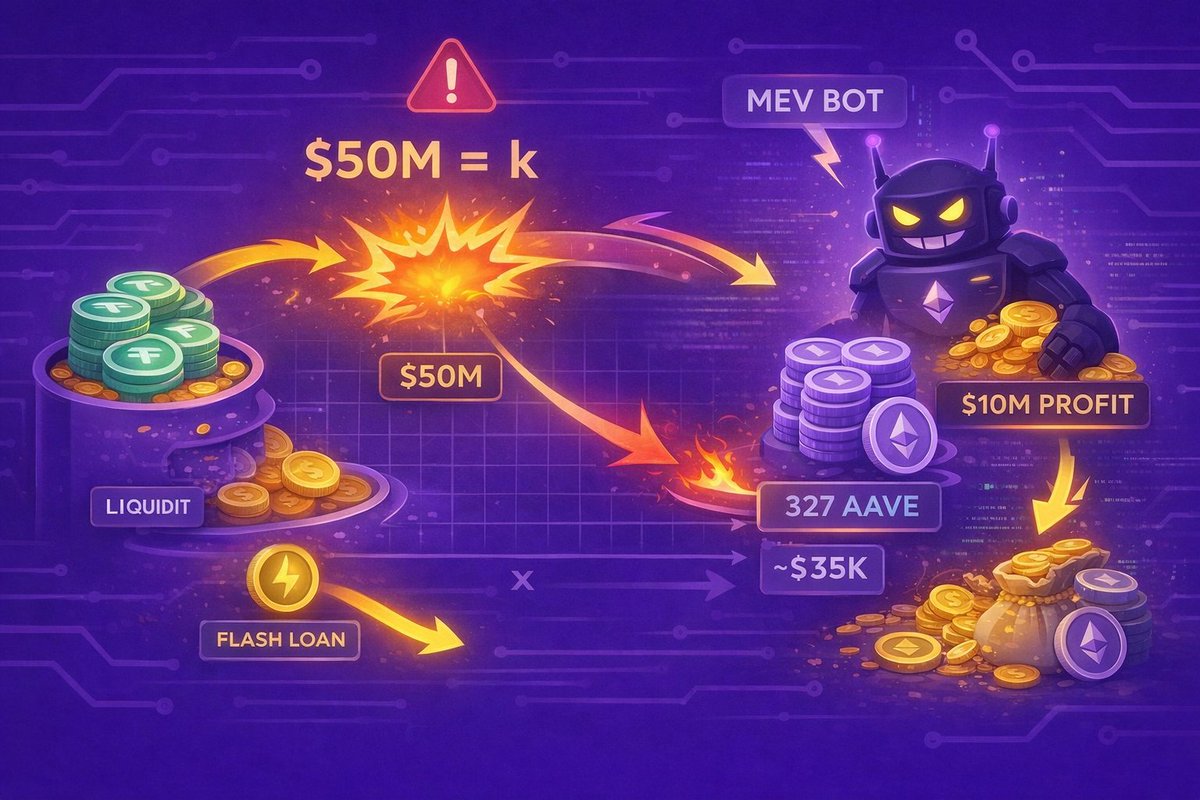
A user attempted to swap roughly 50 million USDT using an extremely poor route and shallow liquidity. The result was catastrophic. The user ended up receiving only about 327 AAVE, worth roughly 35,000 dollars.
In other words, tens of millions of dollars in value were destroyed due to poor execution.
Several factors contributed to this outcome:
- the trade size was extremely large
- the liquidity pool used was shallow
- price impact became extreme
- the transaction became visible in the mempool
- an MEV bot exploited the situation
The bot used a flash loan, rebalanced the pool price, and reportedly captured around 10 million dollars in profit in the same block.
This event highlights several lessons:
- Large trades without understanding liquidity mechanics can lead to catastrophic results.
- AMM pricing curves can produce extreme price impact.
- Execution quality is far more complex than simply pressing the swap button.
How Should That Trade Have Been Executed?
Professional traders rarely execute very large swaps in a single transaction.
Instead they apply several execution strategies.
Order splitting
Large trades are divided into smaller transactions. This reduces price impact because each trade moves the reserve ratio less dramatically.
Liquidity routing
Aggregators such as 1inch, Matcha, or Paraswap can split orders across multiple pools and DEXs. This spreads the trade across different liquidity sources.
Slippage protection
Users can define a slippage tolerance. If execution exceeds that threshold, the transaction reverts.
MEV protection
Large trades can be routed through private relays or batch auction systems that reduce exposure to mempool based arbitrage bots.
These techniques are common both in traditional finance and advanced DeFi trading.
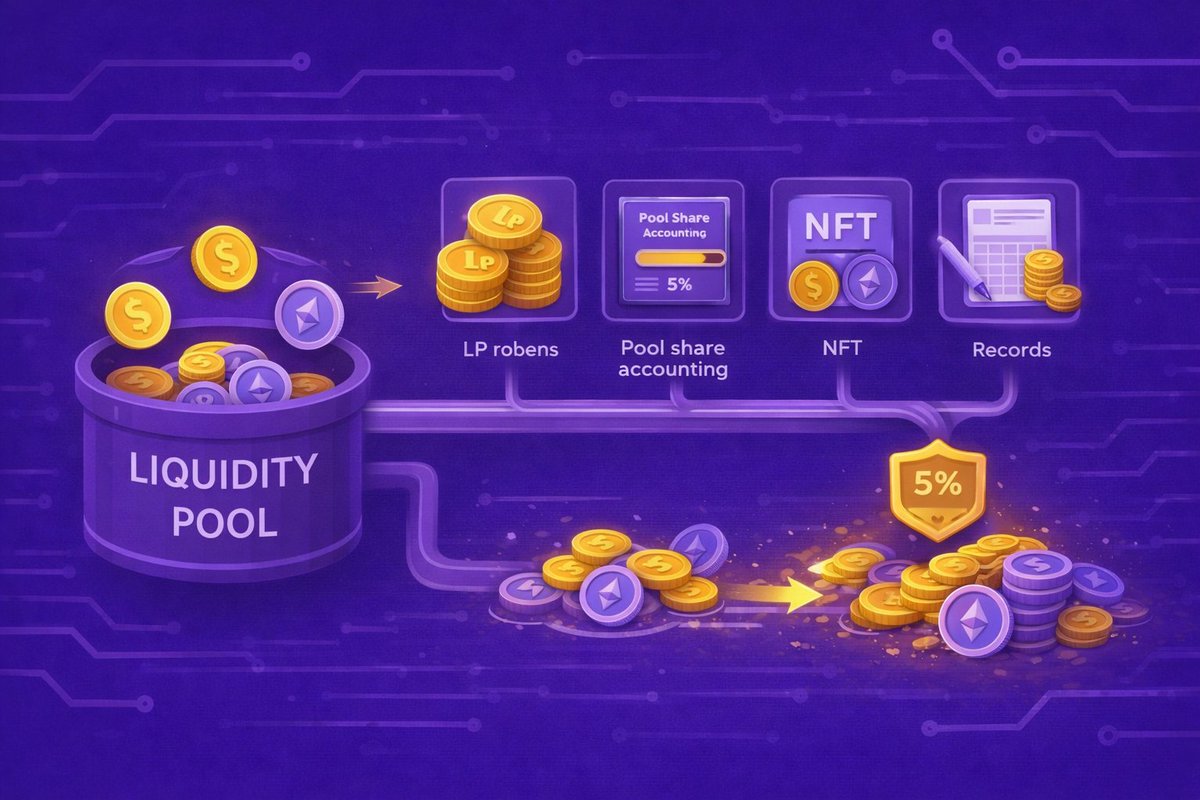
What Do You Receive When You Provide Liquidity?
When you add liquidity, the protocol gives you a representation of your share of the pool.
This representation might appear as:
Choose an option to begin.
- LP tokens
- pool share accounting
- a position NFT
- protocol specific position records
Regardless of the format, the idea is the same.
It records your ownership of a fraction of the pool.
When you withdraw liquidity later, your share determines how much of the reserves you receive.
Providing liquidity therefore means opening a position.
Why LPing Is Not the Same as Holding Two Tokens
This is one of the most important ideas in this article.
Imagine you own:
- 1 ETH
- 2,000 USDC
If those tokens stay in your wallet, your inventory remains unchanged.
But if you deposit them into a liquidity pool, the pool mechanics will constantly rebalance the ratio between the two assets.
If ETH rises in price, you tend to end up with relatively less ETH and more USDC.
If ETH falls in price, you tend to accumulate more ETH relative to USDC.
This means your inventory evolves with market movement.
Providing liquidity therefore resembles an automated market making position rather than simple token holding.
Who Is the Counterparty in a DEX?
Many beginners assume another user is always on the other side of their trade.
In AMM based systems that is usually not the case.
The pool itself is the counterparty.
Behind that pool stand the liquidity providers whose assets make the trade possible.
This structure is why liquidity depth strongly affects pricing and execution quality.
Are Tokens in the Pool Idle?
No.
Tokens in a pool actively participate in the pricing mechanism. Every swap changes reserve ratios. Those changes influence price levels and the internal composition of LP positions.
The assets inside a pool are therefore part of a continuously evolving market system.
Is LPing the Same as Market Making?
Conceptually it is similar.
Liquidity providers supply assets that allow trades to happen. In that sense they perform a role similar to traditional market makers.
However there are key differences:
- the pricing is algorithmic
- the strategy is passive by default
- anyone can participate
- risk management is mostly handled by the LP
So while the function is similar, the implementation is very different.
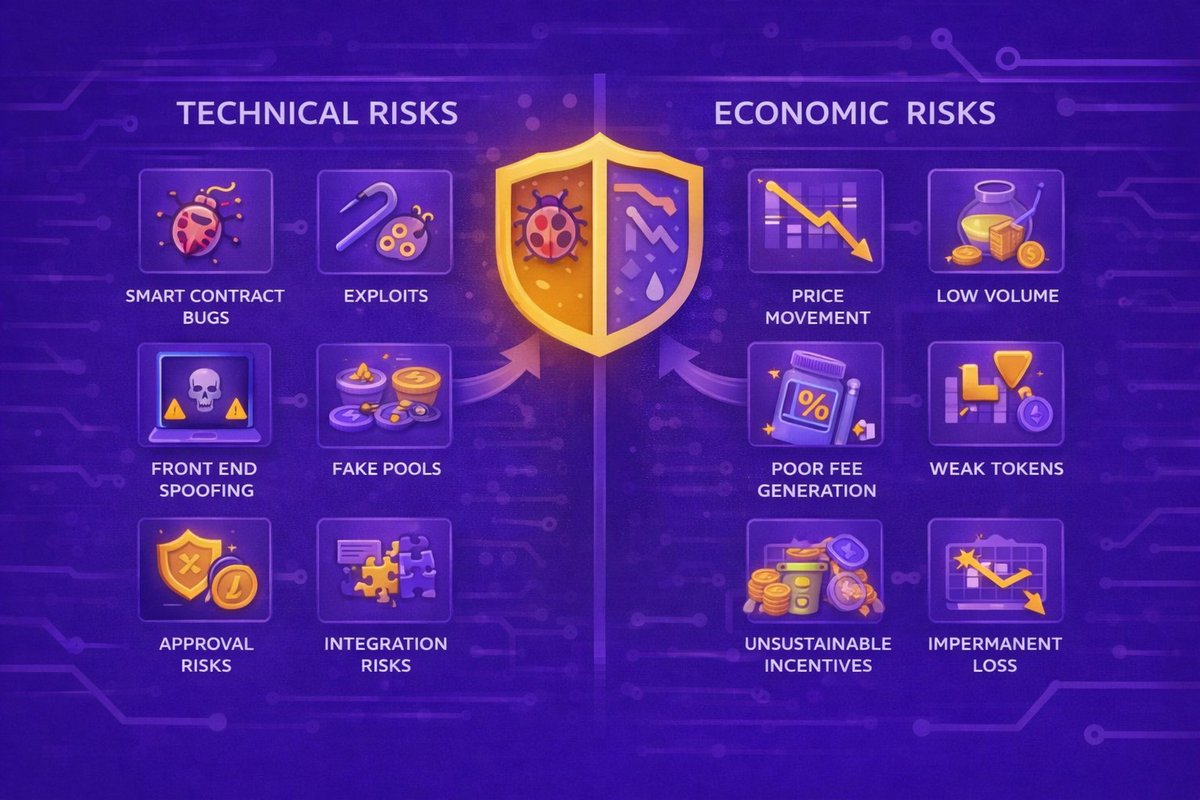
The Main Risks of Providing Liquidity
LP risks fall into two broad categories.
Technical risks
These originate from protocol infrastructure.
- smart contract bugs: software errors in the contract logic
- exploits: attackers abusing contract vulnerabilities
- front end spoofing: fake interfaces tricking users
- fake pools: malicious pools using similar token names
- approval risks: excessive token permissions
- integration risks: vulnerabilities introduced through protocol integrations
Even if the economic model is sound, technical weaknesses can lead to losses.
Economic risks
These exist even when the system works correctly.
- price movement: asset prices change in the broader market
- low trading volume: fewer swaps means lower fee income
- poor fee generation: high TVL with low activity reduces yield
- weak tokens: poor project fundamentals can collapse prices
- unsustainable incentives: temporary rewards may disappear
- impermanent loss: pool rebalancing changes your asset composition
- bad exit timing: withdrawing liquidity during unfavorable conditions
Many beginners focus only on hacks. In practice many losses occur without any exploit at all.
Impermanent Loss
Impermanent loss is one of the most misunderstood costs of providing liquidity.
When prices move, the pool automatically rebalances the asset ratio. Because of that rebalancing, your position may be worth less than simply holding the tokens in your wallet.
The difference between those two outcomes is called impermanent loss.
We will examine this concept in detail in the next article.
Not All Pools Are the Same
Different pools have very different characteristics.
Examples include:
- stablecoin pairs
- volatile asset pairs
- stable volatile pairs
- different fee tiers
- concentrated liquidity pools
- traditional full range pools
Even the same token pair may exist across multiple DEXs and multiple fee structures.
So saying "I added liquidity to an ETH USDC pool" often lacks critical detail.
The real question is:
Which DEX, which pool, which fee tier, and which liquidity design?
Stable Pools vs Volatile Pools
Stable pools typically involve assets with similar prices such as stablecoins. Price volatility tends to be lower under normal conditions.
However stable pools are not risk free. Depegging events, issuer risk, and regulatory controls can still affect them.
Volatile pools include assets with large price swings. These pools may generate higher trading volume but also carry higher economic risk.
Understanding the difference between these structures is essential.
What Is TVL?
TVL stands for total value locked. It measures the total value of assets inside a pool or protocol.
TVL can indicate:
- pool size
- user participation
- depth of liquidity
However TVL alone is not enough to evaluate an LP opportunity.
Liquidity providers must also consider:
- trading volume
- fee generation
- token risk
- competitive liquidity levels
- sustainability of incentives
Large pools are not automatically better for LPs.
Is High APY Always Attractive?
Not necessarily.
High APY should raise several questions:
- where does the yield come from
- is it trading fees or temporary incentives
- is the reward token sustainable
- what happens when incentives end
- can price movement eliminate the yield
Chasing percentages without understanding the mechanism is one of the most common mistakes in DeFi.
Common Beginner Mistakes
Typical mistakes include:

Checklist Before Providing Liquidity
Before adding liquidity ask yourself:
- is the token contract correct
- is the pool legitimate
- is the DEX trustworthy
- what is the trading volume
- what is the TVL
- does the fee tier make sense
- is the pool stable or volatile
- what is the token risk
- are incentives sustainable
- do I truly understand how this position makes or loses money
If you cannot answer these questions, joining a pool based purely on APY is dangerous.
Monitoring an LP Position
Providing liquidity is not a one time action.
Key metrics to monitor include:
- accumulated fees
- trading volume
- asset composition changes
- price movement
- comparison with simple holding
- incentive continuation
- exit timing
LP positions require observation and sometimes active management.
The Core Idea
Providing liquidity is not yield hunting. It is position management.
Yield hunting means jumping between pools chasing the highest APY without understanding the underlying mechanics.
Position management means evaluating:
- the assets involved
- the liquidity structure
- trading activity
- price behavior
- the overall risk profile
LPing is not about chasing the highest percentage.
It is about managing an exposure inside a liquidity system.
Key Terms Summary
- Liquidity: how easily an asset can be traded without moving the price.
- Liquidity Pool: smart contract reserves used for trading.
- LP: participant who provides liquidity.
- AMM: algorithmic market making model.
- Price Impact: how much a trade moves the price.
- Slippage: difference between expected and executed price.
- Swap Fee: trading fee distributed to LPs.
- TVL: total value locked in a pool.
- APY: annualized yield estimate often based on recent activity.
- Impermanent Loss: difference between LP outcome and simply holding assets.
- MEV: profit extracted through transaction ordering.
Understanding these concepts is essential to understanding DeFi.
Can you explain the model?
Does an LP keep fixed amounts of both deposited tokens?
No. The pool rebalances quantities as traders interact; the LP owns a percentage of the changing reserves.
Is high APY enough to judge a pool?
No. Fees, incentives, token emissions, volatility and impermanent loss all affect the outcome.
One Minute Summary For Lazies
A liquidity pool is the reserve system behind DEX swaps. Liquidity providers deposit assets into these pools and earn trading fees. However LPing is not a risk free income strategy. The pool mechanism constantly changes the composition of the assets you hold. Because of this, providing liquidity is closer to managing a dynamic market position than earning simple interest.
To truly understand DEXs you must understand both sides of the system. The trader who performs the swap and the liquidity that makes the swap possible.
In this article we explored how liquidity pools work, how LPs earn fees, and why liquidity provision is not a passive yield strategy.
In the next article we will examine one of the most misunderstood aspects of LPing: impermanent loss.
We will answer a simple but powerful question.
Why can an LP sometimes earn fees yet still end up worse off than simply holding the tokens?
Continue learningPart 10: Impermanent Loss: Why Your Position Changes Even When You Do Nothing →Originally published on X · 2026-03-16
 Post on X
 Telegram