The best displayed price may not produce the best final execution.
See how aggregators route, split and compare trades across pools while accounting for gas, liquidity and token risk.
In the previous articles we explored the core building blocks of DeFi one by one. In particular, the last two articles examined how decentralized exchanges work, how liquidity pools function, how AMMs determine prices, and why concepts such as slippage, price impact, and minimum received matter.
Now we arrive at the next natural question.
If everyone can perform the same token swap, why do users often end up with different results?
Why do some users get better execution while others receive worse outcomes?
Why can the same swap show different results across different interfaces?
The answer is simple but important.
In DeFi, making a swap and making a smart swap are not the same thing.
Converting one token into another is technically easy. Doing it with a better price, lower cost, less risk, and through a better route is a different skill entirely.
Lesson mapNavigate this lessonExplore all 19 sections
See the model before the details.
Use the flow, the routing explorer and the comparison table as a map while you read.
- 01Your trade
- 02Aggregator scans pools
- 03Routes compared
- 04Gas and impact included
- 05Best valid execution
Adjust the controls to begin.
| Route | Potential benefit | Potential cost |
|---|---|---|
| Direct | Simple and lower gas | May have weaker liquidity |
| Multi-hop | Access to deeper combined liquidity | More calls and gas |
| Split | Reduce impact across pools | Execution complexity |
| Unsafe token path | Misleading quote | Transfer restrictions or scam behavior |
Why This Topic Matters
Many beginner users look at a swap screen and focus on only one number.
"How many tokens will I receive?"
In reality, the quality of a swap result depends on much more than the visible output amount.
Execution quality is influenced by several factors:
- which network you are using
- which liquidity pool the trade passes through
- whether the swap uses a single pool or multiple routes
- the size of the trade relative to liquidity
- market volatility at the time of the transaction
- gas costs
- how complex the route is
- the probability that the transaction succeeds
Because of this, two people swapping the same token pair may not get the same result.
Put differently.
Making a swap is one thing.
Making a swap consciously and intelligently is something else.
A Good Swap Is Not Just About Finding a Token
At a beginner level, users often think about swaps in a very simple way.
- I know which token I want to buy
- I know which token I want to sell
- therefore I just perform the swap
But the real system is deeper than that.
A good swap result is not determined only by the token pair.
It also depends on:
- the correct network
- the right liquidity source
- the best route
- the appropriate trade size
- good timing
- a reasonable slippage setting
These factors together determine the final execution.
For that reason it is better to think about swaps in the following way.
A swap is not just a conversion.
A swap is also an execution decision.
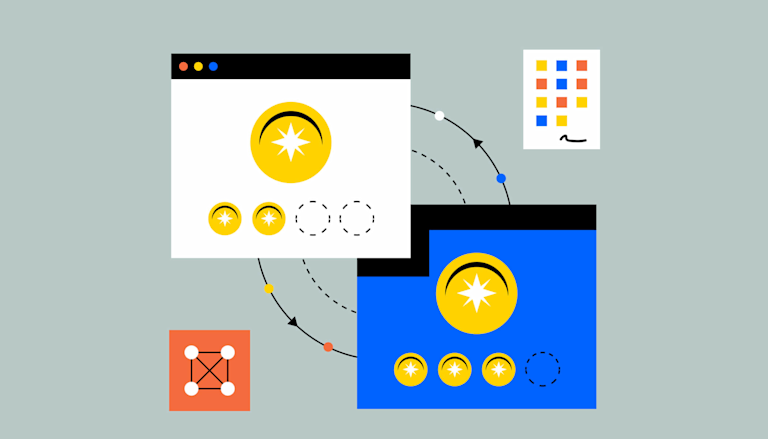
What Is a DEX Aggregator?
A DEX aggregator is a system that scans liquidity pools and possible transaction paths across multiple decentralized exchanges in order to find better execution.
The easiest way to understand this is through a simple example.
Imagine you have 1000 USDC and want to swap it for ETH.
A single DEX interface might only show you the liquidity pools inside its own protocol. It might use only one ETH / USDC pool.
But in reality, the market may offer several alternatives.
For example:
- another DEX may have a deeper pool
- the same DEX may have multiple fee tiers
- the swap might work better through a different route such as USDC → DAI → ETH
A DEX aggregator automatically scans these options and asks a simple question.
"Which path produces the best result for this trade?"
For example, it may compare three possibilities.
Route 1
USDC → ETH (single pool)
Route 2
USDC → DAI → ETH
Route 3
Splitting the USDC trade across two separate pools
The aggregator evaluates each option and usually presents the route that appears to offer the best outcome.
However there is an important point to understand.
An aggregator is not a magical solution.
It can find better routes, but it cannot solve fundamental market problems such as:
- extremely low liquidity tokens
- scam contracts
- incorrect network selection
- user mistakes
In other words, an aggregator can route a swap more intelligently, but it cannot eliminate the fundamental risks of the market.
Why Can the Same Token Pair Have Multiple Pools?
Many users initially assume something like this.
"If ETH / USDC exists, then there must be only one market."
In DeFi that is not the case.
The same token pair may exist:
- across multiple DEX protocols
- across multiple fee tiers within the same DEX
- across different networks with different liquidity structures
Consider a small example.
Suppose you want to buy ETH.
You might see the following options.
- An ETH / USDC pool on Uniswap with 10 million dollars in liquidity
- Another ETH / USDC pool on a different DEX with 2 million dollars in liquidity
- A different fee tier pool on the same DEX
All of these pools contain the same token pair but their liquidity depth differs.
If you perform a large trade:
- a small pool may experience very high price impact
- a deeper pool may move the price much less
This means that two users buying ETH at the same time might use different pools and receive different results.
Which leads to an important idea.
The first pool you see is not always the best pool.
When you perform a swap you are actually making a small market selection decision.
What Does Routing Actually Mean?
Routing refers to the path a swap transaction follows in order to execute.
It is helpful to compare this to traveling through a city.
Choose an option to begin.
When you want to go from one place to another:
- sometimes there is a direct road
- sometimes you must pass through smaller streets
- sometimes combining two different roads is faster
DEX swaps work in a similar way.
Sometimes the swap happens directly.
For example:
USDC → ETH
But sometimes the direct pool is not strong enough.
In that case the system may select a path such as:
USDC → DAI → ETH
This route uses two different pools:
- the USDC / DAI pool
- the DAI / ETH pool
This approach may provide better execution because each pool may have deeper liquidity.
These multi step swaps are called multi hop routing.
So routing simply answers one question.
"Through which market path will this swap be executed?"
Scam or Faulty Token Risks in Routing
At this point an important question appears.
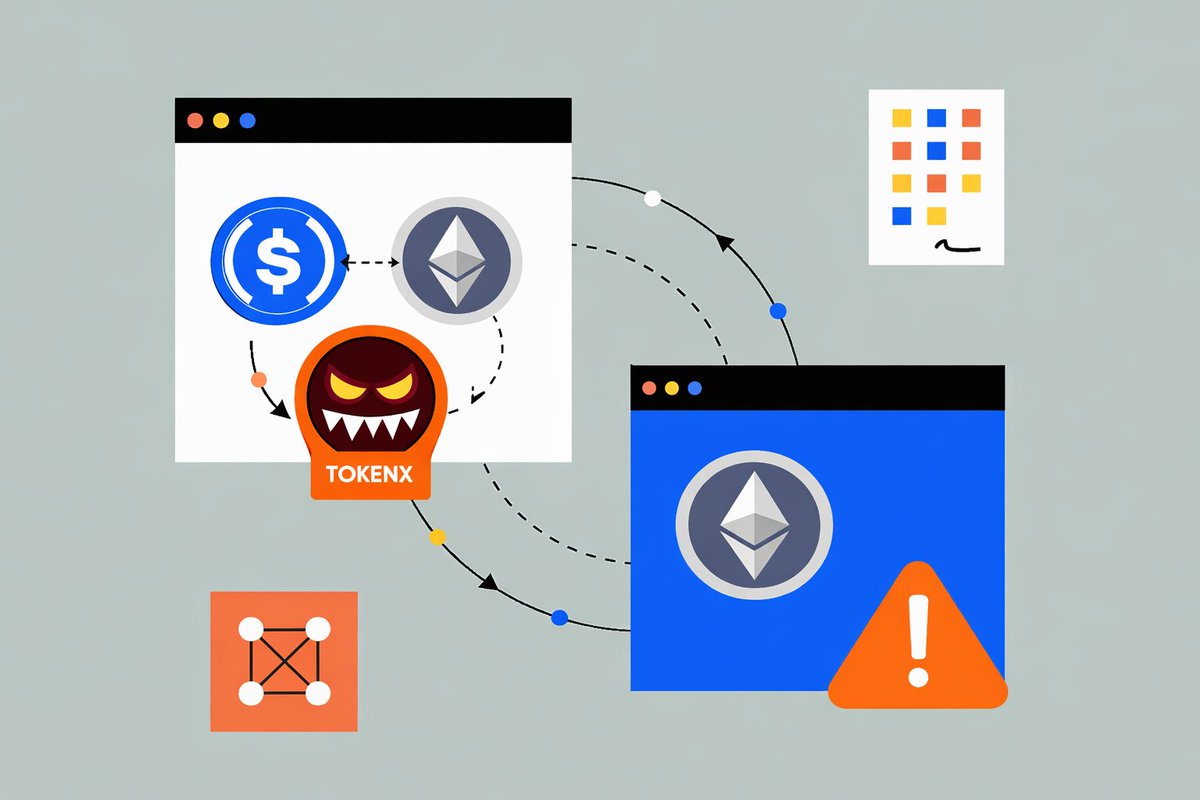
"If an aggregator searches for the best route, what happens if the intermediate token is a scam or faulty token?"
Consider a route like this.
USDC → TOKENX → ETH
If TOKENX is not trustworthy several problems could occur.
For example:
- the contract may take hidden transfer taxes
- the contract may block transfers
- the contract may restrict selling for certain addresses
- the token may be a honeypot where buying is possible but selling is not
In that situation the route might look good in theory but be dangerous in practice.
How do aggregators deal with this?
Most large aggregators use several filters.
1. Known token lists
Many aggregators rely on verified token lists by default.
These typically include:
- major stablecoins
- large liquidity tokens
- verified contracts
This makes it harder for random or suspicious tokens to appear in routing paths.
2. Liquidity filters
Aggregators often exclude extremely small pools from routing calculations.
Low liquidity pools can indicate risks such as:
- manipulation
- extreme price impact
- rug pull risk
3. Transaction simulation
Many aggregators simulate the transaction before sending it.
This simulation can check things such as:
- whether the transaction would fail
- whether the expected output is realistic
- whether the token contract behaves normally
4. Honeypot or tax analysis
Some advanced systems also analyze token contract behavior to detect hidden taxes or transfer restrictions.
However these checks are never perfect.
Which leads to an important principle.
Aggregators can reduce risk.
But they cannot eliminate bad token risk completely.
The final decision always belongs to the user.
Do I Choose the Route or Does the Application?
At this point many beginner users ask a very natural question.
"Do I need to choose these routes myself? If the swap application already finds the best route, why do I need to learn this?"
Most modern swap interfaces and aggregators calculate routes automatically.
Users usually choose only two things.
- which token they want to sell
- which token they want to receive
Behind the scenes the system evaluates several factors.
For example:
- which pools contain liquidity
- which route provides the best output
- whether the trade should be split
- which fee tier is most efficient
So in most cases the software chooses the route automatically.
However understanding this concept is still important for several reasons.
First, the interface only gives you a suggestion. If you do not understand why the suggestion exists, you cannot evaluate the quality of the execution.
Second, there are situations where users must make decisions such as:
- whether to split the trade
- whether to start with a small test transaction
- whether to use a deeper liquidity DEX
- whether to wait during volatile market conditions
Third, different interfaces may use different routing algorithms.
The same swap may produce different results:
- on one aggregator
- on another DEX interface
The goal is not to manually calculate routes.
The goal is to understand the mechanism behind the swap screen so you can make more informed decisions.
Another way to think about it is this.
The application can steer the wheel.
But understanding how the vehicle works makes the driver safer.
Direct Swap vs Multi Hop Swap
Direct swap:
Token A → Token B
This means the swap occurs through a single liquidity pool.
For example:
USDC → ETH
This is the simplest type of swap.
However sometimes the liquidity between Token A and Token B is weak.
For example:
TOKENX → ETH
The liquidity for this pair may be very small.
In that case the system may choose a route such as:
TOKENX → USDC → ETH
This uses two separate pools.
But the total execution may be better because:
- the TOKENX / USDC pool may be stronger
- the USDC / ETH pool may be much deeper
For that reason a two step route can sometimes produce better results than a direct swap.
In DeFi the shortest path is not always the best path.
Best Price Does Not Always Mean Best Execution
An interface might show slightly higher output.
But that does not always mean the final result is better.
Execution quality depends on several additional factors.
- gas cost
- route complexity
- probability of failure
- liquidity quality
This leads to an important mental model.
Best quote is not always equal to best execution.
Why Splitting Trades Can Sometimes Help
Large trades can significantly affect pool balances.
Consider a simple example.
Assume a pool contains 1 million dollars in liquidity.
If you perform a 200,000 dollar swap in that pool:
- the pool balance changes significantly
- price impact increases
- the execution price becomes worse
But if the same trade is executed as:
- 50,000
- 50,000
- 50,000
- 50,000
Each transaction applies less pressure on the pool.
In some situations this can produce a better average price.
But not always.
Because:
- each transaction consumes gas
- the market may change during the sequence
So splitting trades can sometimes be beneficial, but it is not automatically better in every case.
Gas Cost Is Part of Execution Quality
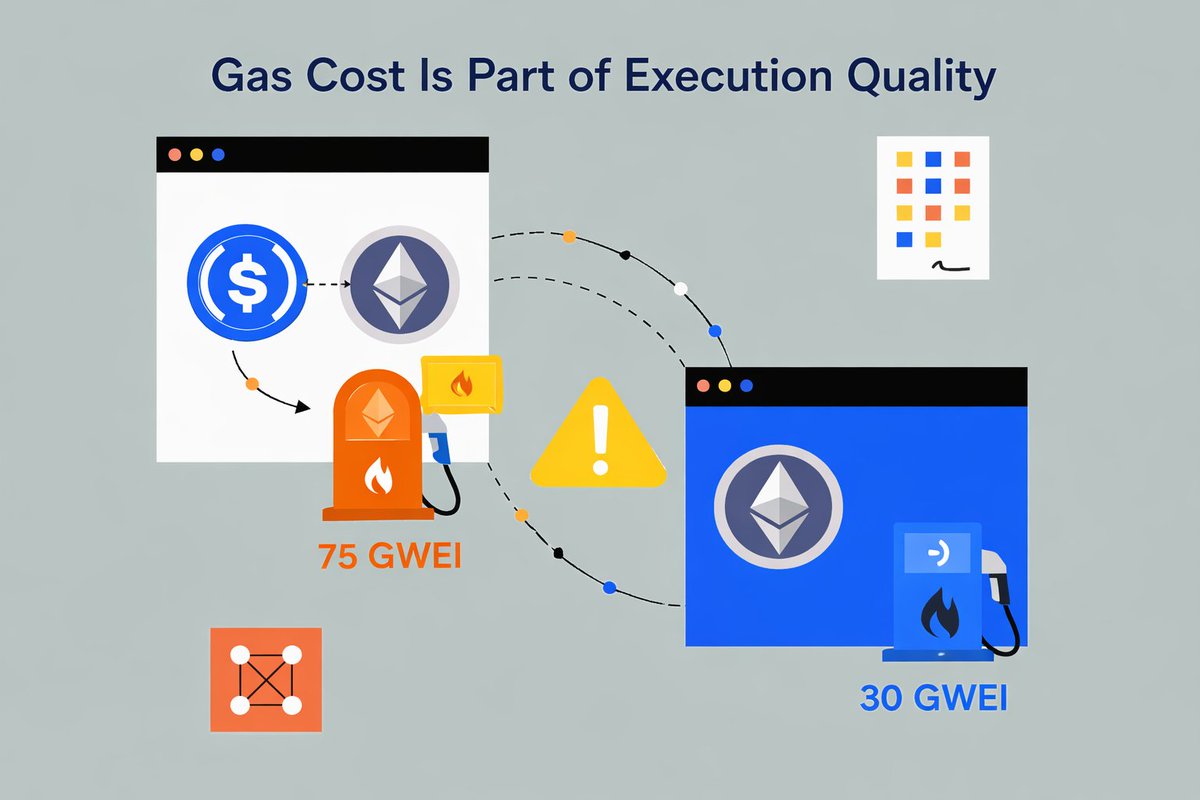
When evaluating execution quality it is not enough to look only at the token output.
Gas cost matters as well.
Imagine two possible routes.
Route A
1000 USDC → 0.50 ETH
Gas cost: 5 dollars
Route B
1000 USDC → 0.505 ETH
Gas cost: 20 dollars
At first glance Route B appears better because it produces more ETH.
However the final net result may favor Route A because the gas cost is much lower.
For smaller trades it is useful to ask a simple question.
"Is the extra output really worth the additional gas cost?"
Good execution is measured not only by output but by the net result.
Timing Matters
Swaps are not determined only by routing.
Timing also plays an important role.
When markets are calm:
- liquidity balances are more stable
- the difference between quote and execution may be smaller
But during rapid price movements a different situation appears.
For example when ETH price is rising quickly:
- many users may try to buy ETH at the same time
- pool balances may change rapidly
- your transaction may wait in the mempool while the price moves
In that situation the final swap result may be worse than expected.
Sometimes the best decision is not immediate execution.
Waiting for the market to stabilize can also be a strategy.
How Does This Work on Centralized Exchanges?
At this point a natural comparison appears.
If DEX systems use aggregators and routing, how do centralized exchanges handle this?
The mechanism is different because the market structure is different.
DEX systems usually rely on liquidity pools and AMM formulas.
Centralized exchanges usually rely on order books.
An order book works like this.
- some users place sell orders at specific prices
- some users place buy orders at specific prices
For example an ETH order book might look like this.
Sell orders
- 1 ETH at 2000 USDT
- 3 ETH at 2001 USDT
- 5 ETH at 2002 USDT
Buy orders
- 2 ETH at 1999 USDT
- 4 ETH at 1998 USDT
If someone places a market buy order, the system fills the trade starting from the best available sell orders.
For example.
If a user wants to buy 3 ETH:
- the first 1 ETH executes at 2000
- the next 2 ETH execute at 2001
The user's average purchase price increases.
This is conceptually similar to price impact in DEX systems.
Large trades consume multiple levels of liquidity.
However there is an important difference.
In DEX systems price is determined by pool ratios.
In CEX systems price is determined by human placed orders.
Another important difference is execution speed.
CEX trades:
- run on company servers
- execute in milliseconds
- do not wait in a mempool
DEX trades:
- execute on a blockchain
- require block confirmation
- pass through the mempool
Because of this, routing and aggregation play a more visible role in DeFi.
Liquidity in CEX markets is usually concentrated in a single order book.
Most users therefore do not think about routing.
However large traders still optimize execution by using strategies such as:
- splitting large trades
- arbitraging across exchanges
- algorithmic execution systems
Execution optimization is therefore important in both DeFi and traditional markets.
Is There Such a Thing as a CEX Aggregator?
Some readers may wonder.
"If DEX systems have aggregators, does something similar exist for centralized exchanges?"
In a limited sense, yes.
But the structure is different.
DEX aggregators scan liquidity pools across multiple protocols.
CEX systems sometimes scan order books across multiple exchanges.
This is often called:
- exchange aggregation
- smart order routing
- multi exchange execution
The idea is simple.
"Send the trade to the exchange offering the best execution."
For example a trading system might monitor:
- Binance
- Coinbase
- Kraken
- OKX
If a trader wants to buy 50 BTC, executing the entire trade on one exchange may create strong price impact.
Instead the system may distribute the order.
For example:
- 20 BTC on Binance
- 15 BTC on Coinbase
- 15 BTC on OKX
This spreads the trade and may produce a better average price.
These systems are typically used by:
- trading firms
- hedge funds
- market makers
- large institutional traders
In traditional finance this approach is known as Smart Order Routing (SOR).
However there is an important difference.
DEX aggregators operate on open blockchain protocols that anyone can access.
CEX routing systems usually operate through:
- proprietary trading infrastructure
- institutional execution tools
- API based trading systems
The concept is similar.
Find the best execution.
But the implementation is different.
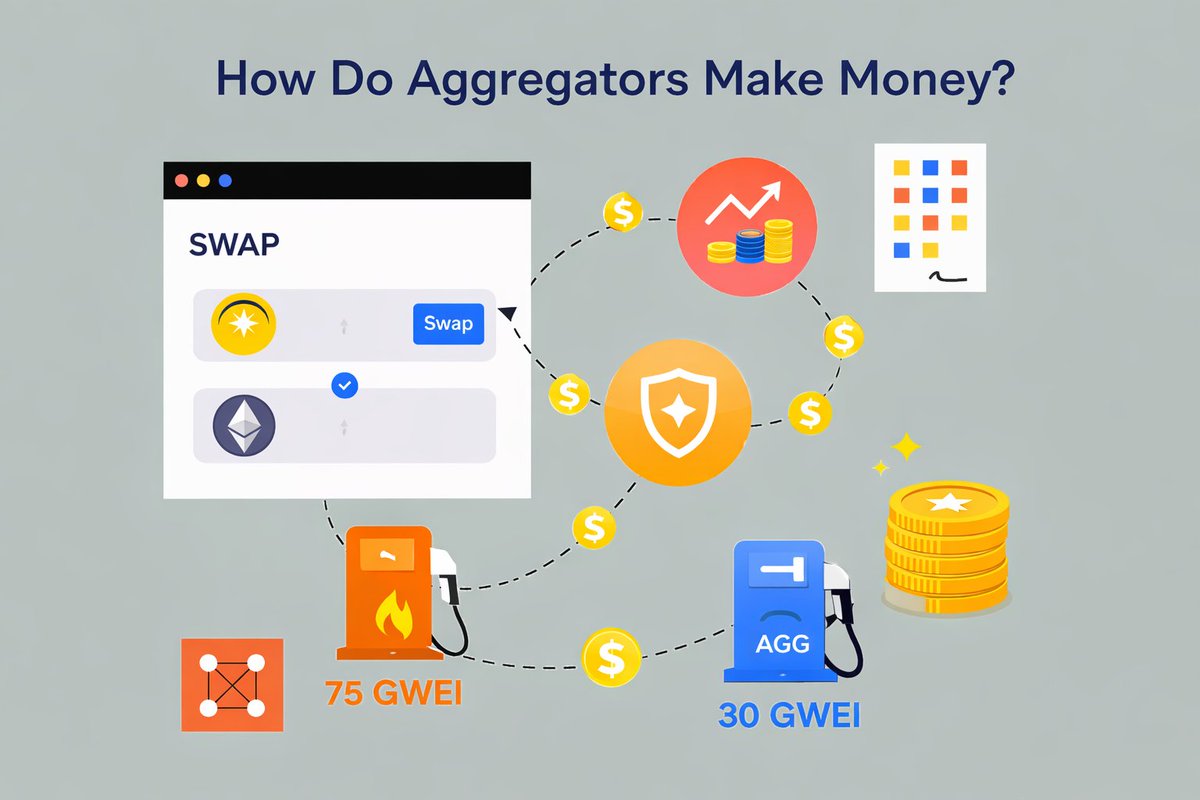
How Do Aggregators Make Money?
At this point many users ask another question.
"If aggregators search for the best route and help me get better execution, how do they earn money?"
Most aggregators combine several revenue models.
1. Small swap fee share
Some aggregators charge a very small fee on the transaction.
For example:
- 0.05 percent
- 0.1 percent
This fee is usually visible to the user and included in the final execution calculation.
2. Partner DEX routing incentives
In some cases aggregators receive small incentives from the DEX protocols they route trades toward.
This is conceptually similar to order flow arrangements in traditional finance.
For the DEX the benefit is:
- more trading volume
- more swap fees
For the aggregator the benefit is routing revenue.
3. Premium routing or advanced tools
Some platforms offer advanced trading tools as paid services.
Examples include:
- MEV protection
- limit order systems
- automated trade splitting
- advanced execution tools
Professional traders often find value in these features.
4. Token based ecosystems
Some aggregators also have their own tokens.
As the platform grows:
- trading volume increases
- protocol revenue increases
- token demand may increase
This can create a long term economic model.
However one principle remains important.
An aggregator may earn money.
But a good aggregator cannot grow by offering poor execution.
Users can switch interfaces quickly.
Which means strong competition exists between aggregators.
The platforms that consistently find better routes tend to attract the most users.

Smart Swap Checklist
Before performing a swap it is helpful to ask a few simple questions.
Common Beginner Mistakes
The most common mistakes include:
- looking only at the token name
- ignoring liquidity depth
- not examining routing details
- using extremely high slippage
- confusing approval and swap actions
Summary for the Impatient
Performing a swap is easy.
Performing the same swap intelligently is a different skill.
Aggregators can find better routes.
But they cannot eliminate risk.
Better execution requires understanding liquidity, routing, and cost.
Can you explain the model?
Why can two aggregators show different outputs?
They may scan different liquidity sources, routes, gas estimates and safety rules.
Is the route always chosen manually?
Usually the application proposes it, but the user still needs to review the assets, pools and final output.
Next Article
In the next article we will explore an important question.
"If swaps are possible, who actually provides the liquidity?"
We will examine liquidity pools and the logic of liquidity providers in detail.
Continue learningPart 09: Liquidity Pools: The Hidden Engine Behind Every DEX Swap →Originally published on X · 2026-03-12
 Post on X
 Telegram