An LP position is an operation, not a deposit-and-forget product.
Turn monitoring, rebalancing and exit rules into a repeatable operating process before volatility arrives.
In previous articles, we clarified a few key ideas:
A liquidity pool is not a vault, it is a pricing engine. Being an LP is not the same as holding tokens, you are constantly exposed to rebalancing. Impermanent loss is not a bug, it is a natural outcome of the system. LP is not one single thing. Volatile/volatile, volatile/stable, and stable/stable pools are each a different game. The right question is not "which pool" but "which position".
Now we go one step further.
The question is no longer:
"Should I be an LP, and in which pool?"
The real question is:
"How do I manage my position after becoming an LP?"
Lesson mapNavigate this lessonExplore all 23 sections
See the model before the details.
Use the flow, the position-lifecycle explorer and the comparison table as a map while you read.
- 01Define thesis
- 02Set monitored signals
- 03Review position
- 04Rebalance or hold
- 05Exit by rule
Adjust the controls to begin.
| Signal | What it can reveal | Possible response |
|---|---|---|
| Pool composition | How token quantities changed | Compare with thesis |
| Fees vs divergence | Whether income compensates risk | Hold, resize or exit |
| Liquidity and volume | Execution and fee conditions | Review pool quality |
| External event | A changed risk regime | Use predefined trigger |
Why This Topic Matters
Most users treat LP as a decision:
I picked the pool. I added liquidity. I am done.
This approach is wrong.
LP is not an event. It is a position.
Positions change over time. They can lose value. Their composition shifts. Fee generation slows down. Risk profiles evolve.
That is why the real work in LP starts after you enter the pool.
In this article, we answer these questions:
How do I track my position? When should I rebalance? When should I exit? What do I need to watch when exiting?
The Basic Truth: LP Is Not Set-and-Forget
In traditional finance, some products work on a "leave and forget" model:
Fixed deposits. Index funds. Bonds.
LP might look like one of these products, but it is not.
Because your asset distribution in the pool keeps changing. Price movement constantly rewrites your position. The reward structure can shift over time. The protocol itself can be updated.
Staying passive in LP often produces the same outcome as making an active decision. Not tracking is also a position, just an unconscious one.

The Three Dimensions of an LP Position
An LP position is not a single number. It lives on three different layers:
Value
The total dollar value of your position. The most watched, but also the most misleading metric.
Composition
The distribution that was 50/50 when you entered. Price movement breaks this balance.
Performance
How your position compares to simply holding the same tokens. This is the metric that actually matters.
Most LPs only look at the first one. But the meaning of LP is hidden in the third.
What Should You Track?
Position Value
Total dollar value. Basic, but insufficient.
Choose an option to begin.
Why insufficient? The value might be higher, but your token counts could have changed significantly. Or the overall market might be up, making your value look good, while you are actually far behind what holding would have delivered.
Token Composition
When you entered the pool, you might have deposited 1 ETH and 3000 USDC. A while later, you check and find you have 0.6 ETH and 4500 USDC.
What happened?
ETH price went up. The system sold ETH on your behalf and accumulated USDC. In other words, you reduced your ETH exposure during the rally.
This is IL in its concrete form.
Fee Accumulation
How much fee has the position generated?
Daily fees. Cumulative fees. Fee as a ratio of your position value.
If fee generation is slowing down, volume in the pool might be dropping. That is a warning sign.
IL (Impermanent Loss)
Compare your current position to what you would have if you had simply held the same tokens.
The formula is simple:
Net Result = (LP Value + Collected Fees) minus Holding Value
If this number is negative, fees did not cover IL.
APR / APY Trend
APR (Annual Percentage Rate): Simple annual return. Compounding is not included.
APY (Annual Percentage Yield): Compound annual return. Assumes fees are reinvested.
For the same pool, APY usually appears slightly higher than APR. Both are just projections of current conditions extrapolated to a full year. Neither is a guarantee.
A position's yield is not constant. As more LPs enter the pool, the same fees get shared among more people. That is why APY tends to drop over time.
Incentive Status
Some pools offer extra token rewards (farming rewards). These rewards can be time-limited, decreasing, or cut entirely.
If incentives are cut, the pool's "real yield" comes to the surface. And most of the time, it is far below what you expected.
TVL and Volume
TVL (Total Value Locked): The total value of assets locked in the pool. Shows the size of the pool.
Volume: The total swap volume in the pool over a given period, usually 24 hours. Shows activity.
Fees come from volume. TVL determines how many people those fees are shared with. So what actually matters is the ratio between the two.
If TVL is dropping, confidence might be fading. If volume is dropping, fee generation will slow down. If TVL is rising while volume stays flat, each LP's fee share shrinks.
Tools You Can Use for Tracking
DEX interfaces like Uniswap, Curve, Balancer (position details, fees). Portfolio trackers like DeBank, Zapper, Zerion. Analytics platforms like DefiLlama, Dune, Revert Finance. On-chain verification through Etherscan, Arbiscan (the ultimate source of truth).
Important note:
The interface shows you the position. The contract tells you the actual state. If they contradict, trust the contract.
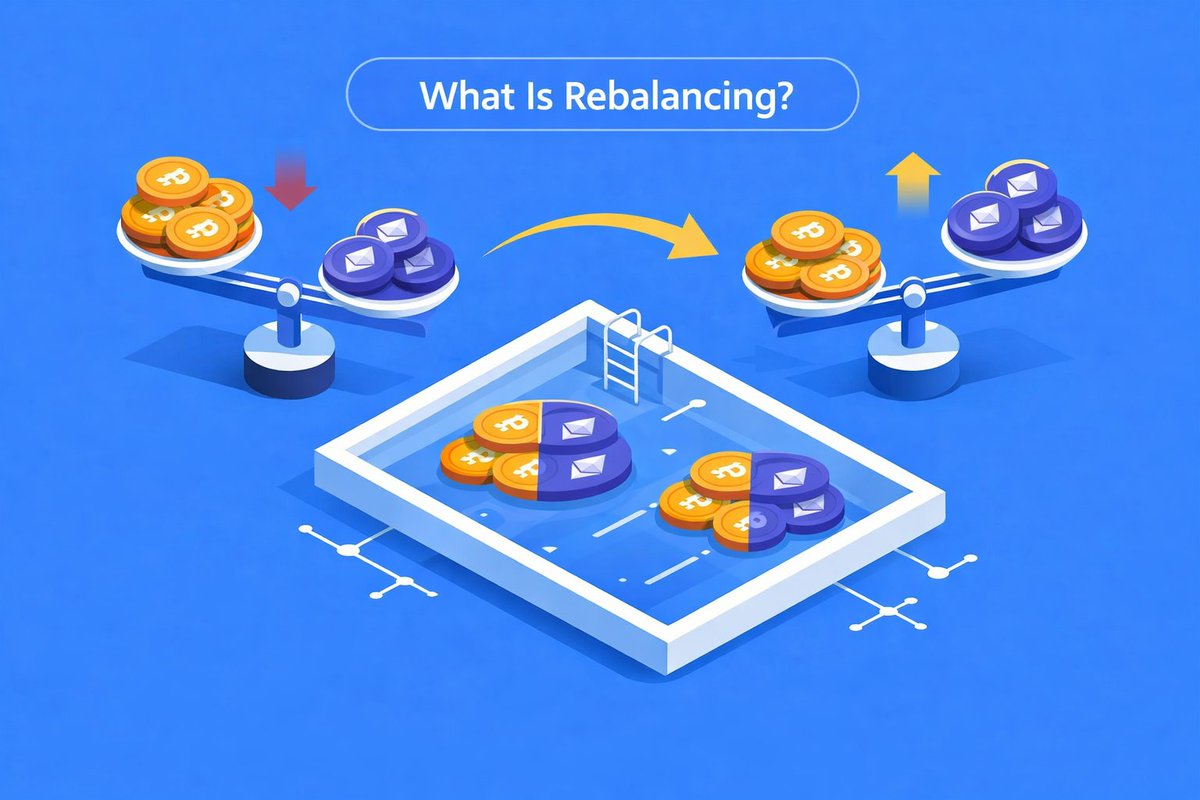
What Is Rebalancing?
Rebalancing means manually adjusting your position to match new market conditions.
Note: The AMM pool is already "rebalancing" on your behalf constantly. What we mean here is your active intervention.
When Might It Be Needed?
When the position ratio is severely broken.
You entered 50/50, now it is 80/20. You unknowingly turned into a different position.
When the market regime changes.
You entered a volatile/volatile pool expecting a sideways market. The market shifted into a strong trend. The strategy no longer works.
When concentrated liquidity positions go out of range.
In systems like Uniswap V3, once price moves past your selected range, your position becomes single-sided and stops generating fees.
When the incentive structure changes.
Extra rewards were cut. The pool is no longer as attractive as it used to be.
How to Rebalance?
There are two basic approaches.
Full exit and re-enter.
Close the current position, rebalance your tokens, open a new position.
Partial adjustment.
Withdraw a portion of liquidity and add it back in at the right ratio.
Rebalancing Is Not Free
Every rebalancing brings gas fees, slippage and price impact during swaps, and potentially a taxable event depending on your jurisdiction.
In other words, too-frequent rebalancing can eat through the fees you earn.
Practical rule: Rebalancing makes sense when the potential loss is greater than the cost.
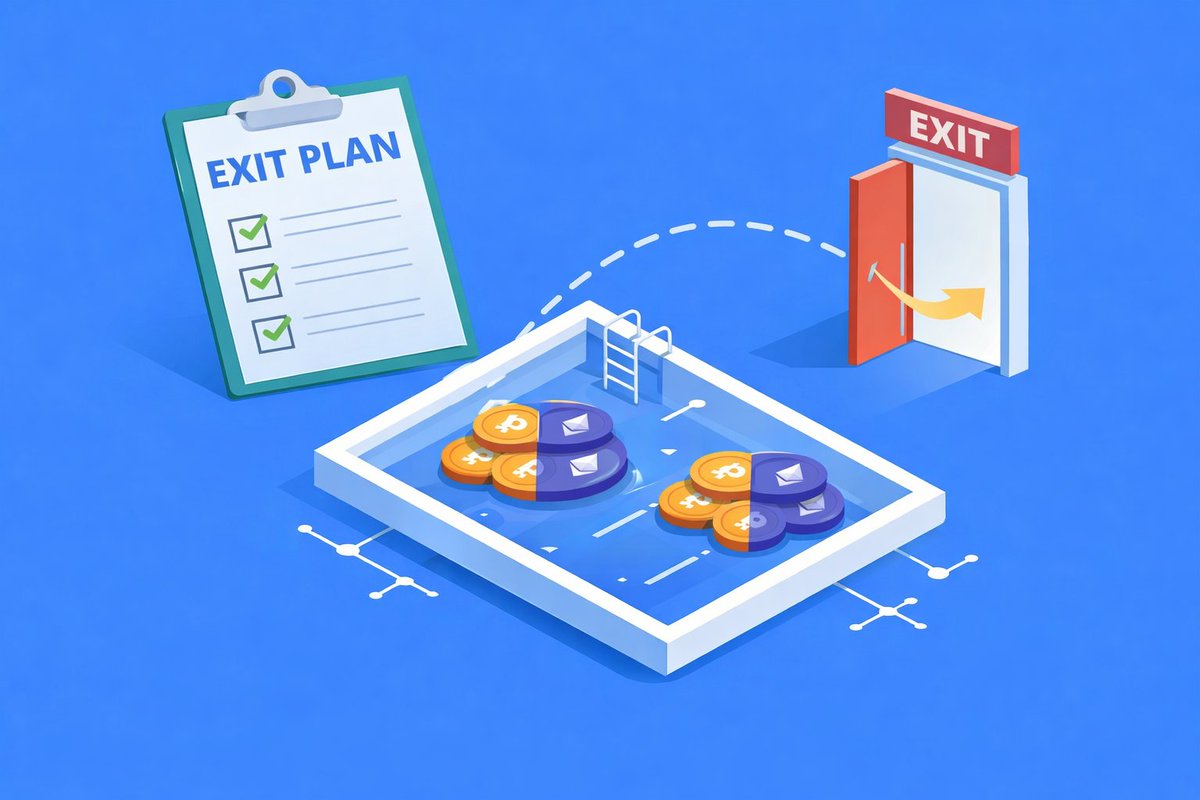
Exit Planning: The Most Neglected Part
What Is an Exit Plan?
An exit plan is the answer to these questions, decided before you enter a position:
Under what conditions will I leave this position? If there is profit, when will I realize it? If there is loss, where do I stop? How will I react if conditions change?
Simply put, an exit plan is a contract you make with yourself while you are still thinking clearly. Once the position is open, emotions take over: greed, fear, hope. It is almost impossible to make good decisions in the middle of those emotions. An exit plan is a note you leave for your future self.
Exit Planning in Crypto
In traditional finance, an exit plan is usually just a stop-loss or take-profit level.
Crypto is more complex because the market is open 24/7, so "I will check tomorrow" does not work. Volatility is high, 20 to 30 percent moves within hours are not unusual. There are non-price risks too: exploits, depegs, team issues, regulation. And the exit itself has a cost: gas, slippage, swap fees.
That is why in crypto, an exit plan is more than price levels. It also includes:
Price triggers (partial or full exit at specific levels). Time triggers (reassess on a specific date). Event triggers (security warnings, depegs, exploit news). Emotion triggers (extreme FOMO or panic atmosphere).
Exit Planning in LP
In LP, exit planning is more layered than a spot position. Because in LP, exit is not a single action.
Exit the pool. Withdraw your liquidity (remove liquidity).
Rearrange the tokens. Swap one token to the other, if needed.
Move to the final position. Cash, a stablecoin, another asset, or another pool.
Each step has its own cost.
Also, the answer to "when should I exit?" is not purely price-based in LP:
When IL crosses a certain threshold? When fee generation dries up? When incentives are cut? When TVL erodes? When the market regime changes (for example, sideways to trend)?
Each of these is a legitimate exit reason. Figuring out which one applies to you before entering the position is the whole idea.
Why Does This Matter So Much?
When entering LP, almost everyone asks:
Which pool? What is the APY? How much should I deposit?
But very few people ask:
"Under what condition will I leave?"
If there is no exit plan, the exit decision gets made emotionally. And in DeFi, emotional decisions tend to be expensive.
Why Is Exiting Hard?
Three reasons.
Psychological.
The "just a little longer, it will bounce back" feeling.
Technical.
Exiting also involves slippage, gas, and swap costs.
Opportunity cost.
The "if I exit, I will miss out" fear.
Exit Triggers
Set these before entering the position.
Value-based triggers
If IL crosses a certain threshold (for example, twice the collected fees). If the position value drops to a specific level.
Time-based triggers
Review at a predetermined interval. Reassess when the incentive period ends.
Market-based triggers
When volatility rises noticeably. When the market regime changes (sideways to trend, for example).
Protocol-based triggers
TVL dropping rapidly. Volume collapsing. Bad signals from the team. Exploit or security warning appearing.
Exit Steps
Start the position close (remove liquidity). The pool gives you tokens at the current ratio, not the ratio you entered with. Accumulated fees are usually collected at this step. Swap the tokens into whatever asset you actually need. Factor in total gas and slippage costs.
Partial Exit
Not every exit has to be all-in or all-out. Closing part of the position reduces risk, keeps fee generation alive, and gives you a measured reaction.
Especially during uncertain periods, partial exit is a solid risk management tool.
Emergency Exit: Panic Scenarios
A normal exit and an emergency exit are not the same thing.
When should you consider an emergency exit?
A security warning comes out for the token or protocol. A depeg event starts. A stablecoin's issuer runs into trouble. Serious negative news about the team surfaces. Abnormal activity is observed in the pool.
The risks of an emergency exit:
Everyone tries to exit at the same time, so slippage explodes. Gas prices shoot up. Price impact grows massively. Sometimes the position value is largely wiped before you can even exit.
Practical suggestion:
Waiting for the moment a position "needs" an emergency exit usually means you are already late. Small signals come before big events.
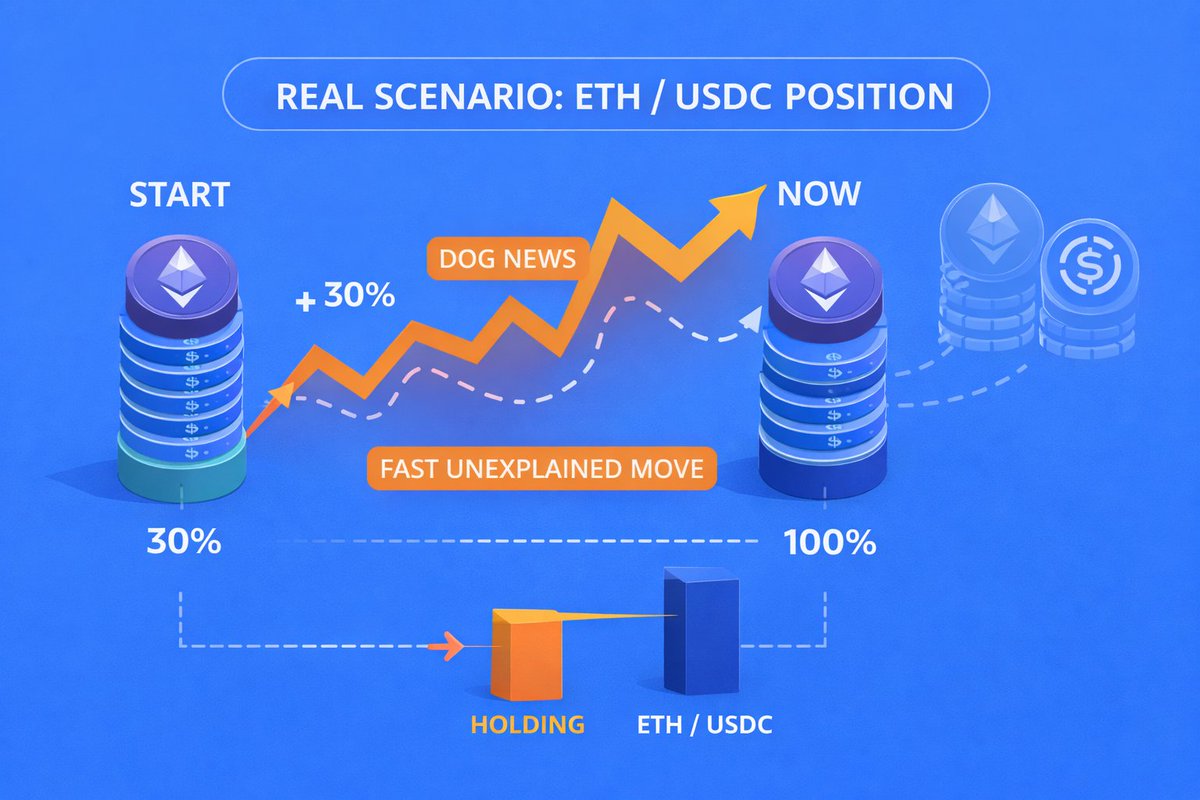
Real Scenario: ETH / USDC Position
Say you have an ETH / USDC LP position. Here are three different situations and what you should be thinking in each:
Scenario 1: Major Shock News
Example: A large stablecoin issuer has a problem with its reserves. A major L1 gets exploited. A big exchange is rumored to be insolvent. A critical bug is announced at the ETH protocol level.
What happens?
Volatility explodes within minutes. Gas prices spike because everyone is trying to exit. Slippage in your pool is much higher than usual. If the USDC side is affected (like an issuer story), the stablecoin itself could depeg.
What should you do?
First, verify. A single tweet or rumor is not enough. Confirm from multiple credible sources. Half of panic news turns out to be wrong.
Does the news actually affect your position? Not every bad headline touches you. Is the issue with ETH, with USDC, or with the broader market? Each one calls for a different reaction.
If it does affect you, move early. Exiting before the panic wave spreads is always better than trying to exit in the middle of it. Exiting when slippage is 0.5 percent is very different from exiting when it is 5 percent.
If it does not affect you, do not intervene. Reacting to every headline is not a strategy that wins over time.
The core principle:
In a shock news situation, the question is not "should I exit?" It is "how does this news specifically affect my position?"
Scenario 2: No News, 20 Percent Move Over a Long Period
Example: Over weeks, ETH slowly moves 20 percent up or down. No dramatic event, just normal market movement.
What happened?
This is exactly the scenario where you should trust the system. The pool rebalanced on your behalf. It reduced your ETH during the rally, or accumulated ETH during the drop. Your composition has drifted from 50/50, but the structure is working. IL has built up, but that was already expected.
What should you do?
Do not panic. This is precisely the situation LP was designed for.
Run the holding vs LP comparison. Where would you be if you had just held the tokens? Are the fees covering the IL?
Is your strategy still valid? If you entered a volatile/stable pool expecting a sideways market, and the market is still moving in a reasonable range, the position is still working.
If the trend is strong and clear, consider your options. If the uptrend suggests ETH will keep accelerating, holding spot ETH might make more sense than LP. But make that decision based on the weekly picture, not a four-hour candle.
Stick to your monthly review ritual. This is a normal market move, your regular review cycle is enough.
The core principle:
A 20 percent move is not a crisis for LP. The system was built for these kinds of moves. The real question is "why did I enter, and is that reason still valid?"
Scenario 3: No News, 20 Percent Move in a Very Short Time
Example: ETH moves 20 percent within a few hours. No clear headline, or the news will come out later.
This is the most dangerous scenario. Because either:
Some non-public information is already leaking (someone knows before you). A major liquidation cascade is unfolding. A whale is opening or closing a significant position. Or there is manipulation.
What happened?
Slippage and price impact in your pool are abnormally high. Arbitrage bots are hitting your pool too, IL is building up fast. MEV activity might have spiked.
What should you do?
Do not rush, but watch closely. The worst reaction is panic-exiting in the middle of the move. That is exactly when slippage is worst.
Investigate the cause. A fast move always has a reason. CryptoTwitter, news sites, funding rates, exchange announcements. The reason usually surfaces within 15 to 30 minutes.
Once the cause surfaces, switch to Scenario 1. If it directly affects you, exit before the spread of the news wave settles in.
If the cause is still unclear and the position is large, consider partial exit. Reducing risk without closing everything leaves room to maneuver if a second wave comes.
Check your stablecoin side. Even stablecoins like USDC can briefly drift during short-term stress. When exiting, check what price you are actually selling your USDC at.
The core principle:
An unexplained fast move usually means "a reason you have not heard yet." Find the reason first, then decide. But do not go blind while waiting for it.
Summary of the Three Scenarios
Shock news affecting your position: react fast, exit before the wave spreads.
Shock news not affecting your position: stay slow, do not intervene.
Calm long-term movement: stay slow, reassess your strategy, do not rush.
Unexplained fast movement: watch first, then act fast. Find the reason, decide accordingly.
The common thread: the speed of your reaction should be determined by the quality of information, not the speed of the move.
Position Sizing
Two common mistakes in LP:
Going all-in at once. When market conditions change, you have no flexibility left.
Adding to losers, removing from winners. Averaging down on a losing position is usually a bad idea in LP. Because the loss might not come from price direction, it might come from the structure itself.
A healthier approach:
Gradual entry (not your entire capital in one go). Gradual exit (not at a single moment). Measured additions to positions that are performing well.
Tax and Accounting Note
This varies by jurisdiction, but in some regions the following are taxable events:
Entering a pool (may count as a token swap). Exiting a pool. Collecting fees. Rebalancing.
This article is not tax advice, but keeping records of your position is a good idea either way: entry date and amounts, fee accumulation, exit date and amounts.

LP Operations Discipline
Build this ritual for yourself.
Daily (optional)
Anything unexpected? Security news?
Weekly
Position value and composition. Fee accumulation. APY trend. TVL and volume.
Monthly
Holding vs LP comparison. Is the strategy still valid? Are exit triggers active? Did the incentive structure change?
This ritual sounds boring. But in LP, money is not made while selecting the pool. It is made or lost while managing the position.
Common Mistakes
"Entered and forgot it."
LP looks passive but it is an active position. An unchecked position is an unmanaged risk.
Only looking at dollar value.
The dollar number might be up while you are still behind holding.
Treating fee accumulation as "real yield."
You earned fees, but if IL overwhelms them, your net result is negative.
Over-rebalancing.
Reacting to every little wobble slowly drains your capital in gas and slippage.
Entering without exit triggers.
No exit plan means the exit decision gets made emotionally.
Incentive dependency. If most of the yield comes from extra token rewards, the position becomes meaningless the moment those rewards stop.
Panic exits. Exiting right when bad news hits usually means exiting at the worst price. But reading signals early is still better than panicking late.
Core Insight
Entering LP is a decision. Managing LP is a discipline.
Successful LPs track (they watch metrics, not interfaces). They plan ahead (entry, rebalancing, exit). They stay calm (no reaction to every tick). They step away when needed (no emotional attachment).
Unsuccessful LPs enter and forget. They enter without an exit plan. They panic in, panic out. They only look at APY.
The difference between the two is not which pool they picked. It is how they manage the position.
One Minute Summary For Lazies
LP is not a set-and-forget product. Tracking the position, rebalancing, and planning the exit are the real parts of LP success. Looking only at dollar value is misleading. The real question is where you would be if you had simply held the tokens. Rebalancing is not free, every intervention brings gas and slippage. The exit plan should be set before entering, otherwise the exit decision gets made emotionally. Tracking should be a weekly ritual, a reassessment a monthly one. Most of the return in LP comes not from picking the pool, but from managing the position.
Can you explain the model?
Should every price move trigger a rebalance?
No. Rebalancing creates costs and should follow a defined strategy or risk threshold.
When should exit rules be written?
Before entering, while decisions are less affected by fear, greed and execution pressure.
What's Next?
By now we have covered DEXs, swap mechanics, liquidity pools, IL, and LP operations.
Next up is another core building block of DeFi:
Lending 101: Supply and Borrow, Simply Explained
What does it actually mean to "lend" an asset on-chain? Where does the interest come from? Why is collateral required? Why is borrowing sometimes an investment strategy?
Because DeFi is not only about swapping. It is also a credit market.
Continue learningPart 13: Lending 101: Understanding Supply and Borrow in Simple Terms →Originally published on X · 2026-04-14
 Post on X
 Telegram