
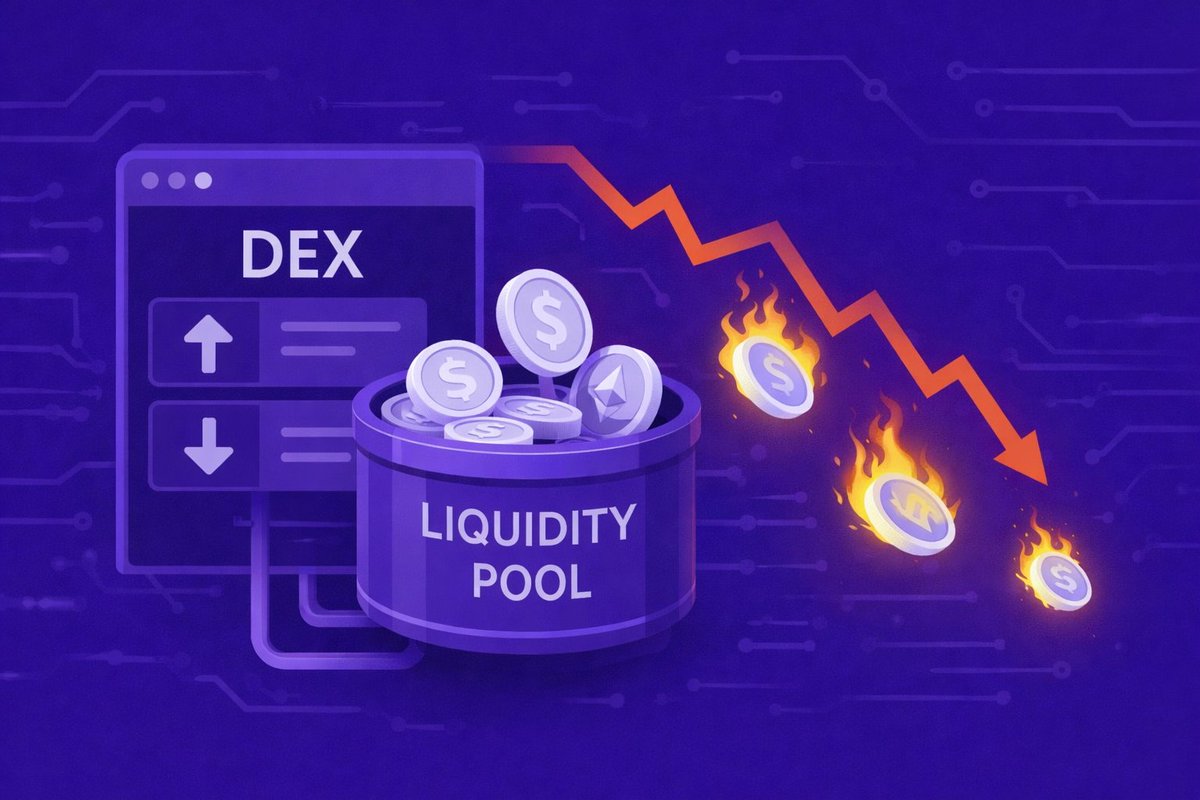
An LP position changes because arbitrage keeps repricing the pool.
Compare holding with providing liquidity and see why token quantities move when relative prices diverge.
In the previous article, we explored how liquidity pools work, how swaps reshape reserves, and why providing liquidity is not the same as holding tokens.
This article is a detailed explanation of a concept that is an inevitable outcome of that system:
impermanent loss.
We briefly mentioned this concept in the previous article. Here, we will break down the mechanism and make it clear.
We saw that a pool is not a passive container. It is a pricing mechanism. LPs are not just depositors, they are part of that mechanism.
If you are not familiar with what LP means, you should review the previous articles first.
Now we go one layer deeper into one of the most misunderstood outcomes of this system:
impermanent loss.
At first glance, impermanent loss may look like a bug, a penalty, or a flaw in DeFi.
It is none of those.
It is the direct result of how automated market makers maintain price.
By the end of this article, one idea should be very clear:
Providing liquidity does not preserve your asset quantities.
It continuously reshapes them.
Lesson mapNavigate this lessonExplore all 18 sections
See the model before the details.
Use the flow, the impermanent-loss calculator and the comparison table as a map while you read.
- 01External price moves
- 02Arbitrage trades pool
- 03Reserve ratio changes
- 04LP token mix changes
- 05LP compared with hold
Adjust the controls to begin.
| Condition | Holding | Liquidity position |
|---|---|---|
| Prices unchanged | Token quantities unchanged | Fees may accumulate |
| Prices diverge | Original quantities remain | Pool shifts toward the underperforming asset |
| Position withdrawn | No pool exit | Difference versus holding becomes realized |
| High volume | No direct fee income | Fees may offset part of divergence |
What Does Impermanent Mean? Why Is This Term Used?
The word “impermanent” means:
not permanent
temporary
something that can change over time
This term is used because the loss is not always permanent.
If prices return to their original level:
the ratio inside the pool moves back toward its initial state
and the impermanent loss can disappear
However, the critical point is this:
if you exit the position
that difference becomes realized
and it is no longer impermanent, it becomes permanent
This is why the term can be misleading.
Because:
- the loss is not always temporary
- it is only temporary if prices revert
A more accurate way to think about it is:
this is not a “temporary loss”
this is a “difference caused by a rebalanced position”
In other words, the name describes the outcome, not the mechanism.
Why This Topic Matters
Many beginners approach LPing with a simple expectation:
“I deposit tokens, I earn fees, my balance grows.”
This expectation comes from traditional finance thinking.
But in DeFi, especially in AMM systems, something else is happening underneath.
Your assets are not just sitting in a pool.
They are actively rebalanced every time someone trades.
Because of this, two different outcomes emerge:
holding tokens in your wallet
providing liquidity in a pool
These two positions react very differently to price movement.
Impermanent loss is the difference between those two outcomes.
If you do not understand this difference:
you cannot evaluate LP returns
you cannot interpret APY
you cannot compare strategies
you cannot understand risk
And most importantly, you may think you are making money while actually losing relative value.
Core Idea
If we reduce everything to the simplest model:
When you provide liquidity, you are not holding tokens.
You are holding a ratio.
For example:
ETH / USDC pool
50% ETH
50% USDC
This ratio defines your position.
But this ratio is not fixed.
It moves with the market.
Why?
Because the pool must always reflect the current price.
And it does that by changing the balance of assets inside it.
What Actually Happens When Price Changes?
Let’s go step by step.
You deposit:
1 ETH = 1000$
1000 USDC
Total: 2000$
Now ETH price increases.
ETH → 2000$
If you think in a holding mindset, what happens next is not obvious.
But if you think in a pool mindset, it becomes clear.
The Role of Arbitrage
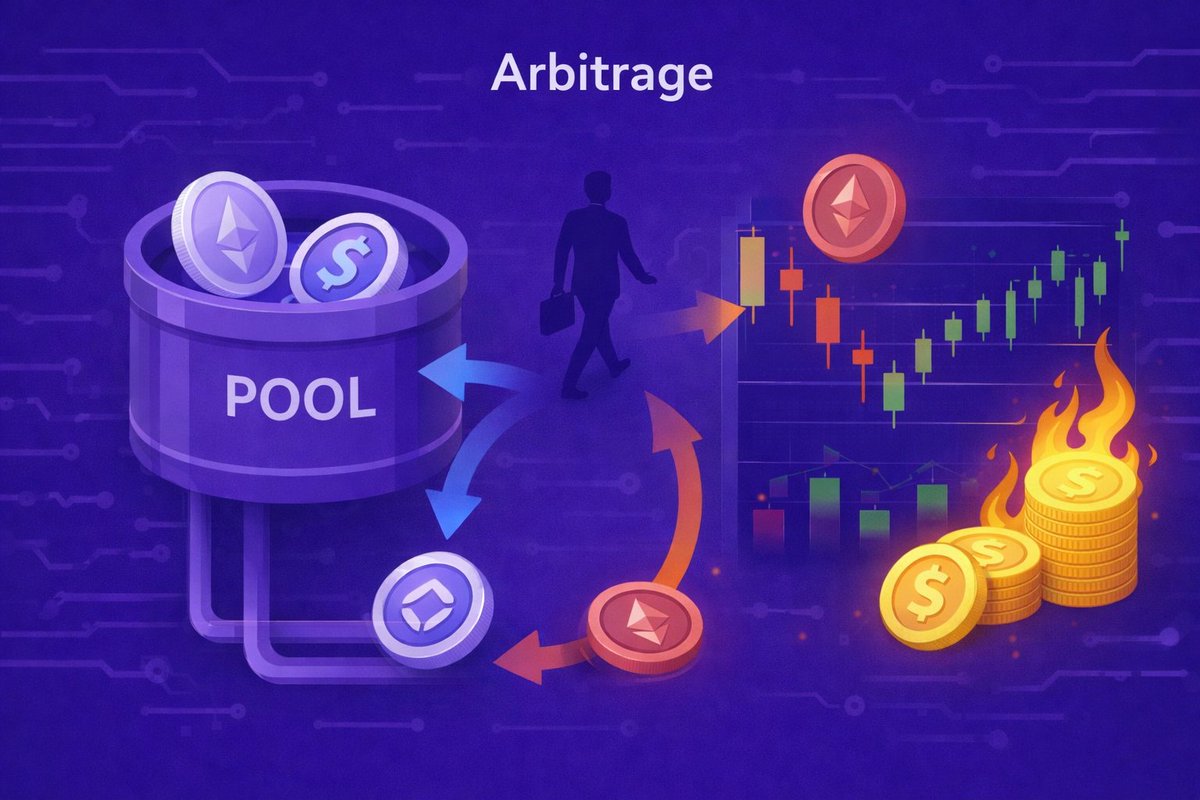
The pool does not automatically know the price changed.
External traders enforce the price.
If ETH becomes more expensive outside the pool, traders will:
buy ETH from the pool because it is cheaper there
sell ETH in the market
This continues until the pool price matches the market price.
During this process:
ETH leaves the pool
USDC enters the pool
So reserves change.
And since your position is a share of those reserves, your position changes as well.
What Your Position Becomes
Let’s think about this in a simple, natural way.
When you enter the pool, you deposit two assets:
- ETH
- USDC
But the system interprets it like this:
“This user holds a 50% ETH / 50% USDC position”
So what you actually hold is not the tokens, but the ratio.
When the price changes, everything starts from here.
ETH moves from 1000$ to 2000$, and two different worlds emerge.
One where you do nothing.
One where you are inside the pool.
If you do nothing:
- 1 ETH becomes 2000$
- 1000 USDC stays the same
Your position remains unchanged.
But inside the pool, things work differently.
The pool’s job is to match market price.
To do that, it changes its reserves.
When ETH price increases:
- traders buy ETH from the pool
- they add USDC into the pool
This continues constantly.
As a result:
- ETH decreases
- USDC increases
And since you are part of the pool, your position changes the same way.
So what is actually happening is this:
You think you are doing nothing
But the system is trading on your behalf
Holding vs LP
Now let’s compare clearly.
Choose an option to begin.
Scenario A: Holding
You do nothing.
- 1 ETH → 2000$
- 1000 USDC
Total: 3000$
In this scenario, you fully benefit from ETH’s rise.
Scenario B: LP
Inside the pool, your position is rebalanced.
Approximately:
- 0.7 ETH
- 1400 USDC
Total: ~2800$
The key point here:
Even though ETH increased, your ETH amount decreased.
You did not fully benefit from the upside.
Where Does the Difference Come From?
The reason is simple.
When holding, you make no trades.
When LPing, the system trades continuously on your behalf.
And the direction of that trade is always the same:
- sell what goes up
- buy what goes down
What Is Impermanent Loss?
You can hold the same assets in two ways:
- in your wallet without any activity
- inside a pool where trades constantly happen
These two approaches do not produce the same result.
That difference is called impermanent loss.
Now we can define it simply:
Impermanent loss is the difference between:
the value of your LP position
and the value of simply holding the same assets
This difference is not caused by an error,
but by continuous rebalancing of your position.
The Most Important Insight
When you become an LP, you are implicitly accepting this:
“I am not just observing price movement.
I am taking a position that continuously adjusts against it.”
And the result of that adjustment is:
impermanent loss.
Why the Name Is Misleading
The term impermanent loss can be confusing.
It suggests something temporary.
But that is not the key idea.
The key idea is this:
You are no longer holding the same assets.
Your position has changed.
If prices return to their original level, the effect may disappear.
But if you exit at a different level:
the loss becomes permanent.
So the real distinction is not temporary vs permanent.
It is:
rebalanced vs unchanged exposure
Where the Loss Actually Comes From
There is no hidden fee.
There is no penalty.
There is no bug.
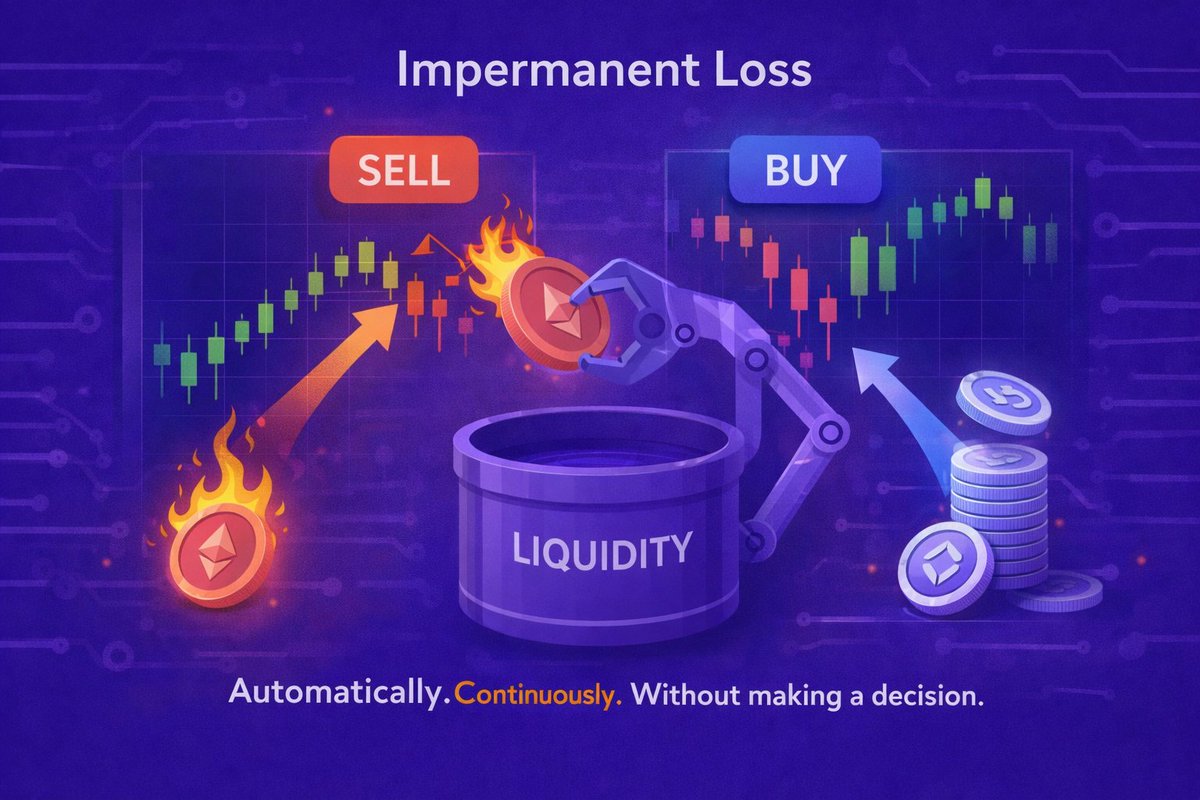
The loss comes from this:
You sell the asset that is going up
You buy the asset that is going down
Automatically.
Continuously.
Without making a decision.
This is the cost of providing liquidity.
When Impermanent Loss Increases
It grows when:
price divergence increases
volatility increases
assets move independently
For example:
ETH vs USDC → high divergence potential
stablecoin vs stablecoin → usually low divergence
The more the assets diverge, the larger the effect.
How to Reduce Loss in Volatile Markets
Impermanent loss cannot be completely avoided in highly volatile conditions.
But it can be managed.
The goal is not to eliminate loss,
but to reduce exposure consciously.
Choosing the Right Pair
This is the most important factor.
- Correlated assets → lower IL
- Independent assets → higher IL
Examples:
stable / stable → lower risk
ETH / USDC → medium risk
volatile altcoin pairs → high risk
Not LPing During High Volatility
You do not have to be in the market at all times.
If:
- news flow is intense
- large price moves are expected
- direction is unclear
not opening an LP position is a valid strategy.
Not Keeping Positions Open Continuously
LPing is not set and forget.
During volatile periods:
- positions can be reduced
- positions can be closed
- capital can move to more stable pools
Balancing Fees and Risk
The key question:
“Does the trading volume justify the risk I am taking?”
If:
- volume is low
- volatility is high
IL often outweighs fees.
Using Stable Pools
Some users move to stable pools during volatile periods.
- lower returns
- more stable behavior
But remember:
stable pools are not risk free
Timing (Entry and Exit)
Performance depends not only on what you choose,
but when you enter.
Entering at the beginning of a trend
is very different from entering in the middle
Mini Case Study: Bad vs Good LP Decision
Consider the same user.
They have 2000$.
Scenario 1: Poor LP Decision
- User enters ETH / USDC pool
- Market is highly volatile
- ETH rises quickly
What happens:
- Pool continuously sells ETH
- User cannot fully benefit from the upside
- Fee income exists but is low
Result:
- ETH doubles
- Holding would be: 3000$
- LP result: ~2800$
So:
It looks like profit
But there is opportunity cost
Scenario 2: Better LP Decision
Same user, different behavior.
- Avoids LP during high volatility
- Or uses stable pools
Result:
- Lower price risk
- Minimal IL
- More stable returns
Alternatively:
- Enters LP after trend stabilizes
Result:
- Lower rebalancing loss
- More controlled exposure
Lesson from the Case Study
LP results depend not only on the pool,
but also on timing and market conditions.
Bad LP:
- wrong timing
- high volatility
- low volume
Good LP:
- correct timing
- appropriate pair
- risk awareness
The Most Important Truth
The only way to avoid impermanent loss completely
is not to LP.
If you choose to LP,
you must see it as a market position,
not a yield product.
You should not blindly assume there is profit and allocate all capital.
Can Fees Offset Impermanent Loss?
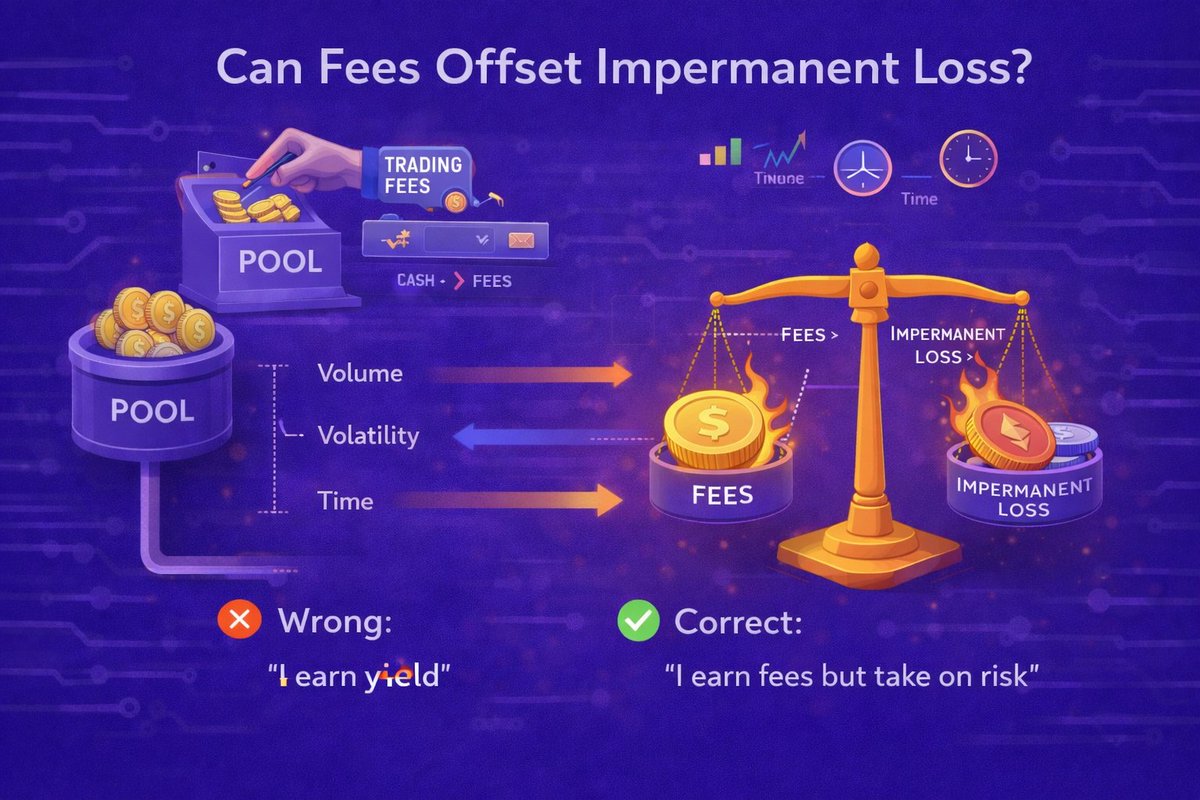
This is one of the most misunderstood topics.
LPs earn trading fees.
These fees come from real trading activity.
Sometimes:
fees > impermanent loss
Sometimes:
impermanent loss > fees
There is no guarantee.
It depends on:
volume
volatility
time
pool design
The wrong mental model:
“I earn yield”
The correct model:
“I take a position that earns fees but carries rebalancing risk”
Common Misconceptions
Impermanent loss is not a hack
Impermanent loss is not caused by MEV
Impermanent loss is unavoidable in AMMs
Impermanent loss is not always bad
Impermanent loss is not independent of price
Most importantly:
impermanent loss is not a separate risk
It is the result of how the system works.
A Better Way to Think About LPing
Instead of thinking:
“I am depositing tokens”
Think:
“I am entering a position that continuously trades against the market”
This is much closer to reality.
LPing is not passive income.
It is automated market participation.
The system does this on your behalf:
sell strength
buy weakness
This is neither good nor bad.
It simply defines your exposure.
Can you explain the model?
Is impermanent loss a mysterious fee charged by the protocol?
No. It is the relative outcome created by automated pool rebalancing compared with holding.
Can fees offset it?
Sometimes, but only if realized fees and incentives exceed the relative loss and other costs.
One Minute Summary For Lazies
Providing liquidity does not preserve your assets.
It transforms them.
As price moves, the pool rebalances your position.
You end up holding a different mix of assets than you started with.
The difference between:
holding tokens
providing liquidity
is impermanent loss.
It is not a bug.
It is the cost of participating in the pricing mechanism.
If liquidity pools are the engine of DeFi,
impermanent loss is the friction inside that engine.
You cannot remove it without changing the system.
Understanding it does not remove risk.
But it allows you to clearly see the position you are taking.
And in DeFi, clarity is half the game.
In the next article, we move from understanding to decision making:
how to choose between volatile pools, stable pools, and mixed pairs
and how different pool types change your risk profile
Originally published on X · 2026-03-23
 Post on X
 Telegram