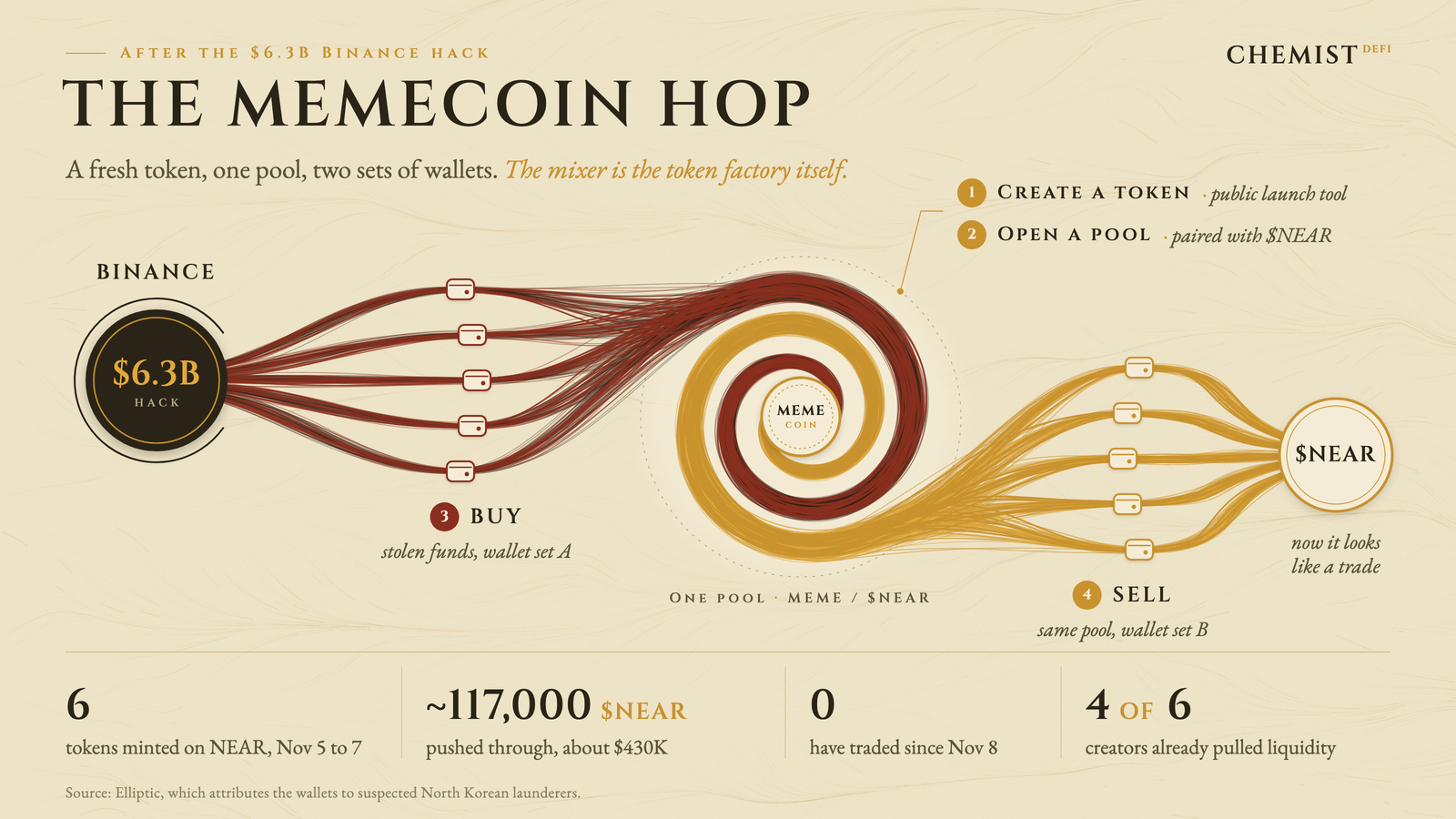
Everyone thinks memecoins are only good for gambling. The $6.3B Binance hack just exposed a second use: laundering.
Funny arc if you think about it. They started as actual jokes: a dog on a coin and people laughing. Then the joke became a casino and fried a whole cycle's dopamine receptors. Now we learn the same launch button doubles as a laundering tool.
According to Elliptic, launderers tied to North Korea minted six tokens on NEAR between Nov 5 and 7 and pushed stolen funds through them. Scroll down and follow the money.
$6.3B leaves the exchange
A strand of stolen NEAR
Create a token. Open a pool.
One set of wallets buys the token
The pool sits in between
the pool sits in between.
A second set sells it back
Clean-looking NEAR walks away
Then the lights go out
- FUKborn Nov 5lived 3 days
- OLCCLborn Nov 6lived 2 days
- MEILIborn Nov 6lived 2 days
- MMLIborn Nov 6lived 2 days
- DABIborn Nov 6lived 2 days
- SINUborn Nov 7lived 1 day
Yes, $430K is nothing
Against $6.3B it does not even register. It is about 1% of the stolen NEAR that has not moved yet.
The size is not the story. Elliptic's point is that the technique is cheap and could carry far larger sums. A route that costs $90 to open does not need to be big to matter.
The trick is older than this hack
I assumed this had been done before, and it has. Elliptic first saw it in the laundering of the 2025 Bybit hack, when at least $24M went through a worthless token paired with a stablecoin on Tron. In the Binance case it showed up on Tron and Solana before it ever reached NEAR.
- 2025 · BybitA homemade token on TronAt least $24M moves through it.
- Nov 2Tron againA worthless token is created for the Binance funds.
- Nov 3SolanaStolen SOL is swapped into thinly traded tokens.
- Nov 5 to 7NEAR, six timesAbout 117,000 NEAR, roughly $430K.
- Nov 8SilenceNo trades since. Four creators pull liquidity.
What changed is the spotlight. A hack this loud gets every hop traced and published.
And traced is the right word. Every step sits on a public chain, and Elliptic says the technique slows investigators down rather than hiding the funds. That is enough. Launderers do not need to be invisible. They need a head start before the wallets get flagged.
A mixer is a fixed target. This is not.
A mixer is a known set of contracts you can flag. This is a fresh contract every time, on any chain with a launchpad, alive for a few days, then gone. Try to keep up.
The mixer is the token factory itself.
The fight moves to the launch button
The timing is rough too. Regulators are looking for any opening to step into crypto right now, imo. A headline tying memecoins to crypto's biggest heist ever hands them one.
To me, that suggests the next compliance fight lands on launchpads and pool deployment, far away from privacy tools. Of course, that part is my guess.
But if you run a launchpad, are you ready for the day a regulator calls your product laundering infrastructure?
 Post on X
 Telegram